THE CLASSIC COLLECTION✦Scepticism and animal faithCLASSIC FREE BOOKS
Scepticism and animal faith
George Santayana
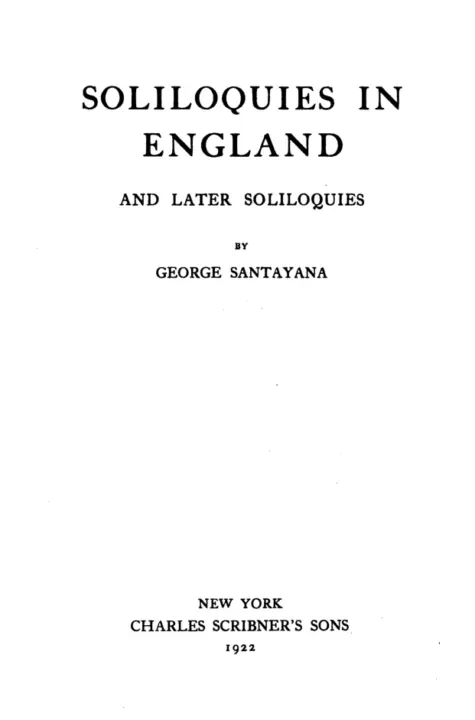
THE CLASSIC COLLECTION · 1922
"Soliloquies in England, and Later Soliloquies" by George Santayana is a philosophical collection of reflective essays written during the early 20th century. The central focus of the work is Santayana's musings and observations on English culture and his personal experiences in England amidst the backdrop of World War I. Through introspective soliloquies, he delves into topics of nature, philosophy, and the complexities of human existence, blending personal narrative with broader cultural commentary. The opening portion of the text introduces readers to the author's background and the context in which the essays were composed. Santayana shares his experiences in England from 1914 to 1918, portraying how the tranquility of nature contrasts sharply with the turmoil of war. He reflects on the significance of his surroundings, the beauty of the English landscape, and the nuanced character of the British people. The prose is rich with imagery and philosophical musings, offering a glimpse into not only the author's emotional state but also his admiration for the cultural and natural elements of England, setting the stage for deeper explorations of liberty, individuality, and the human condition throughout the rest of the collection.
Introduction adapted from the source catalogue; source summaries may be automatically generated.
Free to read · English · 97,788 words · No account needed
MAKE TIME FOR A GOOD BOOK
On by default. Untick to stop anonymous reading totals. Each page counts after 10 seconds in view. How this works.
Anonymous counting is on unless you have switched it off.
I think that Plato in his youth must have seen his Ideas with this mystical directness, and must have felt the irritation common to mystics at being called back out of that poetic ecstasy into the society of material things. Those essences were like the gods, dear and immortal, however fugitive our vision of them might be; whereas things were in their inmost substance intricate and obscure and treacherously changeable; you could never really know what any of them was, nor what it might become. The Ideas were our true friends, our natural companions, and all our safe knowledge was of them; things were only vehicles by which Ideas were conveyed to us, as the copies of a book are vehicles for its sense.
Nevertheless, the happy intuition of pure essences of all sorts, as life vouchsafes it to the free poet or to the logician, could not satisfy the heart of Plato. He felt the burden, the incessant sweet torment, of the flesh; and when age--as I think we may detect in the changed tone of his thoughts--relieved him of this obsession, which had been also his first inspiration, it only reinforced an obsession of a different kind, the indignation of an aristocrat and the sorrow of a patriot at the doom which hung visibly over his country. The fact that love intervened from the beginning in Plato's vision of the Ideas explains why his Ideas were not the essences actually manifested in experience, as it comes to the cold eye or the mathematical brain. When love looks, the image is idealized; it does their several visions; yet of the origin and of the end of life we know as little as ever. And the reason is this: that intuition is not a material organ of the Psyche, like a hand or an antenna; it is a miraculous child, far more alive than herself, whose only instinct is play, laughter, and brooding meditation. This strange child--who could have been his father?--is a poet; absolutely useless and incomprehensible to his poor mother, and only a new burden on her shoulders, because she can't help feeding and loving him. He sees; which to her is a mystery, because although she has always acted as if, in some measure, she felt things at a distance, she has never seen and never can see anything. Nor are his senses, for all their vivacity, of any use to her. For what do they reveal to him? Always something irrelevant: a shaft of dusty light across the rafters, a blue flame dancing on the coals, a hum, a babbling of waters, a breath of heat or of coolness, a mortal weariness or a groundless joy--all dream-images, visions of a play world, essences painted on air, such as any poet might invent in idleness. Yet the child cares about them immensely: he is full of sudden tears and of jealous little loves. "Hush, my child," says good mother Psyche, "it's all nonsense." It is not for those fantastic visions that she watches: she knits with her eyes shut, and mutters her same old prayers. She has always groped amidst obstacles like a mole pressing on where the earth is softest. She can tell friends from enemies (not always correctly) by a mysterious instinct within her, and the rhythm, as it were, of their approaching step. She is long-suffering and faithful, like Penelope; but when hard-pressed and at bay she becomes fierce. She is terribly absolute then, blindly bent on vengeance and wild destruction. At other times she can melt and be generous; in her beehive she is not only the congregation of workers, but also the queen. Her stubborn old-womanish temper makes her ordinarily unjust to her best impulses and hypocritical about her worst ones. She is artful but not intelligent, least of all about herself. For this reason she can never understand how she gave birth to such a thankless child. She hardly remembers the warm ray from the sun or from some other celestial source which one day pierced presents actually will be only a few, and not the most welcome, since this world is a most paradoxical, odd, and picturesque object, and not at all the sort of world which the human mind (being a highly specialized part of it) would have made or can easily believe to be real. The Ideas which a philosopher says govern the world are not likely to be its true laws; and, if he has really drawn them from observation, they cannot possibly be all, nor the best, Ideas on which his free mind would have chosen to dwell. The truth, which is a standard for the naturalist, for the poet is only a stimulus; and in many an idealist the poet debauches the naturalist, and the naturalist paralyses the poet. The earth might well upbraid Plato for trying to build his seven-walled cloud-castle on her back, and to circumscribe her in his magic circles. Why should she be forbidden to exhibit any other essences than those authorized by this metaphysical Solon? Why should his impoverished Olympian theology be imposed upon her, and all her pretty dryads and silly fauns, all her harpies and chimeras, be frowned upon and turned into black devils? How these people who would moralize nature hate nature; and if they loved nature, how sweetly and firmly would morality take its human place there without all this delusion and bluster! But I am not concerned so much with the violence done by Plato to nature; nature can take care of herself, and being really the mother even of the most waspish philosopher, with his sting and his wings and his buzzing, she can comfortably find room for him and his system amongst her swarming children. I wish I knew if the real wasps, too, have a philosophy, and what it is; probably as vital and idealistic as that of the Germans. But I am grieved rather at the servitude and at the stark aspect imposed on the Platonic Ideas by their ambition to rule the world. They are like the shorn Samson in the treadmill; they have lost the radiance and the music of Phoebus Apollo. Socrates taught that to do wrong is to suffer harm; and his Ideas, in establishing their absurd theocracy over nature, were compelled to bend their backs to that earth-labour, and to become merely a celestial zoology, a celestial grammar, and a celestial ethics. Heaven had stooped to rule the earth, and the crooked features of the earth had cast their grotesque shadow on heaven.
Your reading position is saved on this browser. Take it to another device with a library code. Reading pages adapt to text, rather than matching a printed edition.
George Santayana

George Santayana

George Santayana
George Santayana
BEHIND THE BOOK
This eBook is for the use of anyone anywhere in the United States and most other parts of the world at no cost and with almost no restrictions whatsoever. You may copy it, give it away or re-use it under the terms of the Project Gutenberg License included with this eBook or online at www.gutenberg.org. If you are not located in the United States, you will have to check the laws of the country where you are located before using this eBook. Read the source licence.
The original source file, including credits and licence, is retained by this library. Request an original-format copy at no charge. Please include the book title and Project Gutenberg identifier #48429.
KEEP YOUR CURIOSITY GOING

David Patterson (Spirit) Hatch

David Patterson (Spirit) Hatch

David Patterson (Spirit) Hatch
Cécile Tormay

Moritz Busch
Coulson Kernahan