THE CLASSIC COLLECTION✦Scepticism and animal faithCLASSIC FREE BOOKS
Scepticism and animal faith
George Santayana
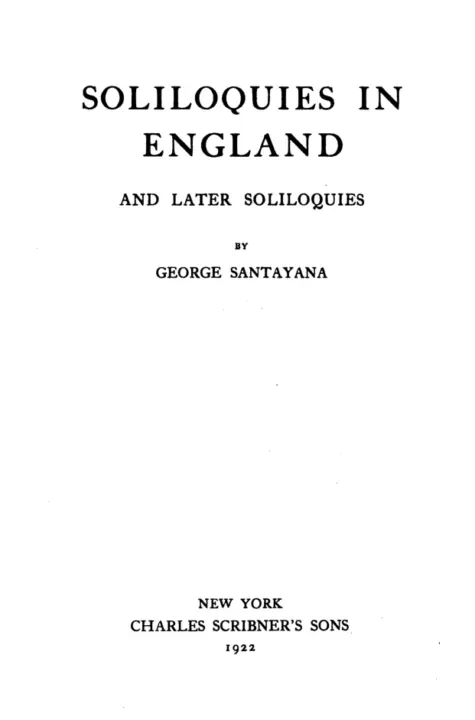
THE CLASSIC COLLECTION · 1922
"Soliloquies in England, and Later Soliloquies" by George Santayana is a philosophical collection of reflective essays written during the early 20th century. The central focus of the work is Santayana's musings and observations on English culture and his personal experiences in England amidst the backdrop of World War I. Through introspective soliloquies, he delves into topics of nature, philosophy, and the complexities of human existence, blending personal narrative with broader cultural commentary. The opening portion of the text introduces readers to the author's background and the context in which the essays were composed. Santayana shares his experiences in England from 1914 to 1918, portraying how the tranquility of nature contrasts sharply with the turmoil of war. He reflects on the significance of his surroundings, the beauty of the English landscape, and the nuanced character of the British people. The prose is rich with imagery and philosophical musings, offering a glimpse into not only the author's emotional state but also his admiration for the cultural and natural elements of England, setting the stage for deeper explorations of liberty, individuality, and the human condition throughout the rest of the collection.
Introduction adapted from the source catalogue; source summaries may be automatically generated.
Free to read · English · 97,788 words · No account needed
MAKE TIME FOR A GOOD BOOK
On by default. Untick to stop anonymous reading totals. Each page counts after 10 seconds in view. How this works.
Anonymous counting is on unless you have switched it off.
To many an Englishman the human head seems too luxuriant. With its quantities of superfluous words and ideas, it grows periodically hot and messy, and needs a thorough cropping and scrubbing. To this end, William of Occam long ago invented his razor: entia non multiplicanda praeter necessitatem; a maxim calculated to shave the British inner man clean, and make a roundhead of him, not to say a blockhead. That everything is "nothing but" something else, probably inferior to it, became in time a sort of refrain in his politics and philosophy. He saw that reflection was constantly embroidering on the facts; but did he suppose that the pattern of things was really simpler than that of ideas, or did he feel that, however elaborate things might be, thought at least might be simple? At any rate, he aimed instinctively at economy of terms, retrenchment in belief, reduction of theory to the irreducible minimum. If theory was not useful, what was the use of it? And certainly all that can be said for some theories is that perhaps they are useful; and when ideas are merely useful, being worthless in themselves and absorbing human caloric, the less we require of them the better. Thought might then be merely a means to a life without thought, and belief a door to a heaven where no beliefs were expected; all speech might be like the curt words one says to the waiter, in the hope of presently dining in silence; and all looking might be looking out, as in crossing a crowded street, ending in the blessed peace of not having to look any more.
Occam's razor has gradually shorn British and German philosophy of the notions of substance and cause, matter and God, truth and the soul. Sometimes these terms were declared to stand for nothing whatever, because (as in the case of matter and substance) if I reduced myself to a state of artificial stupidity I might for a moment stop short of the conception of them. More often (as in the case of the soul) the term was declared to stand for something real, which, however, was "nothing but" something else. Of course, all words and thoughts stand for something else; and the question is only whether we can find another word or thought that will express the reality better. Thus, if I said that the soul was "nothing but" a series of sensations, I should soon have to add that this series, to make up a soul, must arise in the same animal body, and must be capable of being eventually surveyed and recalled together; while I should have to assign to some other obscure agency those unconscious vital functions which were formerly attributed to the soul in forming and governing the body, and breeding the passions; functions without which my series of sensations would hardly be what it is. I am not confident that all this laboured psychology makes things much clearer in the end, or does not multiply entities without necessity; since where I had simply spoken of the soul, I should now have to speak of sensations, series, possibility, synthesis, personal identity, the transcendental unity of apperception, and the unconscious mind. Something is doubtless gained by coining these modern and questionable expressions, since they indicate true complexities in the facts, while a poetic term like "soul" covers them only by pointing the finger of childish wonder at them, without analysis. Nature is far more complicated than any language or philosophy, and the more these refine, the closer they can fit. The anxiety of the honest Occam to stick to the facts, and pare his thoughts to the quick, had this justification in it, that sometimes our images and distinctions are misplaced. Grammar, usurping the rôle of physics, created metaphysics, the trouble with which is not at all that it multiplies entities, since no metaphysician can invent anything that did not lie from all eternity in the realm of essence, like the plot of unwritten novels, waiting for some one with wit enough to think of it. The trouble is rather that the metaphysician probably gives his favourite essences the wrong status. These beings may well be absent from the time and place to which he hastily assigns them; they may even be incongruous altogether with what happens to exist anywhere. What happens to exist is perhaps what he thinks he is describing, or what, like Occam, he would like to describe if he could; but he is probably not able. Yet that doesn't matter so much as he imagines. What happens to exist can take very good care of itself, and is quite indifferent to what people think of it; and as for us, if we possess such cursory knowledge of the nearer parts of existence as is sufficient for our safety, there is no reason why we should attend to it too minutely: there's metal more attractive in discourse and in fiction. Mind, as Hobbes said, is fancy, and it is the things of fancy that greet us first and reward us best. They are far from being more absurd than the facts. In themselves, all things are equally unnecessary and equally possible; for their own part, all are equally ready to be thought of or even to be born. It is only the routine of nature or the sluggish human imagination that refuses to admit most of them, as country people refuse to admit that foreign languages or manners might do as well as their own.
Your reading position is saved on this browser. Take it to another device with a library code. Reading pages adapt to text, rather than matching a printed edition.
George Santayana

George Santayana

George Santayana
George Santayana
BEHIND THE BOOK
This eBook is for the use of anyone anywhere in the United States and most other parts of the world at no cost and with almost no restrictions whatsoever. You may copy it, give it away or re-use it under the terms of the Project Gutenberg License included with this eBook or online at www.gutenberg.org. If you are not located in the United States, you will have to check the laws of the country where you are located before using this eBook. Read the source licence.
The original source file, including credits and licence, is retained by this library. Request an original-format copy at no charge. Please include the book title and Project Gutenberg identifier #48429.
KEEP YOUR CURIOSITY GOING

David Patterson (Spirit) Hatch

David Patterson (Spirit) Hatch

David Patterson (Spirit) Hatch
Cécile Tormay

Moritz Busch
Coulson Kernahan