THE CLASSIC COLLECTION✦Scepticism and animal faithCLASSIC FREE BOOKS
Scepticism and animal faith
George Santayana
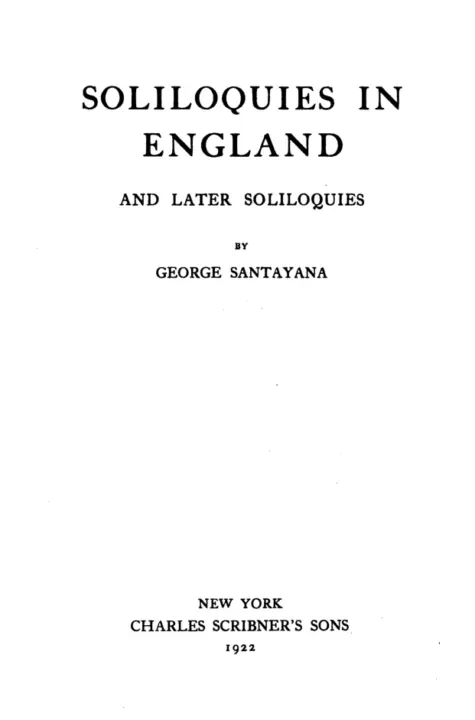
THE CLASSIC COLLECTION · 1922
"Soliloquies in England, and Later Soliloquies" by George Santayana is a philosophical collection of reflective essays written during the early 20th century. The central focus of the work is Santayana's musings and observations on English culture and his personal experiences in England amidst the backdrop of World War I. Through introspective soliloquies, he delves into topics of nature, philosophy, and the complexities of human existence, blending personal narrative with broader cultural commentary. The opening portion of the text introduces readers to the author's background and the context in which the essays were composed. Santayana shares his experiences in England from 1914 to 1918, portraying how the tranquility of nature contrasts sharply with the turmoil of war. He reflects on the significance of his surroundings, the beauty of the English landscape, and the nuanced character of the British people. The prose is rich with imagery and philosophical musings, offering a glimpse into not only the author's emotional state but also his admiration for the cultural and natural elements of England, setting the stage for deeper explorations of liberty, individuality, and the human condition throughout the rest of the collection.
Introduction adapted from the source catalogue; source summaries may be automatically generated.
Free to read · English · 97,788 words · No account needed
MAKE TIME FOR A GOOD BOOK
On by default. Untick to stop anonymous reading totals. Each page counts after 10 seconds in view. How this works.
Anonymous counting is on unless you have switched it off.
It is not politics that can bring true liberty to the soul; that must be achieved, if at all, by philosophy; but liberalism may bring large opportunities for achievement in a man's outward life. It intensifies--because it renders attainable--the lure of public distinction, of luxury, of love surrounded by refined pleasures. The liberal state stimulates the imagination of an ambitious man to the highest degree. Those who have a good start in the universal competition, or sharp wits, or audacity, will find plenty of prizes awaiting them. With the pride of wealth, when it is great, there comes the pride of munificence; in the suburbs of wealth there is culture, and in its service there is science. When science can minister to wealth and intelligence to dominion, both can be carried on the shoulders of the plutocracy which dominates the liberal state; and they can fill it with innumerable comforts and marvellous inventions. At the same time, nothing will hinder the weaker members of rich families from becoming clergymen or even scholars or artists; or they may range over the five continents, hunt whatever wild beasts remain in the jungle, and write books about savages.
Whether these prizes offered by liberal society are worth winning, I cannot say from experience, never having desired them; but the aspects of modern life which any one may observe, and the analytic picture of it which the novelists supply, are not very attractive. Wealth is always, even when most secure, full of itch and fear; worry about health, children, religion, marriage, servants; and the awful question of where to live, when one may live anywhere, and yet all seems to depend on the choice. For the politician, politics are less important than his private affairs, and less interesting than bridge; and he has always a party, or a wicked opposition, on which to throw the blame if his careless measures turn out badly. No one in office can be a true statesman, because a true statesman is consistent, and public opinion will never long support any consistent course. What the successful man in modern society really most cares about is love; love for him is a curious mixture of sensuality, vanity, and friendship; it lights up all the world of his thought and action with its secret and unsteady flame. Even when mutual and legal, it seems to be three-quarters anxiety and sorrow; for if nothing worse happens to lovers, they grow old. I hear no laughter among the rich which is not forced and nervous. I find no sense of moral security amongst them, no happy freedom, no mastery over anything. Yet this is the very cream of liberal life, the brilliant success for the sake of which Christendom was overturned, and the dull peasantry elevated into factory-hands, shopkeepers, and chauffeurs. When the lists are open to all, and the one aim of life is to live as much as possible like the rich, the majority must needs be discouraged. The same task is proposed to unequal strengths, and the competition emphasizes the inequality. There was more encouragement for mediocre people when happiness was set before them in mediocrity, or in excellence in some special craft. Now the mass, hopelessly out of the running in the race for wealth, falls out and drifts into squalor. Since there is liberty, the listless man will work as little and drink as much as he can; he will crawl into whatever tenement he can get cheapest, seek the society in which least effort is demanded and least shame is felt, have as many children as improvidence sends him, let himself out, at a pinch, for whatever service and whatever wages he can obtain, drift into some syndicated servitude or some great migration, or sink in solitude into the deepest misery. He then becomes a denizen of those slimy quarters, under the shadow of railway bridges, breweries, and gas-works, where the blear lights of a public-house peer through the rain at every corner, and offer him the one joy remaining in life; for joy is not to be mentioned in the same breath as the female prowling by the door, hardly less befuddled and bedraggled than the lurching idlers whom she endeavours to entice; but perhaps God does not see all this, because a pall hangs over it perpetually of impenetrable smoke. The liberal system, which sought to raise the individual, has degraded the masses; and this on so vast a scale and to so pitiable a degree, that the other element in liberalism, philanthropic zeal, has come again to the fore. Liberty go hang, say the new radicals; let us save the people. Liberal legislation, which was to have reduced government to the minimum of police control, now has undertaken public education, social reform, and even the management of industry.
Your reading position is saved on this browser. Take it to another device with a library code. Reading pages adapt to text, rather than matching a printed edition.
George Santayana

George Santayana

George Santayana
George Santayana
BEHIND THE BOOK
This eBook is for the use of anyone anywhere in the United States and most other parts of the world at no cost and with almost no restrictions whatsoever. You may copy it, give it away or re-use it under the terms of the Project Gutenberg License included with this eBook or online at www.gutenberg.org. If you are not located in the United States, you will have to check the laws of the country where you are located before using this eBook. Read the source licence.
The original source file, including credits and licence, is retained by this library. Request an original-format copy at no charge. Please include the book title and Project Gutenberg identifier #48429.
KEEP YOUR CURIOSITY GOING

David Patterson (Spirit) Hatch

David Patterson (Spirit) Hatch

David Patterson (Spirit) Hatch
Cécile Tormay

Moritz Busch
Coulson Kernahan