THE CLASSIC COLLECTION✦Scepticism and animal faithCLASSIC FREE BOOKS
Scepticism and animal faith
George Santayana
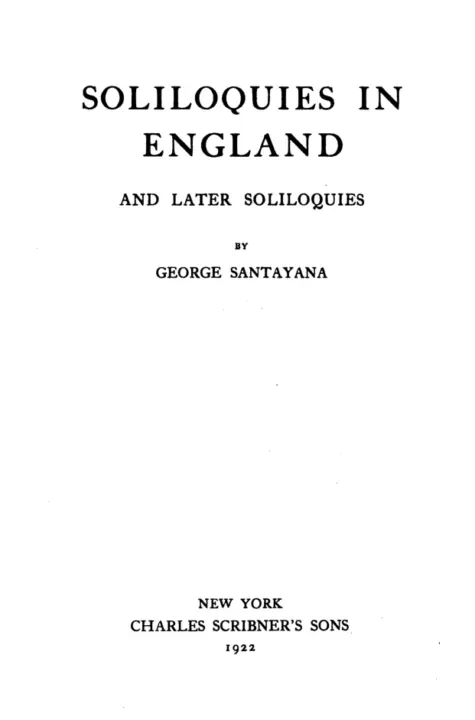
THE CLASSIC COLLECTION · 1922
"Soliloquies in England, and Later Soliloquies" by George Santayana is a philosophical collection of reflective essays written during the early 20th century. The central focus of the work is Santayana's musings and observations on English culture and his personal experiences in England amidst the backdrop of World War I. Through introspective soliloquies, he delves into topics of nature, philosophy, and the complexities of human existence, blending personal narrative with broader cultural commentary. The opening portion of the text introduces readers to the author's background and the context in which the essays were composed. Santayana shares his experiences in England from 1914 to 1918, portraying how the tranquility of nature contrasts sharply with the turmoil of war. He reflects on the significance of his surroundings, the beauty of the English landscape, and the nuanced character of the British people. The prose is rich with imagery and philosophical musings, offering a glimpse into not only the author's emotional state but also his admiration for the cultural and natural elements of England, setting the stage for deeper explorations of liberty, individuality, and the human condition throughout the rest of the collection.
Introduction adapted from the source catalogue; source summaries may be automatically generated.
Free to read · English · 97,788 words · No account needed
MAKE TIME FOR A GOOD BOOK
On by default. Untick to stop anonymous reading totals. Each page counts after 10 seconds in view. How this works.
Anonymous counting is on unless you have switched it off.
I often wonder, looking at my rich friends, how far their possessions are facilities and how far they are impediments. The telephone, for instance, is a facility if you wish to be in many places at once and to attend to anything that may turn up; it is an impediment if you are happy where you are and in what you are doing. Public motor-vehicles, public libraries, and public attendants (such as waiters in hotels, when they wait) are a convenience, which even the impecunious may enjoy; but private automobiles, private collections of books or pictures, and private servants are, to my thinking, an encumbrance: but then I am an old fogy and almost an ancient philosopher, and I don't count. I prize civilization, being bred in towns and liking to hear and to see what new things people are up to. I like to walk about amidst the beautiful things that adorn the world; but private wealth I should decline, or any sort of personal possessions, because they would take away my liberty.
Perhaps what liberalism aspires to marry with liberty is not so much prosperity as progress. Progress means continued change for the better; and it is obvious that liberty will conduce to progress in all those things, such as writing poetry, which a man can pursue without aid or interference from others: where aid is requisite and interference probable, as in politics, liberty conduces to progress only in so far as people are unanimous, and spontaneously wish to move in the same direction. Now what is the direction of change which seems progress to liberals? A pure liberal might reply, The direction of liberty itself: the ideal is that every man should move in whatever direction he likes, with the aid of such as agree with him, and without interfering with those who disagree. Liberty so conceived would be identical with happiness, with spontaneous life, blamelessly and safely lived; and the impulse of liberalism, to give everybody what he wants, in so far as that is possible, would be identical with simple kindness. Benevolence was one of the chief motives in liberalism in the beginning, and many a liberal is still full of kindness in his private capacity; but politically, as a liberal, he is something more than kind. The direction in which many, or even most, people would like to move fills him with disgust and indignation; he does not at all wish them to be happy, unless they can be happy on his own diet; and being a reformer and a philanthropist, he exerts himself to turn all men into the sort of men he likes, so as to be able to like them. It would be selfish, he thinks, to let people alone. They must be helped, and not merely helped to what they desire--that might really be very bad for them--but helped onwards, upwards, in the right direction. Progress could not be rightly placed in a smaller population, a simpler economy, more moral diversity between nations, and stricter moral discipline in each of them. That would be progress backwards, and if it made people happier, it would not make the liberal so. Progress, if it is to please him, must continue in the direction in which the nineteenth century progressed, towards vast numbers, material complexity, moral uniformity, and economic interdependence. The best little boy, for instance, according to the liberal ideal, desires to be washed, to go to school, to do Swedish exercises, and to learn everything out of books. But perhaps the individual little boy (and according to the liberal philosophy his individuality is sacred, and the only judge of what is good or true for him is his own consciousness) desires to go dirty, to make mud-pies in the street, and to learn everything by experience or by report from older boys. When the philanthropist runs up to the rescue, this little ingrate snivels at him the very principle of liberal liberty, "Let me alone." To inform such an urchin that he does not know what is good for him, that he is a slave to bad habits and devilish instincts, that true freedom for him can only come of correcting himself, until he has learned to find happiness in virtue--plainly that would be to abandon liberalism, and to preach the classical doctrine that the good is not liberty but wisdom. Liberalism was a protest against just such assumptions of authority. It emphatically refused to pursue an eventual stoical freedom, absurdly so called, which was to come when we had given up everything we really wanted--the mock freedom of service. In the presence of the little boy liberal philosophy takes a middle course. It is convinced--though it would not do to tell him so prematurely--that he must be allowed to go dirty for a time, until sufficient experience of filth teaches him how much more comfortable it is to be clean; also that he will go to school of his own accord if the books have pictures enough in them, and if the teacher begins by showing him how to make superior mud-pies. As to morals and religion, the boy and his companions will evolve the appropriate ones in time out of their own experience, and no others would be genuine.
Your reading position is saved on this browser. Take it to another device with a library code. Reading pages adapt to text, rather than matching a printed edition.
George Santayana

George Santayana

George Santayana
George Santayana
BEHIND THE BOOK
This eBook is for the use of anyone anywhere in the United States and most other parts of the world at no cost and with almost no restrictions whatsoever. You may copy it, give it away or re-use it under the terms of the Project Gutenberg License included with this eBook or online at www.gutenberg.org. If you are not located in the United States, you will have to check the laws of the country where you are located before using this eBook. Read the source licence.
The original source file, including credits and licence, is retained by this library. Request an original-format copy at no charge. Please include the book title and Project Gutenberg identifier #48429.
KEEP YOUR CURIOSITY GOING

David Patterson (Spirit) Hatch

David Patterson (Spirit) Hatch

David Patterson (Spirit) Hatch
Cécile Tormay

Moritz Busch
Coulson Kernahan