THE CLASSIC COLLECTION✦Scepticism and animal faithCLASSIC FREE BOOKS
Scepticism and animal faith
George Santayana
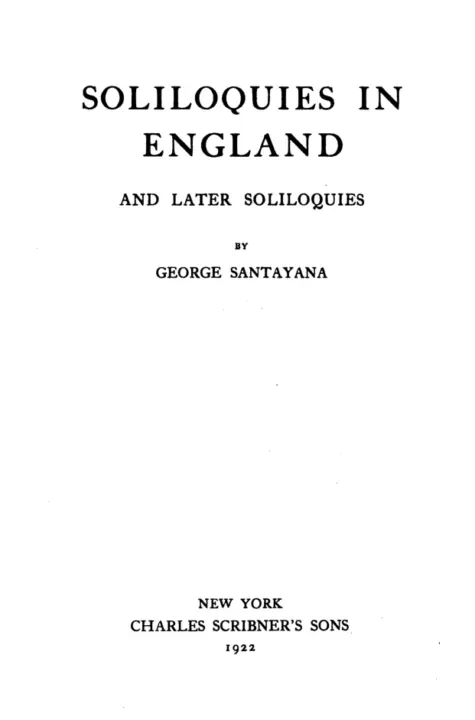
THE CLASSIC COLLECTION · 1922
"Soliloquies in England, and Later Soliloquies" by George Santayana is a philosophical collection of reflective essays written during the early 20th century. The central focus of the work is Santayana's musings and observations on English culture and his personal experiences in England amidst the backdrop of World War I. Through introspective soliloquies, he delves into topics of nature, philosophy, and the complexities of human existence, blending personal narrative with broader cultural commentary. The opening portion of the text introduces readers to the author's background and the context in which the essays were composed. Santayana shares his experiences in England from 1914 to 1918, portraying how the tranquility of nature contrasts sharply with the turmoil of war. He reflects on the significance of his surroundings, the beauty of the English landscape, and the nuanced character of the British people. The prose is rich with imagery and philosophical musings, offering a glimpse into not only the author's emotional state but also his admiration for the cultural and natural elements of England, setting the stage for deeper explorations of liberty, individuality, and the human condition throughout the rest of the collection.
Introduction adapted from the source catalogue; source summaries may be automatically generated.
Free to read · English · 97,788 words · No account needed
MAKE TIME FOR A GOOD BOOK
On by default. Untick to stop anonymous reading totals. Each page counts after 10 seconds in view. How this works.
Anonymous counting is on unless you have switched it off.
Existence is indeed distinguishable from the platonic essences that are embodied in it precisely by being a conjunction of things mutually irrelevant, a chapter of accidents, a medley improvised here and now for no reason, to the exclusion of the myriad other farces which, so far as their ideal structure is concerned, might have been performed just as well. This world is contingency and absurdity incarnate, the oddest of possibilities masquerading momentarily as a fact. Custom blinds persons who are not naturally speculative to the egregious character of the actual, because custom assimilates their expectations to the march of existing things and deadens their power to imagine anything different. But wherever the routine of a barbaric life is broken by the least acquaintance with larger ways, the arbitrariness of the actual begins to be discovered. The traveller will first learn that his native language is not the only one, nor the best possible, nor itself constant; then, perhaps, he will understand that the same is true of his home religion and government. The naturalist will begin by marvelling at the forms and habits of the lower animals, while continuing to attribute his own to their obvious propriety; later the heavens and the earth, and all physical laws, will strike him as paradoxically arranged and unintelligible; and ultimately the very elements of existence--time, change, matter, habit, life cooped in bodies--will reveal themselves to him in their extreme oddity, so that, unless he has unusual humility and respect for fact, he will probably declare all these actual things to be impossible and therefore unreal. The most profound philosophers accordingly deny that any of those things exist which we find existing, and maintain that the only reality is changeless, infinite, and indistinguishable into parts; and I call them the most profound philosophers in spite of this obvious folly of theirs, because they are led into it by the force of intense reflection, which discloses to them that what exists is unintelligible and has no reason for existing; and since their moral and religious prejudices do not allow them to say that to be irrational and unintelligible is the character proper to existence, they are driven to the alternative of saying that existence is illusion and that the only reality is something beneath or above existence. That real existence should be radically comic never occurs to these solemn sages; they are without one ray of humour and are persuaded that the universe too must be without one. Yet there is a capital joke in their own systems, which prove that nothing exists so strenuously, that existence laughs aloud in their vociferations and drowns the argument. Their conviction is the very ghost which it rises to exorcise; yet the conviction and the exorcism remain impressive, because they bear witness to the essential strangeness of existence to the spirit. Like the Ghost in Hamlet this apparition, this unthinkable fact, is terribly disturbing and emphatic; it cries to us in a hollow voice, "Swear!" and when in an agony of concern and affection we endeavour to follow it, "Tis here! 'Tis here! Tis gone!" Certainly existence can bewitch us; it can compel us to cry as well as to laugh; it can hurt, and that is its chief claim to respect. Its cruelty, however, is as casual as its enchantments; it is not cruel on purpose but only rough, like thoughtless boys. Coarseness--and existence is hopelessly coarse--is not an evil unless we demand refinement. A giggling lass that peeps at us through her fingers is well enough in her sphere, but we should not have begun by calling her Dulcinea. Dulcinea is a pure essence, and dwells only in that realm. Existence should be met on its own terms; we may dance a round with it, and perhaps steal a kiss; but it tempts only to flout us, not being dedicated to any constant love. As if to acknowledge how groundless existence is, everything that arises instantly backs away, bowing its excuses, and saying, "My mistake!" It suffers from a sort of original sin or congenital tendency to cease from being. This is what Heraclitus called [Greek: Dikè], or just punishment; because, as Mephistopheles long afterwards added, alles was entsteht ist wert dass es zugrunde geht--whatsoever arises deserves to perish; not of course because what arises is not often a charming creation, but because it has no prerogative to exist not shared by every Cinderella-like essence that lies eternally neglected in that limbo to which all things intrinsically belong--the limbo of unheard melodies and uncreated worlds. For anything to emerge from that twilight region is inexplicable and comic, like the popping up of Jack-in-the-box; and the shock will amuse us, if our wits are as nimble as nature and as quick as time. We too exist; and existence is a joy to the sportive side of our nature, itself akin to a shower of sparks and a patter of irrevocable adventures. What indeed could be more exhilarating than such a rout, if only we are not too exacting, and do not demand of it irrelevant perfections? The art of life is to keep step with the celestial orchestra that beats the measure of our career, and gives the cue for our exits and our entrances. Why should we willingly miss anything, or precipitate anything, or be angry with folly, or in despair at any misadventure? In this world there should be none but gentle tears, and fluttering tip-toe loves. It is a great Carnival, and amongst these lights and shadows of comedy, these roses and vices of the playhouse, there is no abiding.
Your reading position is saved on this browser. Take it to another device with a library code. Reading pages adapt to text, rather than matching a printed edition.
George Santayana

George Santayana

George Santayana
George Santayana
BEHIND THE BOOK
This eBook is for the use of anyone anywhere in the United States and most other parts of the world at no cost and with almost no restrictions whatsoever. You may copy it, give it away or re-use it under the terms of the Project Gutenberg License included with this eBook or online at www.gutenberg.org. If you are not located in the United States, you will have to check the laws of the country where you are located before using this eBook. Read the source licence.
The original source file, including credits and licence, is retained by this library. Request an original-format copy at no charge. Please include the book title and Project Gutenberg identifier #48429.
KEEP YOUR CURIOSITY GOING

David Patterson (Spirit) Hatch

David Patterson (Spirit) Hatch

David Patterson (Spirit) Hatch
Cécile Tormay

Moritz Busch
Coulson Kernahan