
Letters of Marque
Rudyard Kipling
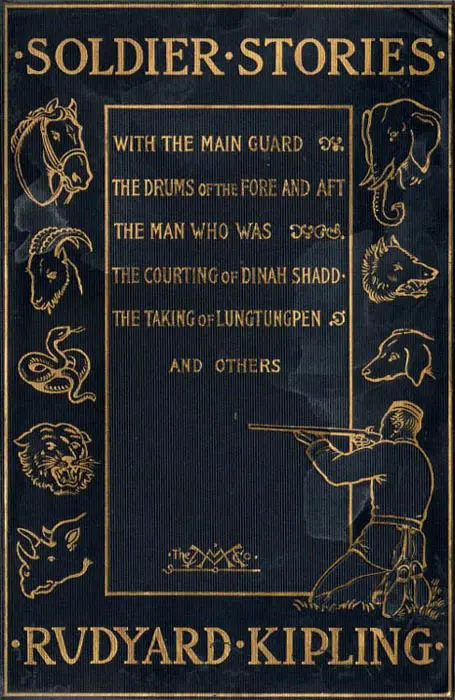
THE CLASSIC COLLECTION · 1896
"Soldier Stories" by Rudyard Kipling is a collection of military-themed short stories written in the late 19th century. The narrative centers around the lives, experiences, and camaraderie of British soldiers serving in India, highlighting their challenges, humor, and the stark realities of military life. The characters, including Mulvaney, Ortheris, and Learoyd, navigate the temptations of barracks life and the brutalities of combat. The opening of "Soldier Stories" introduces the reader to Mulvaney and his comrades stationed at Fort Amara during a stifling June night. The soldiers converse about their weariness and the mental strain of their service in such a desolate place. As Mulvaney recounts past battles and experiences, the narrative captures the camaraderie and resilience among the men, contrasted with the looming threats of combat and the weight of their responsibilities. This initial glimpse sets the stage for deeper explorations of the characters’ lives, showcasing the complex interplay between humor and the harshness of war.
Introduction adapted from the source catalogue; source summaries may be automatically generated.
Free to read · English · 47,909 words · No account needed
MAKE TIME FOR A GOOD BOOK
On by default. Untick to stop anonymous reading totals. Each page counts after 10 seconds in view. How this works.
Anonymous counting is on unless you have switched it off.
'You little devils are more trouble than the rest of the Regiment put together,' said the Colonel angrily. 'One might as well admonish thistledown, and I can't well put you in cells or under stoppages. You must be birched again.'
'Beg y' pardon, Sir. Can't we say nothin' in our own defence, Sir?'
shrilled Jakin.
'Hey! What? Are you going to argue with me?' said the Colonel.
'No, Sir,' said Lew. 'But if a man come to you, Sir, and said he was going to report you, Sir, for 'aving a bit of a turn-up with a friend, Sir, an' wanted to get money out o' you, Sir--'
The Orderly-room exploded in a roar of laughter. 'Well?' said the
Colonel.
'That was what that measly jarnwar there did, Sir, and 'e'd 'a' done it, Sir, if we 'adn't prevented 'im. We didn't 'it 'im much, Sir. 'E 'adn't no manner o' right to interfere with us, Sir. I don't mind bein' birched by the Drum-Major, Sir, nor yet reported by any Corp'ral, but I'm--but I don't think it's fair, Sir, for a civilian to come an' talk over a man in the Army.'
A second shout of laughter shook the Orderly-room, but the Colonel was
grave.
'What sort of characters have these boys?' he asked of the Regimental
Sergeant-Major.
'Accordin' to the Bandmaster, Sir,' returned that revered official--the only soul in the regiment whom the boys feared--'they do everything but lie, Sir.'
'Is it like we'd go for that man for fun, Sir?' said Lew, pointing to
the plaintiff.
'Oh, admonished--admonished!' said the Colonel testily, and when the boys had gone he read the Bazar-Sergeant's son a lecture on the sin of unprofitable meddling, and gave orders that the Bandmaster should keep the Drums in better discipline.
'If either of you comes to practice again with so much as a scratch on your two ugly little faces,' thundered the Bandmaster, 'I'll tell the Drum-Major to take the skin off your backs. Understand that, you young devils.'
Then he repented of his speech for just the length of time that Lew, looking like a Seraph in red worsted embellishments, took the place of one of the trumpets--in hospital--and rendered the echo of a battle-piece. Lew certainly was a musician, and had often in his more exalted moments expressed a yearning to master every instrument of the Band.
'There's nothing to prevent your becoming a Bandmaster, Lew,' said the Bandmaster, who had composed waltzes of his own, and worked day and night in the interests of the Band.
'What did he say?' demanded Jakin after practice.
Your reading position is saved on this browser. Take it to another device with a library code. Reading pages adapt to text, rather than matching a printed edition.
Rudyard Kipling

Rudyard Kipling
Rudyard Kipling

Rudyard Kipling
BEHIND THE BOOK
This eBook is for the use of anyone anywhere in the United States and most other parts of the world at no cost and with almost no restrictions whatsoever. You may copy it, give it away or re-use it under the terms of the Project Gutenberg License included with this eBook or online at www.gutenberg.org. If you are not located in the United States, you will have to check the laws of the country where you are located before using this eBook. Read the source licence.
The original source file, including credits and licence, is retained by this library. Request an original-format copy at no charge. Please include the book title and Project Gutenberg identifier #28537.
KEEP YOUR CURIOSITY GOING
Cécile Tormay

Moritz Busch
Coulson Kernahan
John L. Ransom

Maurice Baring
Frances Wright