THE CLASSIC COLLECTION✦Human nature and the social orderCLASSIC FREE BOOKS
Human nature and the social order
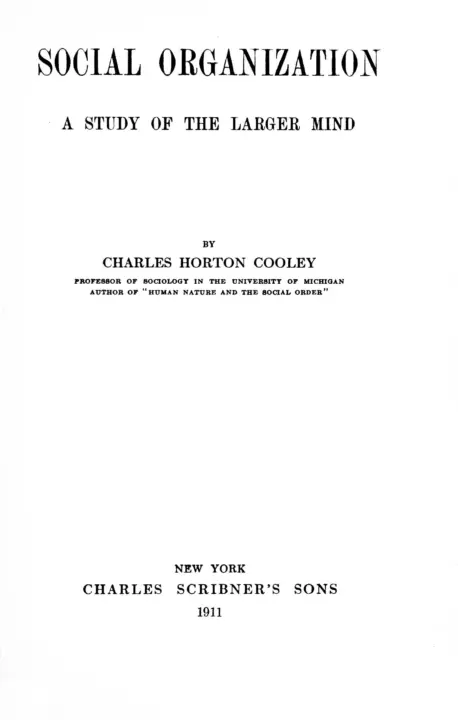
Charles Horton Cooley
THE CLASSIC COLLECTION · 1918
"Social Process" by Charles Horton Cooley is a scholarly work on sociology written in the early 20th century. The book explores the intricate dynamics of human interactions and social structures, emphasizing the organic growth and interconnectedness of individual and collective experiences. Cooley analyzes how personal and impersonal forms of life evolve, adapt, and influence one another, ultimately shaping society as a whole. At the start of "Social Process," Cooley introduces the concept of adaptive growth in human life, where individual development is seen as a continuous interaction with others and their conditions. He highlights the interplay between personal and impersonal forms, such as myths and language, demonstrating that even collective ideas and social institutions have a significant impact on individual identity. Cooley emphasizes the importance of the tentative process of social growth, where varied individual experiences contribute to the broader social fabric. Through examples, he illustrates how personal aspirations, social roles, and institutional changes work together to shape the ongoing evolution of society.
Introduction adapted from the source catalogue; source summaries may be automatically generated.
Free to read · English · 117,857 words · No account needed
MAKE TIME FOR A GOOD BOOK
On by default. Untick to stop anonymous reading totals. Each page counts after 10 seconds in view. How this works.
Anonymous counting is on unless you have switched it off.
James Logan in System, December, 1916.
Footnote 35:
Henry Ford in System, November, 1916.
Footnote 36:
H. G. Wells.
Footnote 37:
Kuno Francke in the Atlantic Monthly, November, 1914.
Footnote 38:
The Atlantic Monthly, September, 1911.
Footnote 39:
Areopagitica.
Footnote 40:
The Survey, vol. 29, p. 419.
Footnote 41:
The Chicago Commons Year-Book, 1911.
Footnote 42:
Any one who cares for a moving yet trustworthy account of the way city conditions affect the young may find it in Jane Addams’s books, especially The Spirit of Youth and the City Streets, and A New Conscience and an Ancient Evil.
Footnote 43:
See the Annual Report for 1909.
Footnote 44:
See his Folkways, sec. 115.
Footnote 45:
The Native Tribes of Central Australia, 7.
Footnote 46:
Kafir Socialism, 41, 42.
Footnote 47:
Ibid., 145.
Footnote 48:
Ibid., 192, 193.
Footnote 49:
Savage Childhood, 108.
Footnote 50:
Travels in West Africa, 403.
Footnote 51:
See his Hereditary Genius.
Footnote 52:
The very statement of the problem as one of “heredity and environment” implies a biological point of view, because the biological factor, heredity, is made central while the social is merely a surrounding condition or “environment.”
Footnote 53:
Professor E. A. Ross, in his Foundations of Sociology, has a good summary of the earlier literature of social selection, and a bibliography. See pp. 327 ff.
Footnote 54:
According to the estimates of W. I. King, in his Wealth and Income of the People of the United States, the number of families in each of these classes, excluding single men and women, would have been, in 1910: Well-to-do families, 1,437,190; families in want, 1,870,000; families in an intermediate state, 14,970,000. See Chap. IX, Table XLIII, from which these figures are computed.
Footnote 55:
See the three articles on Race Suicide in the United States, by W. S. Thompson, The Scientific Monthly, July, August, and September, 1917.
Footnote 56:
Galton’s practical eugenic programme is given in Sociological Papers (an early publication of the English Sociological Society), vol. I, 45 ff. For the general argument, see his Hereditary Genius.
Footnote 57:
The view that race degenerates under civilization is developed at length and with much pessimistic ardor by G. Vacher de Lapouge in his work, Les sélections sociales.
Footnote 58:
Apart from the mixture of races, or changes in their relative numbers.
Footnote 59:
A. G. Warner, American Charities (Revised Edition), 60.
Footnote 60:
Professor Edward T. Devine suggests this distinction in his book,
Misery and Its Causes.
Footnote 61:
I hardly need say, regarding the class revolution in Russia, that that country was lacking in those conditions of intelligence, communication, and economic development which my argument assumes to exist.
Footnote 62:
See his Industrial Evolution, translation, p. 382.
Footnote 63:
The human-nature values, of course, vary much less than the institutional values. Thus fashions vary infinitely, but conformity, the human-nature basis of allegiance to fashion, remains much the same.
Footnote 64:
Pecunia, from pecus, cattle.
Footnote 65:
B. M. Anderson, Jr., Social Value, p. 116.
Footnote 66:
Your reading position is saved on this browser. Take it to another device with a library code. Reading pages adapt to text, rather than matching a printed edition.
Charles Horton Cooley
Charles Horton Cooley
BEHIND THE BOOK
This eBook is for the use of anyone anywhere in the United States and most other parts of the world at no cost and with almost no restrictions whatsoever. You may copy it, give it away or re-use it under the terms of the Project Gutenberg License included with this eBook or online at www.gutenberg.org. If you are not located in the United States, you will have to check the laws of the country where you are located before using this eBook. Read the source licence.
The original source file, including credits and licence, is retained by this library. Request an original-format copy at no charge. Please include the book title and Project Gutenberg identifier #75188.
KEEP YOUR CURIOSITY GOING

Charles G. (Charles Griffith) Ross
Hannah Webster Foster

Emily Lawless
Edwin Hamlin Carr

Charles De Lano Hine
Andrew Ure