THE CLASSIC COLLECTION✦Human nature and the social orderCLASSIC FREE BOOKS
Human nature and the social order
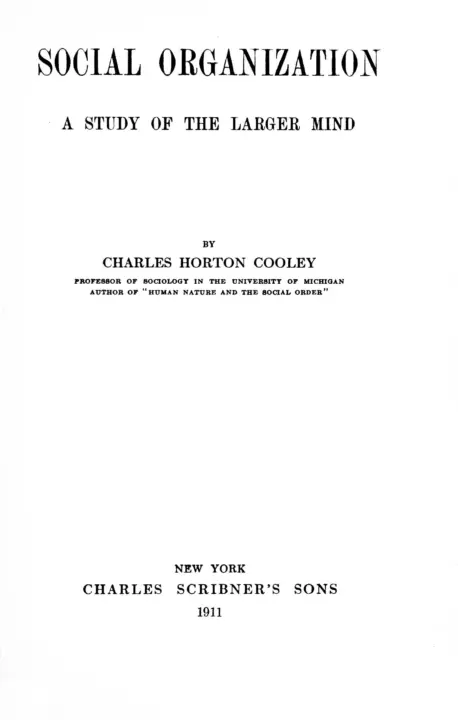
Charles Horton Cooley
THE CLASSIC COLLECTION · 1918
"Social Process" by Charles Horton Cooley is a scholarly work on sociology written in the early 20th century. The book explores the intricate dynamics of human interactions and social structures, emphasizing the organic growth and interconnectedness of individual and collective experiences. Cooley analyzes how personal and impersonal forms of life evolve, adapt, and influence one another, ultimately shaping society as a whole. At the start of "Social Process," Cooley introduces the concept of adaptive growth in human life, where individual development is seen as a continuous interaction with others and their conditions. He highlights the interplay between personal and impersonal forms, such as myths and language, demonstrating that even collective ideas and social institutions have a significant impact on individual identity. Cooley emphasizes the importance of the tentative process of social growth, where varied individual experiences contribute to the broader social fabric. Through examples, he illustrates how personal aspirations, social roles, and institutional changes work together to shape the ongoing evolution of society.
Introduction adapted from the source catalogue; source summaries may be automatically generated.
Free to read · English · 117,857 words · No account needed
MAKE TIME FOR A GOOD BOOK
On by default. Untick to stop anonymous reading totals. Each page counts after 10 seconds in view. How this works.
Anonymous counting is on unless you have switched it off.
The same is true of the religious and moral institutions, whose special function it is to give us a sound and stable basis of conduct. Churches, creeds, standards, mores, every form of established righteousness, have been shaken and discredited by their apparent unsuitability, so that a large part of mankind, tacitly if not openly, treat all such institutions as obsolete, and tend to the view that you may do anything you like unless you encounter something strong enough to prevent it. However one may trust in the power of human nature as a whole to weather such a storm, it would be a foolish optimism to doubt that large numbers will be lost in it. In fact we see on every hand individuals, associations, schools of literature, art, and philosophy, even mighty nations, struggling with one another, and with their own thoughts in the endeavor to work a moral whole out of this confusion.
The principle of moral disintegration through abrupt change is the same that acts so destructively in the contact of savage and civilized life. Irrespective of any intentional aggression, and in spite, sometimes, of a sincere aim to do good, the mere contact of civilization with the social system of more primitive peoples is, generally speaking, destructive of the latter, and of the character of the individuals involved in it. The white man, whether he be soldier, settler, or missionary, brings with him overwhelming evidences of superiority, in power, knowledge, and resources. He may mean well, but he always wants his own way, and that way is inevitably that of the traditions, ideals, and organization of the white race. As the savage comes to feel this superiority his own institutions are degraded in his eyes, and himself, also, as inseparable from these institutions. Confused, displaced, helpless, thrown back upon mere impulses without the dignity and discipline of a corporate life, he falls into degeneration. “It is really the great tragedy of civilization,” says Professor Stunner, “that the contact of lower and higher is disastrous to the former, no matter what may be the point of contact, or how little the civilized may desire to do harm.”[44] Unbiassed observers are for the most part, I think, of this opinion. Thus Spencer and Gillen, speaking of the tribes of Central Australia, say that the white man “introduces a disturbing element into the environment of the native, and from that moment degeneration sets in.”[45] Old morals are lost and no new ones gained. Dudley Kidd says of the Negroes of South Africa: “We have undermined the clan system right and left, and have riddled its defenses through and through with the explosive shells of civilization; we have removed nearly all the old restraints which curbed the people, and have disintegrated their religion, and so rendered it, comparatively speaking, useless.... With the clan system have gone, or are going, some of the best traits in Kafir character.[46]... If we would but leave them alone they could easily set up a civilization that would give them unbounded satisfaction. But our industrial requirements, no less than our moral impulses, make that solution of the difficulty impossible.[47]... We expose savages to the highly complex stimuli of individualism, labor demands, economic pressure, violent legal changes, trade, clothing, industries, a lofty spiritual religion; and to all these we add a wholly unsuitable system of book-learning....”[48] There is a discipline under the native system that is quite effective in its way. “Obedience to parents hardly needs to be taught, for the children notice how every one in the kraal is instinctively obedient to the old men: the children catch this spirit without knowing it.”[49] This, of course, disappears with the irruption of disorganizing ideas. Miss Kingsley, speaking of the Negro tribes of the northwest coast, says: “Nothing strikes one so much in studying the degeneration of these native tribes as the direct effect that civilization and reformation has in hastening it.”[50] And so Nansen tells of the degeneration of the Eskimo, in his account of The First Crossing of Greenland. Their food-supply has been reduced, their skill in seal-catching lost, sickness increased by poverty and wearing clothes indoors, a demoralizing taste for luxury aroused, and their self-respect and social unity undermined. All this notwithstanding that they have been extremely well treated by the Danes.
Your reading position is saved on this browser. Take it to another device with a library code. Reading pages adapt to text, rather than matching a printed edition.
Charles Horton Cooley
Charles Horton Cooley
BEHIND THE BOOK
This eBook is for the use of anyone anywhere in the United States and most other parts of the world at no cost and with almost no restrictions whatsoever. You may copy it, give it away or re-use it under the terms of the Project Gutenberg License included with this eBook or online at www.gutenberg.org. If you are not located in the United States, you will have to check the laws of the country where you are located before using this eBook. Read the source licence.
The original source file, including credits and licence, is retained by this library. Request an original-format copy at no charge. Please include the book title and Project Gutenberg identifier #75188.
KEEP YOUR CURIOSITY GOING

Charles G. (Charles Griffith) Ross
Hannah Webster Foster

Emily Lawless
Edwin Hamlin Carr

Charles De Lano Hine
Andrew Ure