THE CLASSIC COLLECTION✦Social processCLASSIC FREE BOOKS
Social process
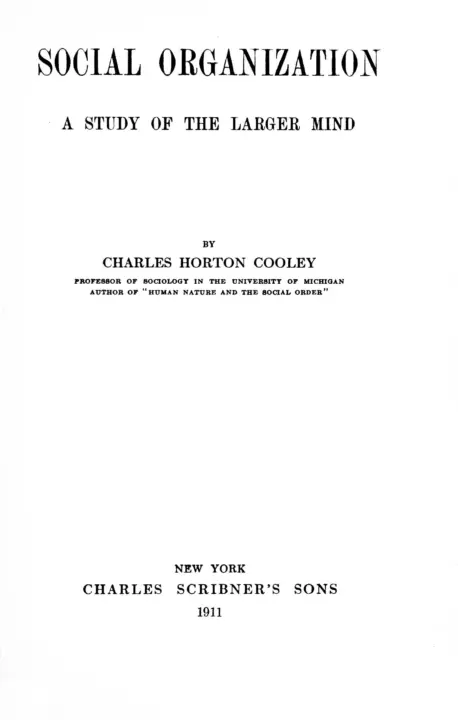
Charles Horton Cooley
THE CLASSIC COLLECTION · 1909
"Social Organization: A Study of the Larger Mind" by Charles Horton Cooley is a scholarly publication written in the early 20th century. This work focuses on the relationship between the individual mind and social dynamics, emphasizing how personal consciousness is shaped by social interactions and relationships. It delves into the intricacies of social organization, collective consciousness, and the interplay between individual thoughts and societal influences. The opening of the book outlines Cooley's perspective on social organization, positing that the mind functions as an organic whole influenced by interpersonal relations. He highlights the interconnectedness of self-consciousness and social consciousness, arguing that they emerge simultaneously. Cooley also critiques traditional views that prioritize individual self-awareness, instead advocating for a vision of the mind as fundamentally communal. His introduction sets the stage for a deeper exploration of social ideals, communication, and the moral fabric of society, positing that human nature and social structures evolve together as integrated components of social life.
Introduction adapted from the source catalogue; source summaries may be automatically generated.
Free to read · English · 110,332 words · No account needed
MAKE TIME FOR A GOOD BOOK
On by default. Untick to stop anonymous reading totals. Each page counts after 10 seconds in view. How this works.
Anonymous counting is on unless you have switched it off.
Finally, all theories that aim to deduce from social conditions the limits of personal achievement must be received with much caution. It is the very nature of a virile sense of self to revolt from the usual and the expected and pursue a lonesome road. Of course it must have support, but it may find this in literature and imaginative intercourse. So, in spite of everything, we have had in America men of signal distinction—such, for instance, as Emerson, Thoreau and Whitman—and we shall no doubt have more. We need fear no dearth of inspiring issues; for if old ones disappear energetic minds will always create new ones by making greater demands upon life.
The very fact that our time has so largely cast off all sorts of structure is in one way favorable to enduring production, since it means that we have fallen back upon human nature, upon that which is permanent and essential, the adequate record of which is the chief agent in giving life to any product of the mind.
[75] Democracy in America, vol. ii, book iv, chap. 7. But elsewhere he expresses the opinion that this levelling and confusion is only temporary. See, for example, book iii, chap. 21.
[76] Republic, book viii.
[77] Outre-Mer. English Translation, 306.
[78] See the final chapter of his French Traits.
[79] Conversation with Eckermann, May 12, 1825.
[80] French Traits, 385, 387, 393.
[81] Poe is the only notable exception that occurs to me.
[82] Memorials of Edward Burne-Jones, ii, 100, 101.
[83] Our most notable group of writers—flourishing at Concord and Boston about 1850—is, of course, connected with the maturing, in partial isolation, of a local type of culture, now disintegrated and dispersed on the wider currents of the time.
[84] Outre-Mer, 25.
[85] In his essay on Balzac.
[86] Democracy in America, vol. ii, book i, chap. 10.
[87] Henry Van Brunt, Greek Lines, 225. Some of these phrases, such as “illiterate combinations,” could never apply to the work of good architects.
[88] Democracy in America, vol. ii, book i, chap. 11.
[89] Emerson, Alphonso of Castile.
Your reading position is saved on this browser. Take it to another device with a library code. Reading pages adapt to text, rather than matching a printed edition.
BEHIND THE BOOK
This eBook is for the use of anyone anywhere in the United States and most other parts of the world at no cost and with almost no restrictions whatsoever. You may copy it, give it away or re-use it under the terms of the Project Gutenberg License included with this eBook or online at www.gutenberg.org. If you are not located in the United States, you will have to check the laws of the country where you are located before using this eBook. Read the source licence.
The original source file, including credits and licence, is retained by this library. Request an original-format copy at no charge. Please include the book title and Project Gutenberg identifier #72636.
KEEP YOUR CURIOSITY GOING

Charles G. (Charles Griffith) Ross
Hannah Webster Foster

Emily Lawless
Edwin Hamlin Carr

Charles De Lano Hine
Andrew Ure