THE CLASSIC COLLECTION✦The way the world is goingCLASSIC FREE BOOKS
The way the world is going
H. G. (Herbert George) Wells
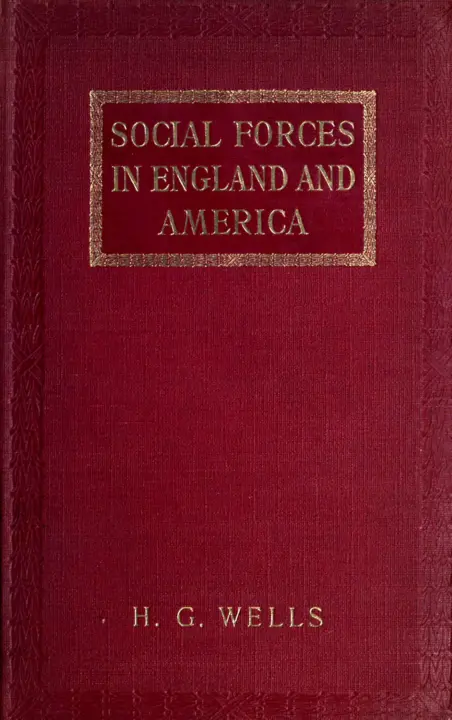
THE CLASSIC COLLECTION · 1914
"Social Forces in England and America" by H. G. Wells is an essay collection published in 1914. This gathering of twenty-six journalistic pieces reflects Wells's shift from fiction to social commentary during the years before World War I. Ranging across topics from aviation and imperialism to socialism, divorce, and the future of civilization, these essays reveal Wells grappling with the transformative forces reshaping Edwardian society. Through his characteristically provocative lens, Wells examines everything from traffic problems to the possibilities of science and the grand sweep of human adventure.
Introduction adapted from the source catalogue; source summaries may be automatically generated.
Free to read · English · 101,149 words · No account needed
MAKE TIME FOR A GOOD BOOK
On by default. Untick to stop anonymous reading totals. Each page counts after 10 seconds in view. How this works.
Anonymous counting is on unless you have switched it off.
This great network of universities that is now spread over the States, interchanging teachers, literature and ideas, and educating not only the professions but a growing proportion of business leaders and wealthy people, must necessarily take an important part in the reconstruction of the American tradition that is now in progress. It is giving a large and increasing amount of attention to the subjects that bear most directly upon the peculiar practical problems of statecraft in America, to psychology, sociology and political science. It is influencing the press more and more directly by supplying a rising proportion of journalists and creating an atmosphere of criticism and suggestion. It is keeping itself on the one hand in touch with the popular literature of public criticism in those new and curious organs of public thought, the ten-cent magazines; and on the other it is making a constantly more solid basis of common understanding upon which the newer generation of plutocrats may meet. That older sentimental patriotism must be giving place under its influence to a more definite and effectual conception of a collective purpose. It is to the moral and intellectual influence of sustained scientific study in the universities, and a growing increase of the college-trained element in the population that we must look if we are to look anywhere for the new progressive methods, for the substitution of persistent, planned and calculated social development for the former conditions of systematic neglect and corruption in public affairs varied by epileptic seizures of “Reform.”
A third influence that may also contribute very materially to the reconstruction of the American tradition is the Socialist movement. It is true that so far American Socialism has very largely taken an Anarchistic form, has been, in fact, little more than a revolutionary movement of the wages-earning class against the property owner. It has already been pointed out that it derives not from contemporary English Socialism, but from the Marxist social democracy of the continent of Europe, and has not even so much of the constructive spirit as has been developed by the English Socialists of the Fabian and Labour Party group or by the newer German evolutionary Socialists. Nevertheless, whenever Socialism is intelligently met by discussion or whenever it draws near to practicable realisation, it becomes, by virtue of its inherent implications, a constructive force, and there is no reason to suppose that it will not be intelligently met on the whole and in the long run in America. The alternative to a developing Socialism among the labouring masses in America is that revolutionary Anarchism from which it is slowly but definitely marking itself off. In America we have to remember that we are dealing with a huge population of people who are for the most part, and more and more evidently destined under the present system of free industrial competition, to be either very small traders, small farmers on the verge of debt, or wages-earners for all their lives. They are going to lead limited lives and worried lives—and they know it. Nearly everyone can read and discuss now, the process of concentrating property and the steady fixation of conditions that were once fluid and adventurous goes on in the daylight visibly to everyone. And it has to be borne in mind also that these people are so far under the sway of the American tradition that each thinks himself as good as any man and as much entitled to the fullness of life. Whatever social tradition their fathers had, whatever ideas of a place to be filled humbly and seriously and duties to be done, have been left behind in Europe. No Church dominates the scenery of this new land, and offers in authoritative and convincing tones consolations hereafter for lives obscurely but faithfully lived. Whatever else happens in this national future, upon one point the patriotic American may feel assured, and that is of an immense general discontent in the working class and of a powerful movement in search of a general betterment. The practical forms and effects of that movement will depend almost entirely upon the average standard of life among the workers and their general education. Sweated and ill-organised foreigners, such as one finds in New Jersey living under conditions of great misery, will be fierce, impatient and altogether dangerous. They will be acutely exasperated by every picture of plutocratic luxury in their newspaper, they will readily resort to destructive violence. The Western miner, the Western agriculturist, worried beyond endurance between the money-lender and railway combinations, will be almost equally prone to savage methods of expression. The Appeal to Reason, for example, to which I have made earlier reference in this chapter, is furious to wreck the present capitalistic system, but it is far too angry and impatient for that satisfaction to produce any clear suggestion of what shall replace it.
Your reading position is saved on this browser. Take it to another device with a library code. Reading pages adapt to text, rather than matching a printed edition.
H. G. (Herbert George) Wells
H. G. (Herbert George) Wells
H. G. (Herbert George) Wells
H. G. (Herbert George) Wells
BEHIND THE BOOK
This eBook is for the use of anyone anywhere in the United States and most other parts of the world at no cost and with almost no restrictions whatsoever. You may copy it, give it away or re-use it under the terms of the Project Gutenberg License included with this eBook or online at www.gutenberg.org. If you are not located in the United States, you will have to check the laws of the country where you are located before using this eBook. Read the source licence.
The original source file, including credits and licence, is retained by this library. Request an original-format copy at no charge. Please include the book title and Project Gutenberg identifier #64186.
KEEP YOUR CURIOSITY GOING
Cécile Tormay

Moritz Busch
John L. Ransom
Frances Wright
Cécile Tormay

Mabel Potter Daggett