THE CLASSIC COLLECTION✦The way the world is goingCLASSIC FREE BOOKS
The way the world is going
H. G. (Herbert George) Wells
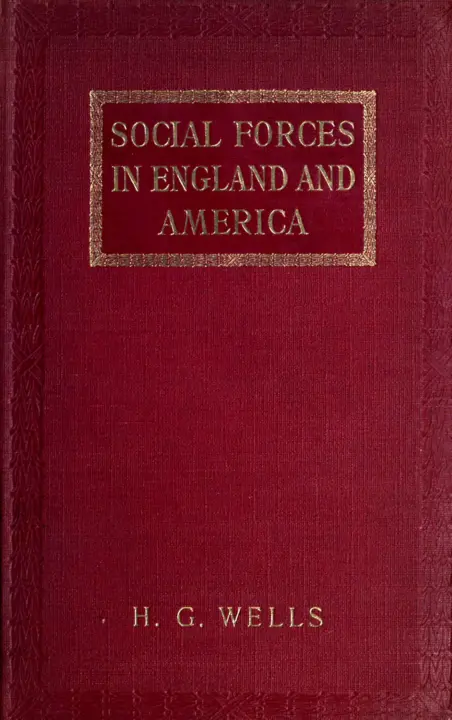
THE CLASSIC COLLECTION · 1914
"Social Forces in England and America" by H. G. Wells is an essay collection published in 1914. This gathering of twenty-six journalistic pieces reflects Wells's shift from fiction to social commentary during the years before World War I. Ranging across topics from aviation and imperialism to socialism, divorce, and the future of civilization, these essays reveal Wells grappling with the transformative forces reshaping Edwardian society. Through his characteristically provocative lens, Wells examines everything from traffic problems to the possibilities of science and the grand sweep of human adventure.
Introduction adapted from the source catalogue; source summaries may be automatically generated.
Free to read · English · 101,149 words · No account needed
MAKE TIME FOR A GOOD BOOK
On by default. Untick to stop anonymous reading totals. Each page counts after 10 seconds in view. How this works.
Anonymous counting is on unless you have switched it off.
Now do these things indicate the ultimate failure and downfall of representative government? Was this idea which inspired so much of the finest and most generous thought of the eighteenth and nineteenth centuries a wrong idea, and must we go back to Cæsarism or oligarchy or plutocracy or a theocracy, to Rome or Venice or Carthage, to the strong man or the ruler by divine right, for the political organisation of the future?
My answer to that question would be an emphatic No. My answer would be that the idea of representative government is the only possible idea for the government of a civilised community. But I would add that so far representative government has not had even the beginnings of a fair trial. So far we have not had representative government, but only a devastating caricature.
It is quite plain now that those who first organised the parliamentary institutions which now are the ruling institutions of the greater part of mankind fell a prey to certain now very obvious errors. They did not realise that there are hundreds of different ways in which voting may be done, and that every way will give a different result. They thought, and it is still thought by a great number of mentally indolent people, that if a country is divided up into approximately equivalent areas, each returning one or two representatives, if every citizen is given one vote, and if there is no legal limit to the presentation of candidates, that presently a cluster of the wisest, most trusted and best citizens will come together in the legislative assembly.
In reality the business is far more complicated than this. In reality a country will elect all sorts of different people according to the electoral method employed. It is a fact that anyone who chooses to experiment with a willing school or club may verify. Suppose, for example, that you take your country, give every voter one single vote, put up six and twenty candidates for a dozen vacancies, and give them no adequate time for organisation. The voters, you will find, will return certain favourites, A and B and C and D let us call them, by enormous majorities, and behind these at a considerable distance will come E, F, G, H, I, J, K, and L. Now give your candidates time to develop organisation. A lot of people who swelled A’s huge vote will dislike J and K and L so much, and prefer M and N so much, that if they are assured that by proper organisation A’s return can be made certain without their voting for him, they will vote for M and N. But they will do so only on that understanding. Similarly certain B-ites will want O and P if they can be got without sacrificing B. So that adequate party organisation in the community may return not the dozen a naïve vote would give, but A, B, C, D, E, F, G, H, M, N, O, P. Now suppose that, instead of this arrangement, your community is divided into twelve constituencies and no candidate may contest more than one of them. And suppose each constituency has strong local preferences. A, B and C are widely popular; in every constituency they have supporters, but in no constituency does any one of the three command a majority. They are great men, not local men. Q, who is an unknown man in most of the country, has, on the contrary, a strong sect of followers in the constituency for which A stands, and beats him by one vote; another local celebrity, R, disposes of B in the same way; C is attacked not only by S but T, whose peculiar views upon vaccination, let us say, appeal to just enough of C’s supporters to let in S. Similar accidents happen in the other constituencies, and the country that would have unreservedly returned A, B, C, D, E, F, G, H, I, J, K and L on the first system, return instead O, P, Q, R, S, T, U, V, W, X, Y, Z. Numerous voters who would have voted for A if they had a chance vote instead for R, S, T, etc., numbers who would have voted for B, vote for Q, V, W, X, etc. But now suppose that A and B are opposed to one another, and that there is a strong A party and a strong B party highly organised in the country. B is really the second favourite over the country as a whole, but A is the first favourite. D, F, H, J, L, N, P, R, U, W, Y constitute the A candidates, and in his name they conquer. B, C, E, G, I, K, M, O, Q, S, V are all thrown out in spite of the wide popularity of B and C. B and C, we have supposed, are the second and third favourites, and yet they go out in favour of Y, of whom nobody has heard before, some mere hangers-on of A’s. Such a situation actually occurs in both Ulster and Home-Rule Ireland.
Your reading position is saved on this browser. Take it to another device with a library code. Reading pages adapt to text, rather than matching a printed edition.
H. G. (Herbert George) Wells

H. G. (Herbert George) Wells
H. G. (Herbert George) Wells
H. G. (Herbert George) Wells
BEHIND THE BOOK
This eBook is for the use of anyone anywhere in the United States and most other parts of the world at no cost and with almost no restrictions whatsoever. You may copy it, give it away or re-use it under the terms of the Project Gutenberg License included with this eBook or online at www.gutenberg.org. If you are not located in the United States, you will have to check the laws of the country where you are located before using this eBook. Read the source licence.
The original source file, including credits and licence, is retained by this library. Request an original-format copy at no charge. Please include the book title and Project Gutenberg identifier #64186.
KEEP YOUR CURIOSITY GOING
Cécile Tormay

Moritz Busch
John L. Ransom
Frances Wright
Cécile Tormay

Mabel Potter Daggett