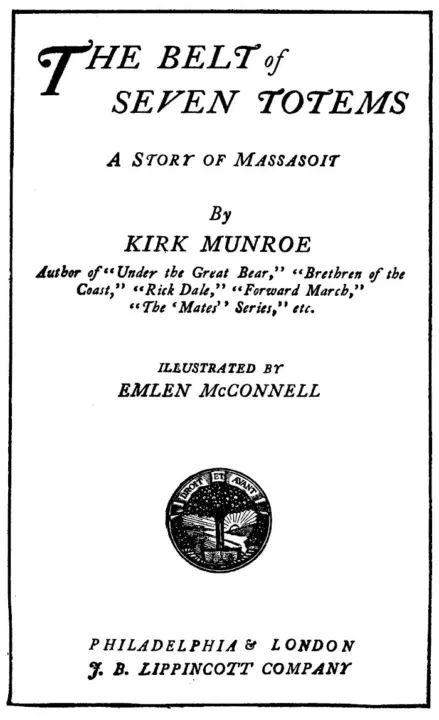
The Belt of Seven Totems: A Story of Massasoit
Kirk Munroe
THE CLASSIC COLLECTION · 1895
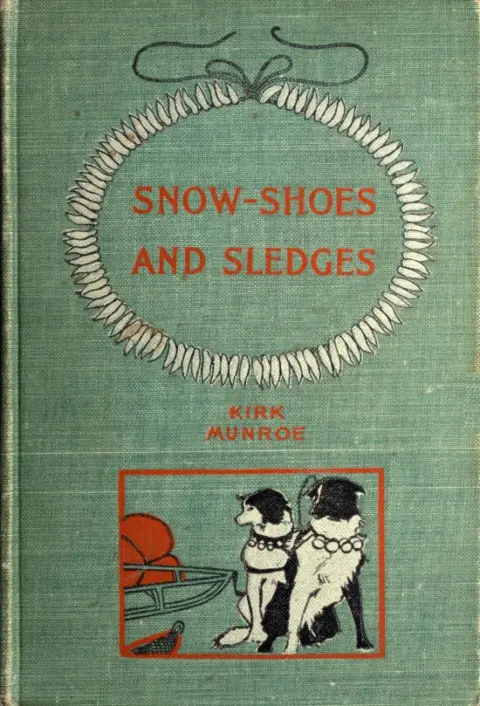
"Snow-shoes and Sledges" by Kirk Munroe is a sequel to the adventure story "The Fur-Seal’s Tooth," written in the early 20th century. This book continues the journey of its main characters as they navigate the challenges and dangers of Alaskan geography and the unique culture of its inhabitants. The narrative dives into themes of friendship, adventure, and survival in the Arctic wilderness. The opening of "Snow-shoes and Sledges" introduces readers to Phil Ryder, who is deeply frustrated about the unresolved tensions from the earlier story, as he and his friend Serge are traveling up the Yukon River bound for Sitka. During their journey, they encounter mysterious delays and challenges, including potential mutiny among the crew of the steamer they've boarded. Additional characters and complications arise that set the stage for a gripping adventure about navigating the wilderness, dealing with illness, and interacting with local native populations. The starting chapters set an engaging tone, filled with suspense and anticipation as Phil and Serge take on greater responsibilities in their expedition while facing the trials of arctic travel.
Introduction adapted from the source catalogue; source summaries may be automatically generated.
Free to read · English · 79,078 words · No account needed
MAKE TIME FOR A GOOD BOOK
On by default. Untick to stop anonymous reading totals. Each page counts after 10 seconds in view. How this works.
Anonymous counting is on unless you have switched it off.
At length one evening, when Phil, who had pushed on longer than usual, in an effort to end their suspense, was reluctantly compelled, by gathering darkness, to go into camp, Chitsah suddenly attracted attention to himself by running to a tree and pressing an ear to its trunk. As the others stared at him, a broad smile overspread his face, and he said something to his father, which the latter instantly interpreted.
“What?” cried Phil, incredulously. “He thinks he hears the sound of
chopping?”
“Yaas,” answered Kurilla. “Axe, chop um, white men, plenty. Yaas.”
“I, too, can hear something!” exclaimed Serge, who had imitated Chitsah’s movements, “though I wouldn’t swear it was chopping.”
“Hurrah! So can I!” shouted Phil, after a moment of intent listening at another tree. “First time, though, I ever knew that the public telephone service was extended to this country. The sound I heard might be a train of cars twenty miles away, or a woodpecker somewhere within sight. No matter. If Chitsah says it’s chopping, it must be, for he ought to know, seeing that he first heard it with the aid of the tree-telephone. So let’s go for it. We can afford to travel an hour or two in the dark for the sake of meeting the white man who is swinging that axe, can’t we?”
“Of course we can,” replied Serge.
“Aye, aye, sir!” answered Jalap Coombs.
“Mebbe catch um. Yaas,” added Kurilla, sharing the general enthusiasm.
Even the tired dogs barked, pricked up their sharp ears, sniffed the air, and did not, seemingly, object to moving on.
So the long teams were again swung into line, the pistol-like reports of the three sledge-whips rang sharply through the keen air, and the whole party swept on down the darkening river at a greater speed than they had made that day.
An hour later, as they rounded a projecting point, Phil uttered an exulting shout. A cluster of twinkling lights shone dead ahead, and our travellers knew that their goal was won.
“Let’s give them a volley,” suggested Serge. “It’s the custom of the country, you know.”
So the guns were taken from their deerskin coverings, and at Phil’s word of command a roar from double-barrel, flintlock, and Winchester woke glad echoes from both sides of the broad valley and from the rugged Yukon cliffs beyond. Then, with whoopings and cheers and frantic yelpings of dogs, the sledge brigade dashed on towards the welcoming lights.
“Hello the camp!” yelled Phil, as they approached the dark cluster of
cabins.
“On deck!” roared Jalap Coombs, as though he were hailing a ship at sea.
Your reading position is saved on this browser. Take it to another device with a library code. Reading pages adapt to text, rather than matching a printed edition.
BEHIND THE BOOK
This eBook is for the use of anyone anywhere in the United States and most other parts of the world at no cost and with almost no restrictions whatsoever. You may copy it, give it away or re-use it under the terms of the Project Gutenberg License included with this eBook or online at www.gutenberg.org. If you are not located in the United States, you will have to check the laws of the country where you are located before using this eBook. Read the source licence.
The original source file, including credits and licence, is retained by this library. Request an original-format copy at no charge. Please include the book title and Project Gutenberg identifier #59240.
KEEP YOUR CURIOSITY GOING
Wilfrid Scawen Blunt
Wilfrid Scawen Blunt

E. W. (Edgar Watson) Howe
Coulson Kernahan

Maurice Baring
Frances Wright