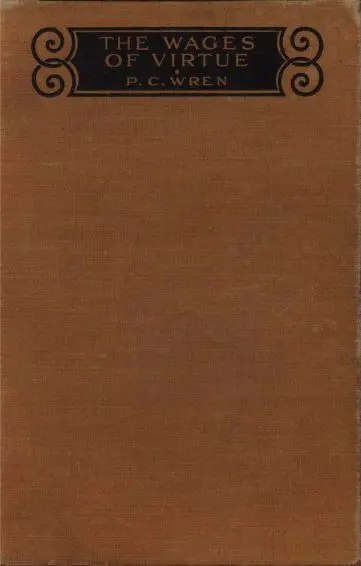
The Wages of Virtue
Percival Christopher Wren
THE CLASSIC COLLECTION · 1914
"Snake and Sword: A Novel" by Percival Christopher Wren is a work of fiction likely written in the early 20th century. The narrative revolves around the intertwined fates of Colonel Matthew Devon de Warrenne, his wife Lenore, and their son Damocles, set against the backdrop of British colonial India. The themes of bravery, love, and the emotional weight of family heredity permeate the story, exploring how trauma and valor shape the lives of the characters. The opening of the novel introduces Colonel de Warrenne, who, in a moment of grief and impulsivity, pins his awarded Victoria Cross to the night-dress of his dying wife, Lenore. The narrative then shifts to a tense and gripping moment where Lenore finds herself in peril, literally standing on a snake, as she summons the courage to protect her unborn child. This event foreshadows the significant impact of fear and bravery on both Lenore's life and the life of her son, Damocles, who is born amidst tragedy. The complex relationships and emotional struggles set the stage for the analysis of fate, loss, and legacy, which will unfold as the story progresses.
Introduction adapted from the source catalogue; source summaries may be automatically generated.
Free to read · English · 78,312 words · No account needed
MAKE TIME FOR A GOOD BOOK
On by default. Untick to stop anonymous reading totals. Each page counts after 10 seconds in view. How this works.
Anonymous counting is on unless you have switched it off.
The Haddock had no bloodful vice, but he was unstable as water and could not excel, a moral coward and weakling, a liar, a borrower of what he never intended to return, undeniably and incurably mean, the complete parasite.
From the first he feared and blindly obeyed Miss Smellie, propitiated while loathing her; accepted her statements, standards, and beliefs; curried favour and became her spy and informer.
“What’s about the record cricket-ball throw, Dam?” inquired Lucille, as they strolled down the path to the orchard and kitchen-garden, hot-houses, stream and stables, to seek the coy, reluctant worm.
“Dunno,” replied the boy, “but a hundred yards wants a lot of doing.”
“Wonder if I could do it,” mused Lucille, picking up a tempting egg-shaped pebble, nearly as big as her fist, and throwing it with remarkably neat action (for a girl) at the first pear-tree over the bridge that spanned the trout-stream.
At, but not into.
With that extraordinary magnetic attraction which glass has for the missile of the juvenile thrower, the orchid-house, on the opposite side of the path from the pear-tree, drew the errant stone to its hospitable shelter.
Through the biggest pane of glass it crashed, neatly decapitated a rare, choice exotic, the pride of Mr. Alastair Kenneth MacIlwraith, head gardener, released from its hold a hanging basket, struck a large pot (perched high in a state of unstable equilibrium), and passed out on the other side with something accomplished, something done, to earn a long repose.
So much for the stone.
The descending pot lit upon the edge of one side of the big glass aquarium, smashed it, and continued its career, precipitating an avalanche of lesser pots and their priceless contents.
The hanging basket, now an unhung and travelling basket, heavy, iron-ribbed, anciently mossy, oozy of slime, fell with neat exactitude upon the bald, bare cranium of Mr. Alastair Kenneth MacIlwraith, head gardener, and dour, irascible child and woman hater.
“Bull’s-eye!” commented Dam—always terse when not composing
fairy-tales.
“Crikey!” shrieked Lucille. “That’s done it,” and fled straightway to her room and violent earnest prayer, not for forgiveness but for salvation, from consequences. (What’s the good of Saying your Prayers if you can’t look for Help in Time of Trouble such as this?)
The face of Mr. Alastair Kenneth MacIlwraith was not pleasant to see as he pranced forth from the orchid-house, brandishing an implement of his trade.
“Ye’ll be needing a wash the day, Mon Sandy, and the Sawbath but fower days syne,” opined Dam, critically observing the moss-and-mud streaked head, face and neck of the raving, incoherent victim of Lucille’s effort.
Your reading position is saved on this browser. Take it to another device with a library code. Reading pages adapt to text, rather than matching a printed edition.
Percival Christopher Wren
Percival Christopher Wren
Percival Christopher Wren
BEHIND THE BOOK
This eBook is for the use of anyone anywhere in the United States and most other parts of the world at no cost and with almost no restrictions whatsoever. You may copy it, give it away or re-use it under the terms of the Project Gutenberg License included with this eBook or online at www.gutenberg.org. If you are not located in the United States, you will have to check the laws of the country where you are located before using this eBook. Read the source licence.
The original source file, including credits and licence, is retained by this library. Request an original-format copy at no charge. Please include the book title and Project Gutenberg identifier #10667.
KEEP YOUR CURIOSITY GOING
Coulson Kernahan

Maurice Baring
Frances Wright
Cécile Tormay

Frederic Jesup Stimson

W. H. P. (William Henry Pope) Jarvis