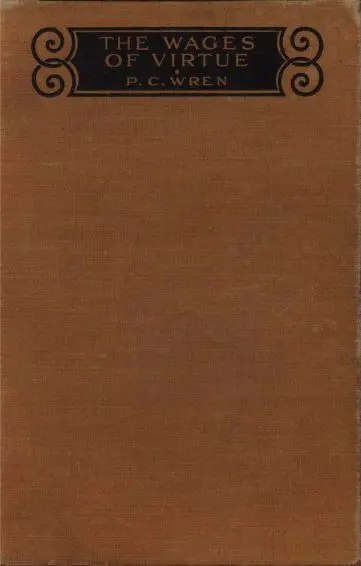
The Wages of Virtue
Percival Christopher Wren
THE CLASSIC COLLECTION · 1914
"Snake and Sword: A Novel" by Percival Christopher Wren is a work of fiction likely written in the early 20th century. The narrative revolves around the intertwined fates of Colonel Matthew Devon de Warrenne, his wife Lenore, and their son Damocles, set against the backdrop of British colonial India. The themes of bravery, love, and the emotional weight of family heredity permeate the story, exploring how trauma and valor shape the lives of the characters. The opening of the novel introduces Colonel de Warrenne, who, in a moment of grief and impulsivity, pins his awarded Victoria Cross to the night-dress of his dying wife, Lenore. The narrative then shifts to a tense and gripping moment where Lenore finds herself in peril, literally standing on a snake, as she summons the courage to protect her unborn child. This event foreshadows the significant impact of fear and bravery on both Lenore's life and the life of her son, Damocles, who is born amidst tragedy. The complex relationships and emotional struggles set the stage for the analysis of fate, loss, and legacy, which will unfold as the story progresses.
Introduction adapted from the source catalogue; source summaries may be automatically generated.
Free to read · English · 78,312 words · No account needed
MAKE TIME FOR A GOOD BOOK
On by default. Untick to stop anonymous reading totals. Each page counts after 10 seconds in view. How this works.
Anonymous counting is on unless you have switched it off.
Also the boy fervently hoped it might never be his lot to go to Heaven—a shockingly dreary place where it was always Sunday and one must, presumably, be very quiet except when singing hymns. A place tenanted by white-robed Angels, unsympathetic towards dirty-faced little sinners who tore their clothes. Angels, cold, superior, unhuggable, haughty, given to ecstatic throes, singers of Hallelujah and other silly words—always praising.
How he loathed and dreaded the idea of Dearest being an Angel! Fancy sweet Dearest or his own darling Lucille with silly wings (like a beastly goose or turkey in dear old Cook’s larder), with a long trumpet, perhaps, in a kind of night-gown, flying about the place, it wasn’t decent at all—Dearest and Lucille, whom he adored and hugged—unsympathetic, cold, superior, unhuggable, haughty; and the boy who was very, very tender-hearted, would throw his arms round Dearest’s neck and hug and hug and hug, for he abhorred the thought of her becoming a beastly angel.
Surely, if God knew His business, Dearest would be always happy and bright and live ever so long, and be ever so old, forty years and more.
And Dearest, fearing that her idolized boy might grow up a man like—well, like “Grumper” had been—hard, quarrelsome, adventurous, flippant, wicked, pleasure-loving, drunken, Godless … redoubled her efforts to Influence-the-child’s-mind-for-good by means of the Testaments and Theology, the Covenant, the Deluge, Miracles, the Immaculate Conception, the Last Supper, the Resurrection, Pentecost, Creeds, Collects, Prayers.
And the boy’s mind weighed these things deliberately, pondered them, revolted—and rejected them one and all.
Dearest had been taken in….
He said the prayers she taught him mechanically, and when he felt the need of real prayer—(as he did when he had dreamed of the Snake)—he always began, “If you are there, God, and are a good, kind God” … and concluded, “Yours sincerely, Damocles de Warrenne”.
He got but little comfort, however, for his restless and logical mind
asked:—
“If God knows best and will surely do what is best, why bother Him? And if He does not and will not, why bother yourself?”
But Dearest succeeded, at any rate, in filling his young soul with a love of beauty, romance, high adventure, honour, and all physical, mental, and moral cleanliness.
She taught him to use his imagination, and she made books a necessity. She made him a gentleman in soul—as distinct from a gentleman in clothes, pocket, or position.
Your reading position is saved on this browser. Take it to another device with a library code. Reading pages adapt to text, rather than matching a printed edition.
Percival Christopher Wren
Percival Christopher Wren
Percival Christopher Wren
BEHIND THE BOOK
This eBook is for the use of anyone anywhere in the United States and most other parts of the world at no cost and with almost no restrictions whatsoever. You may copy it, give it away or re-use it under the terms of the Project Gutenberg License included with this eBook or online at www.gutenberg.org. If you are not located in the United States, you will have to check the laws of the country where you are located before using this eBook. Read the source licence.
The original source file, including credits and licence, is retained by this library. Request an original-format copy at no charge. Please include the book title and Project Gutenberg identifier #10667.
KEEP YOUR CURIOSITY GOING
Coulson Kernahan

Maurice Baring
Frances Wright
Cécile Tormay

Frederic Jesup Stimson

W. H. P. (William Henry Pope) Jarvis