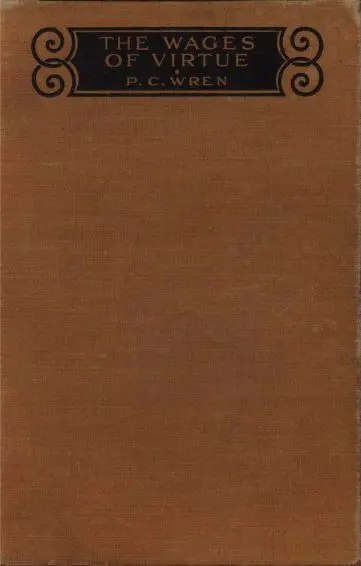
The Wages of Virtue
Percival Christopher Wren
THE CLASSIC COLLECTION · 1914
"Snake and Sword: A Novel" by Percival Christopher Wren is a work of fiction likely written in the early 20th century. The narrative revolves around the intertwined fates of Colonel Matthew Devon de Warrenne, his wife Lenore, and their son Damocles, set against the backdrop of British colonial India. The themes of bravery, love, and the emotional weight of family heredity permeate the story, exploring how trauma and valor shape the lives of the characters. The opening of the novel introduces Colonel de Warrenne, who, in a moment of grief and impulsivity, pins his awarded Victoria Cross to the night-dress of his dying wife, Lenore. The narrative then shifts to a tense and gripping moment where Lenore finds herself in peril, literally standing on a snake, as she summons the courage to protect her unborn child. This event foreshadows the significant impact of fear and bravery on both Lenore's life and the life of her son, Damocles, who is born amidst tragedy. The complex relationships and emotional struggles set the stage for the analysis of fate, loss, and legacy, which will unfold as the story progresses.
Introduction adapted from the source catalogue; source summaries may be automatically generated.
Free to read · English · 78,312 words · No account needed
MAKE TIME FOR A GOOD BOOK
On by default. Untick to stop anonymous reading totals. Each page counts after 10 seconds in view. How this works.
Anonymous counting is on unless you have switched it off.
The boy liked the face. It was strong and fierce, thin and clean-cut—marred only, in his estimation, by the funny little tuft of hair on the lower lip. He liked the wavy, rough, up-turned moustache, but not that silly tuft. How nice he would look with his hair cut, his lower lip shaved, and his ridiculous silks, velvet, and lace exchanged for a tweed shooting-suit or cricketing-flannels! How Grumper, Father, Major Decies, and even Khodadad Khan and the sepoys would have laughed at the get-up. Nay, they would have blushed for the fellow—a Sahib, a gentleman—to tog himself up so!
The boy also liked the man’s voice when he turned towards the tent and
called:—
“Lubin, you drunken dog, come hither,” a call which brought forth a servant-like person, who, by reason of his clean-shaven face and red nose, reminded the boy of Pattern the coachman.
He wore a dark cloth suit, cotton stockings, shoes that had neither laces nor buttons, but fastened with a kind of strap and buckle, and, queer creature, a big Eton collar!
“Sword and horse, rascal,” said the gentleman, “and warn Digby for duty. Bring me wine and a manchet of bread.”
The man bowed and re-entered the tent, to emerge a moment later bearing
the Sword.
How the cut-steel hilt sparkled and shone! How bright and red the leather scabbard—now black, dull, cracked and crumbling. But it was unmistakeably the Sword.
It hung from a kind of broad cross-belt and was attached to it by
several parallel buckled straps—not like Father’s Sam Browne belt at
all.
As the gentleman rose from his stool (he must have been over six feet in height) Lubin passed the cross-belt over his head and raised left arm so that it rested on his right shoulder, and the Sword hung from hip to heel.
To the boy it had always seemed such a huge, unwieldy thing. At this big man’s side it looked—just right.
Lubin then went off at a trot to where long lines of bay horses pawed the ground, swished their tails, tossed their heads, and fidgeted generally….
From a neighbouring tent came the sounds of a creaking camp-bed, two
feet striking the ground with violence, and a prodigious, prolonged
yawn.
A voice then announced that all parades should be held in Hell, and that it was better to be dead than damned. Why should gentlemen drill on a fine evening while the world held wine and women?
After a brief space, occupied with another mighty yawn, it loudly and tunefully requested some person or persons unknown to superintend its owner’s obsequies.
Your reading position is saved on this browser. Take it to another device with a library code. Reading pages adapt to text, rather than matching a printed edition.
Percival Christopher Wren
Percival Christopher Wren
Percival Christopher Wren
BEHIND THE BOOK
This eBook is for the use of anyone anywhere in the United States and most other parts of the world at no cost and with almost no restrictions whatsoever. You may copy it, give it away or re-use it under the terms of the Project Gutenberg License included with this eBook or online at www.gutenberg.org. If you are not located in the United States, you will have to check the laws of the country where you are located before using this eBook. Read the source licence.
The original source file, including credits and licence, is retained by this library. Request an original-format copy at no charge. Please include the book title and Project Gutenberg identifier #10667.
KEEP YOUR CURIOSITY GOING
Coulson Kernahan

Maurice Baring
Frances Wright
Cécile Tormay

Frederic Jesup Stimson

W. H. P. (William Henry Pope) Jarvis