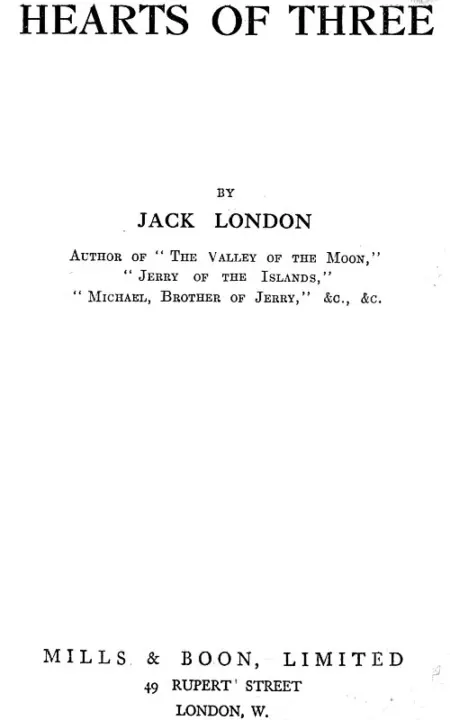
Hearts of three
Jack London
THE CLASSIC COLLECTION · 1912
"Smoke Bellew" by Jack London is a novel written in the late 19th century that encapsulates the spirit of adventure during the Klondike Gold Rush. The story follows the protagonist, Christopher Bellew—known as Kit and eventually as Smoke—as he embarks on a transformative journey from a comfortable life in San Francisco to the harsh realities of the Alaskan wilderness. Driven by a sense of duty and a yearning for authenticity, Smoke ventures to the Klondike, where he encounters challenges that strip him of his previous comforts and force him to embrace a rugged, self-reliant lifestyle. The opening of the book introduces Smoke Bellew as a character marked by his evolution, from a privileged, somewhat effete artist to a man forged in the fires of hardship. Initially, he is ensnared in the demands of editing a struggling magazine under the coercive guidance of his friend O'Hara. After a brutal conversation with his iron-willed uncle, he decides to join his family on a trek into the Klondike, where he soon lands on Dyea Beach amidst the chaos of the gold rush. Through struggles with labor and natural elements, we begin to see Smoke's realization of his own strength and resilience; the narrative hints at his transformation into a more capable and hardened individual as he attempts to adapt to the adversities surrounding him. Overall, this introduction sets the stage for an engaging tale that explores themes of personal growth, adventure, and survival against the backdrop of a historical gold rush.
Introduction adapted from the source catalogue; source summaries may be automatically generated.
Free to read · English · 41,539 words · No account needed
MAKE TIME FOR A GOOD BOOK
On by default. Untick to stop anonymous reading totals. Each page counts after 10 seconds in view. How this works.
Anonymous counting is on unless you have switched it off.
"We could make it if they had the souls of clams," Kit told Shorty, as they dried their moccasins by the fire on the evening of the third day. "We could have made it to-day if they hadn't turned back. Another hour's work would have fetched that west shore. They're--they're babes in the woods."
"Sure," Shorty agreed. He turned his moccasin to the flame and debated a moment. "Look here, Smoke. It's hundreds of miles to Dawson. If we don't want to freeze in here, we've got to do something. What d'ye say?"
Kit looked at him, and waited.
"We've got the immortal cinch on them two babes," Shorty expounded. "They can give orders an' shed mazuma, but, as you say, they're plum babes. If we're goin' to Dawson, we got to take charge of this here outfit."
They looked at each other.
"It's a go," said Kit, as his hand went out in ratification.
In the morning, long before daylight, Shorty issued his call.
"Come on!" he roared. "Tumble out, you sleepers! Here's your coffee! Kick in to it! We're goin' to make a start!"
Grumbling and complaining, Stine and Sprague were forced to get under way two hours earlier than ever before. If anything, the gale was stiffer, and in a short time every man's face was iced up, while the oars were heavy with ice. Three hours they struggled, and four, one man steering, one chopping ice, two toiling at the oars, and each taking his various turns. The north-west shore loomed nearer and nearer. The gale blew even harder, and at last Sprague pulled in his oar in token of surrender. Shorty sprang to it, though his relief had only begun.
"Chop ice," he said, handing Sprague the hatchet.
"But what's the use?" the other whined. "We can't make it. We're
going to turn back."
"We're going on," said Shorty. "Chop ice. An' when you feel better
you can spell me."
It was heart-breaking toil, but they gained the shore, only to find it composed of surge-beaten rocks and cliffs, with no place to land.
"I told you so," Sprague whimpered.
"You never peeped," Shorty answered.
"We're going back."
Nobody spoke, and Kit held the boat into the seas as they skirted the forbidding shore. Sometimes they gained no more than a foot to the stroke, and there were times when two or three strokes no more than enabled them to hold their own. He did his best to hearten the two weaklings. He pointed out that the boats which had won to this shore had never come back. Perforce, he argued, they had found a shelter somewhere ahead. Another hour they laboured, and a second.
Your reading position is saved on this browser. Take it to another device with a library code. Reading pages adapt to text, rather than matching a printed edition.
Jack London
Jack London
Jack London
Jack London
BEHIND THE BOOK
This eBook is for the use of anyone anywhere in the United States and most other parts of the world at no cost and with almost no restrictions whatsoever. You may copy it, give it away or re-use it under the terms of the Project Gutenberg License included with this eBook or online at www.gutenberg.org. If you are not located in the United States, you will have to check the laws of the country where you are located before using this eBook. Read the source licence.
The original source file, including credits and licence, is retained by this library. Request an original-format copy at no charge. Please include the book title and Project Gutenberg identifier #1596.
KEEP YOUR CURIOSITY GOING
Coulson Kernahan

Maurice Baring
Frances Wright
Cécile Tormay

Frederic Jesup Stimson

W. H. P. (William Henry Pope) Jarvis