
Last letters from the living dead man
David Patterson (Spirit) Hatch
THE CLASSIC COLLECTION · 1835
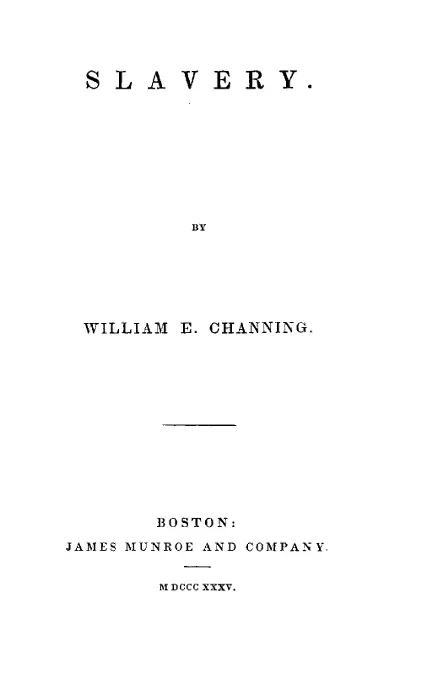
"Slavery" by William Ellery Channing is a philosophical treatise written in the early 19th century. The text presents a thorough moral examination of the institution of slavery, arguing against its legitimacy by discussing fundamental human rights, property ownership, and ethical responsibilities. Through logical discourse, the book aims to elevate the moral understanding of slavery as a significant societal issue rather than a mere economic or political concern. The opening of the work establishes a framework for discussing slavery as a moral dilemma, emphasizing the importance of recognizing the rights and dignity of every human being. Channing argues that slavery fundamentally violates these rights by treating individuals as property and stripping them of their humanity. He articulates the moral imperative to confront this injustice, urging readers to consider the broader implications of accepting slavery as social norm and the profound harm it inflicts on individual lives and society as a whole. The introduction sets the stage for further exploration of the evils of slavery, the rights of individuals, and the responsibilities of society in addressing these moral failings.
Introduction adapted from the source catalogue; source summaries may be automatically generated.
Free to read · English · 39,091 words · No account needed
MAKE TIME FOR A GOOD BOOK
On by default. Untick to stop anonymous reading totals. Each page counts after 10 seconds in view. How this works.
Anonymous counting is on unless you have switched it off.
4. That a human being cannot be justly held and used as property is apparent from the very nature of property. Property is an exclusive, single right. It shuts out all claim but that of the possessor, What one man owns cannot belong to another. What, then, is the consequence of holding a human being as property? Plainly this. He can have no right to himself. His limbs are, in truth, not morally his own. He has not a right to his own strength. It belongs to another. His will, intellect, and muscles, all the powers of body and mind which are exercised in labor, he is bound to regard as another's. Now, if there be property in any thing, it is that of a man in his own person, mind, and strength. All other rights are weak, unmeaning, compared with this, and in denying this all right is denied. It is true that an individual may forfeit by crime his right to the use of his limbs, perhaps to his limbs, and even to life. But the very idea of forfeiture implies that the right was originally possessed. It is true that a man may by contract give to another a limited right to his strength. But he gives only because he possesses it, and gives it for considerations which he deems beneficial to himself; and the right conferred ceases at once on violation of the conditions on which it was bestowed. To deny the right of a human being to himself, to his own limbs and faculties, to his energy of body and mind, is an absurdity too gross to be confuted by any thing but a simple statement. Yet this absurdity is involved in the idea of his belonging to another.
5. We have a plain recognition of the principle now laid down, in the universal indignation excited towards a man who makes another his slave. Our laws know no higher crime than that of reducing a man to slavery. To steal or to buy an African on his own shores is piracy. In this act the greatest wrong is inflicted, the most sacred right violated. But if a human being cannot without infinite injustice be seized as property, then he cannot without equal wrong be held and used as such. The wrong in the first seizure lies in the destination of a human being to future bondage, to the criminal use of him as a chattel or brute. Can that very use, which makes the original seizure an enormous wrong, become gradually innocent? If the slave receive injury without measure at the first moment of the outrage, is he less injured by being held fast the second or the third? Does the duration of wrong, the increase of it by continuance, convert it into right? It is true, in many cases, that length of possession is considered as giving a right, where the goods were acquired by unlawful means. But in these cases the goods were such as might justly be appropriated to individual use. They were intended by the Creator to be owned. They fulfil their purpose by passing into the hands of an exclusive possessor. It is essential to rightful property in a thing, that the thing from its nature may be rightfully appropriated. If it cannot originally be made one's own without crime, it certainly cannot be continued as such without guilt. Now, the ground, on which the seizure of the African on his own shore is condemned, is, that he is a Man, who has by his nature a right to be free. Ought not, then, the same condemnation to light on the continuance of his yoke? Still more. Whence is it that length of possession is considered by the laws as conferring a right? I answer, from the difficulty of determining the original proprietor, and from the apprehension of unsettling all property by carrying back inquiry beyond a certain time. Suppose, however, an article of property to be of such a nature that it could bear the name of the true original owner, stamped on it in bright and indelible characters. In this case, the whole ground, on which length of possession bars other claims, would fail. The proprietor would not be concealed or rendered doubtful by the lapse of time. Would not he, who should receive such an article from a robber or a succession of robbers, be involved in their guilt? Now, the true owner of a human being is made manifest to all. It is Himself. No brand on the slave was ever so conspicuous as the mark of property which God has set on him. God, in making him a rational and moral being, has put a glorious stamp on him, which all the slave-legislation and slave-markets of worlds cannot efface. Hence no right accrues to the master from the length of the wrong which has been done to the slave.
Your reading position is saved on this browser. Take it to another device with a library code. Reading pages adapt to text, rather than matching a printed edition.
BEHIND THE BOOK
This eBook is for the use of anyone anywhere in the United States and most other parts of the world at no cost and with almost no restrictions whatsoever. You may copy it, give it away or re-use it under the terms of the Project Gutenberg License included with this eBook or online at www.gutenberg.org. If you are not located in the United States, you will have to check the laws of the country where you are located before using this eBook. Read the source licence.
The original source file, including credits and licence, is retained by this library. Request an original-format copy at no charge. Please include the book title and Project Gutenberg identifier #44736.
KEEP YOUR CURIOSITY GOING
David Patterson (Spirit) Hatch

David Patterson (Spirit) Hatch

David Patterson (Spirit) Hatch
Cécile Tormay

Moritz Busch
Coulson Kernahan