THE CLASSIC COLLECTION✦The Mystery of the Pinckney DraughtCLASSIC FREE BOOKS
The Mystery of the Pinckney Draught
Charles C. Nott
THE CLASSIC COLLECTION · 1865
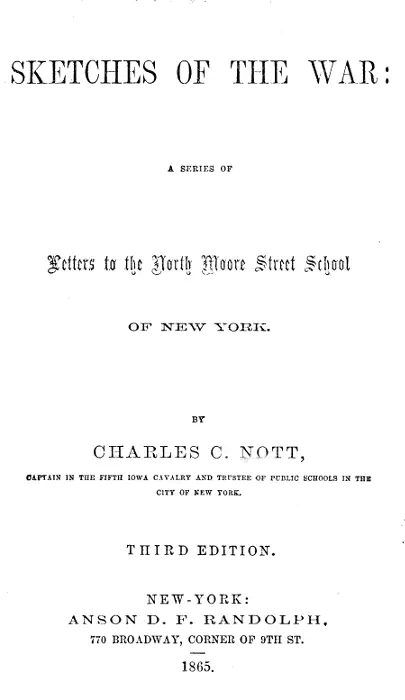
"Sketches of the War" by Charles C. Nott is a collection of letters recounting the author's experiences during the American Civil War, written in the mid-19th century. Nott, who served as a Captain in the Fifth Iowa Cavalry, shares vivid and personal reflections on military life, hardships, and the struggles faced by soldiers and civilians alike during this tumultuous time in American history. The opening of the work introduces a poignant narrative about a young soldier named Frank Gillham, who, after nursing his sick horse, succumbs to pneumonia in a hospital far from home. The sorrow of his lonely death and the struggles to inform his family highlight the human cost of war and the emotional toll it takes on those involved. As Nott visits the hospital, he describes both the grim atmosphere and the neglect faced by many soldiers, conveying a sense of loss and reflection on duty, sacrifice, and the burden of the war's legacy. This initial section sets the tone for a deeply humanistic treatment of the experiences of soldiers during the Civil War, emphasizing personal stories amid the broader historical context.
Introduction adapted from the source catalogue; source summaries may be automatically generated.
Free to read · English · 46,612 words · No account needed
MAKE TIME FOR A GOOD BOOK
On by default. Untick to stop anonymous reading totals. Each page counts after 10 seconds in view. How this works.
Anonymous counting is on unless you have switched it off.
But two or three miles down this road we come to a gate, on which three little contrabands hang, grinning. Very quickly they drop down and swing open the gate; and very glad they are to see us, whatever missus may be. Within this gate is a fine open grove, and through it are seen a small timber house, some contraband cabins, and a barn or two. We have heard of this house before. It belongs to a Lieutenant Reynolds of the rebel service, and was selected, before we started, as a good stopping-place. In one of the cabins we find a young mulatto woman, whose sad, intelligent face awakens more than usual respect.
"Is Mrs. Reynolds at home?" I ask.
"No, sir, she's at her mother's."
"Are you alone here?"
"There's a man a ploughing, sir, out in the field there, and another
girl--she's a grubbing."
"Whose children are these? Yours?"
"That one's mine, sir; the other two's mother is gone."
"Where?"
"To Memphis, I s'pose, sir. They sent her off and sold her the time your soldiers took the fort."
"Will your mistress be back to-night?"
"No, sir, she don't stay here nights."
"Then I must trouble you to show me where your provisions are. My men have eaten up all their rations and must have supper here."
Two of the men come in and go to work as cooks, and the others are in the yard, unsaddling and cleaning their horses. With one of the sergeants, I stroll out to the road. We cross it and walk a few yards, to get a view of some fields beyond. As we are looking and talking of the pickets for the coming night, in the distance, down the road, we hear a shout or two, and then a rumbling noise.
"What is that, sergeant?"
"It's horses," says the sergeant; "they are galloping--and there's more
than one too."
We both spring for the gate.
"Shall I order the men to fall in?" asks the sergeant.
"No; there are not many horses coming. Let us wait and see."
In another moment appears through the trees, a black boy mounted on a horse, and behind him two mules on a gallop. The black boy repeats his wild "Yoo, yoo--yo, yoo," and when he does so the mules redouble their speed. As he approaches the gate, he pulls up.
"What are you galloping for?" I ask. "Is anything the matter?"
"Oh, no, sah; I been a ploughing all day, and am a comin' home."
"What! do those mules plough all day and gallop home in this way at
night?"
"Oh, yes, sah; they likes it. Why, it does 'em good."
Your reading position is saved on this browser. Take it to another device with a library code. Reading pages adapt to text, rather than matching a printed edition.
BEHIND THE BOOK
This eBook is for the use of anyone anywhere in the United States and most other parts of the world at no cost and with almost no restrictions whatsoever. You may copy it, give it away or re-use it under the terms of the Project Gutenberg License included with this eBook or online at www.gutenberg.org. If you are not located in the United States, you will have to check the laws of the country where you are located before using this eBook. Read the source licence.
The original source file, including credits and licence, is retained by this library. Request an original-format copy at no charge. Please include the book title and Project Gutenberg identifier #60629.
KEEP YOUR CURIOSITY GOING
Cécile Tormay

Moritz Busch
John L. Ransom
Frances Wright
Cécile Tormay

Mabel Potter Daggett