THE CLASSIC COLLECTION✦The Mystery of the Pinckney DraughtCLASSIC FREE BOOKS
The Mystery of the Pinckney Draught
Charles C. Nott
THE CLASSIC COLLECTION · 1865
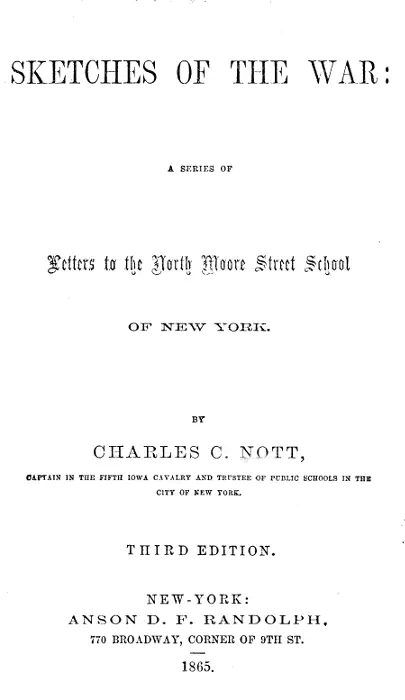
"Sketches of the War" by Charles C. Nott is a collection of letters recounting the author's experiences during the American Civil War, written in the mid-19th century. Nott, who served as a Captain in the Fifth Iowa Cavalry, shares vivid and personal reflections on military life, hardships, and the struggles faced by soldiers and civilians alike during this tumultuous time in American history. The opening of the work introduces a poignant narrative about a young soldier named Frank Gillham, who, after nursing his sick horse, succumbs to pneumonia in a hospital far from home. The sorrow of his lonely death and the struggles to inform his family highlight the human cost of war and the emotional toll it takes on those involved. As Nott visits the hospital, he describes both the grim atmosphere and the neglect faced by many soldiers, conveying a sense of loss and reflection on duty, sacrifice, and the burden of the war's legacy. This initial section sets the tone for a deeply humanistic treatment of the experiences of soldiers during the Civil War, emphasizing personal stories amid the broader historical context.
Introduction adapted from the source catalogue; source summaries may be automatically generated.
Free to read · English · 46,612 words · No account needed
MAKE TIME FOR A GOOD BOOK
On by default. Untick to stop anonymous reading totals. Each page counts after 10 seconds in view. How this works.
Anonymous counting is on unless you have switched it off.
The sun has gone down, and the moon has risen, and we are on the main road from Fort Donelson, and will reach our camp soon, and have a good supper, and rest sweetly in our tents after our day's ride. We think over what we will have for supper, and debate whether the pigs, or chickens, or corn-meal can be added to the rations we shall find in camp. We are reckoning like inexperienced soldiers. The uncertainty of legal, is nothing to the uncertainty of military life. In the law you can at least calculate on your breakfast, and a part of your bed; but in camp you can calculate on nothing. We approach Fort Henry, and plunge into the mud that environs our camp. We struggle through till we come to the trees where the horses should be tied, and to the little knoll where the tents should be pitched. We look around in vague astonishment--horses, and men, and tents have vanished; all is darkness and silence; our camp has gone. To come home and find your home absconded, to leave your house in the morning and find it has walked away at the evening, is something new. Searching in the darkness for the new camp is folly; there is nothing to be done but wait till to-morrow. It is very easy to say wait, but how are we to wait? If we had some beds to wait in, and some supper to wait for, it would be tolerable; but we were only going for a little while, so we left our blankets, and it was such a fine day that we did not take our overcoats. Who would have dreamt of the colonel playing us such a trick? At Fort Donelson I learned the first lesson--"do not trust to your trunk;" now I have to learn the second--"do not trust to your camp." Hereafter I will not leave for half an hour without having my blanket rolled behind, and my overcoat strapped before. If I only had them now! But lamenting will do no good; something must be done. "Who has got any matches?" "Smith and Jones." "Then Smith and Jones light a fire." The fire soon blazes up and discloses a small pile, which the wagons have overlooked. There are a few blankets and overcoats, three plates, a couple of mess-pans, and one camp-kettle. A new discovery is made--some coffee and a sack of meat. "What kind?" "Pork." "Hurrah! we're all right now." "No, salt beef." "Pshaw! What do they send salt beef to the army for? If it had only been pork, we could have toasted it on sticks, and fried it on plates, and broiled it on the coals, and have greased the pans with it; but this beef, we can do nothing with." But' we have the bushel of meal I fortunately bought, and the chickens. Pick the chickens, and cut them up; mix some meal and water, and make corn dodgers, as the Tennessians do. There are the plates to bake it on, and we can try baking it in the ashes. But the coffee--everybody looks forward to it--no matter if it is poor and weak. Without milk, without sugar, and full of grounds, it is always the tired soldier's great restorative, his particular comfort. Our camp-kettle is set apart for it. The chickens must be stewed in pans and roasted on sticks. The camp-kettle is sacred for the coffee. "Captain," says somebody, "this coffee is not ground, and we have no mill. What shall we do?" "What indeed shall we do?" We must have coffee, and some one hits on the remedy; we take the tough linen bag of a haversack, put the coffee in it, and pound it on a log. Somewhat to our surprise, we find that it is soon well ground, and in the course of half an hour we have as good coffee as usual. Chicken and corn dodgers come along more slowly, but after awhile we sit around the fire to eat them; and everybody declares that he has had enough, and that it is very good. From supper to bed. The corn forage that we brought for the horses must be used for blankets. Spread on the ground, it makes a comfortable mattress. I have said that we had left our blankets; but, nevertheless, every man has one. Some years ago, a young cavalry captain, named McClellan, who (in my opinion) does all things quietly but well, observed that the padding of a saddle frequently got out of order, causing the poor horse a sore back, and requiring a saddler to put it in order again. He also remarked that the pad was of no other use than to play the part of cushion between the saddle and the horse's back. He thereupon introduced into the army what is now known as the McClellan saddle. It is made of wood, hollowed out so that on the one side it makes a comfortable seat for the man, and on the other conforms to the shape of the horse. A narrow slit is cut out over the backbone, which not only saves the horse's spine, but makes it much more cool and comfortable for him. And, finally, the padding consists of a horse blanket folded up. Thus, to the wise, judicious foresight of General McClellan, each of us is indebted for a blanket.
Your reading position is saved on this browser. Take it to another device with a library code. Reading pages adapt to text, rather than matching a printed edition.
BEHIND THE BOOK
This eBook is for the use of anyone anywhere in the United States and most other parts of the world at no cost and with almost no restrictions whatsoever. You may copy it, give it away or re-use it under the terms of the Project Gutenberg License included with this eBook or online at www.gutenberg.org. If you are not located in the United States, you will have to check the laws of the country where you are located before using this eBook. Read the source licence.
The original source file, including credits and licence, is retained by this library. Request an original-format copy at no charge. Please include the book title and Project Gutenberg identifier #60629.
KEEP YOUR CURIOSITY GOING
Cécile Tormay

Moritz Busch
John L. Ransom
Frances Wright
Cécile Tormay

Mabel Potter Daggett