THE CLASSIC COLLECTION✦The Mystery of the Pinckney DraughtCLASSIC FREE BOOKS
The Mystery of the Pinckney Draught
Charles C. Nott
THE CLASSIC COLLECTION · 1865
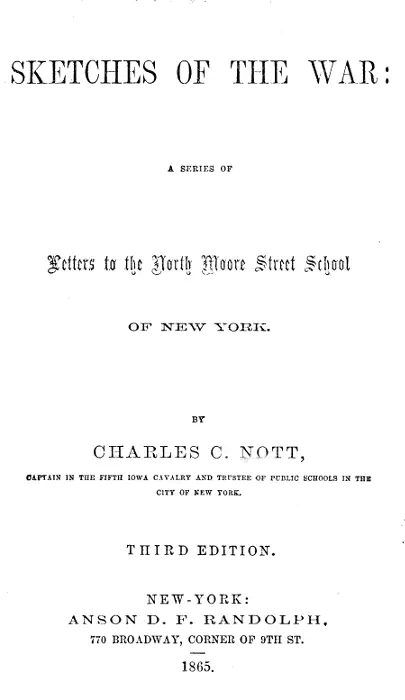
"Sketches of the War" by Charles C. Nott is a collection of letters recounting the author's experiences during the American Civil War, written in the mid-19th century. Nott, who served as a Captain in the Fifth Iowa Cavalry, shares vivid and personal reflections on military life, hardships, and the struggles faced by soldiers and civilians alike during this tumultuous time in American history. The opening of the work introduces a poignant narrative about a young soldier named Frank Gillham, who, after nursing his sick horse, succumbs to pneumonia in a hospital far from home. The sorrow of his lonely death and the struggles to inform his family highlight the human cost of war and the emotional toll it takes on those involved. As Nott visits the hospital, he describes both the grim atmosphere and the neglect faced by many soldiers, conveying a sense of loss and reflection on duty, sacrifice, and the burden of the war's legacy. This initial section sets the tone for a deeply humanistic treatment of the experiences of soldiers during the Civil War, emphasizing personal stories amid the broader historical context.
Introduction adapted from the source catalogue; source summaries may be automatically generated.
Free to read · English · 46,612 words · No account needed
MAKE TIME FOR A GOOD BOOK
On by default. Untick to stop anonymous reading totals. Each page counts after 10 seconds in view. How this works.
Anonymous counting is on unless you have switched it off.
On her arrival at Fort Henry, Gipsy was greatly disgusted with Tennessee. For the clear, prairie fields of Missouri, she found nothing but thick woods, steep hills and muddy roads--no chance for her to run races or frolic here. For a week, the rain has fallen steadily on Gipsy; her water-proof blanket has kept her dry; but she is knee deep in mud, and has not lain down for three nights. No wonder she puts her ears back, and tries to look sulky. But an order has come for me to go with half the squadron and search for forage. The saddle and bridle are brought from the tent, and Gipsy brightens up at the sight. The men are soon ready; the clouds break away; the sun comes out; Gipsy takes her place at the head of the column, and throws her heels joyously in the air, champing the bit and tossing the white foam over her jetty coat.
The road is but a bridle-path through woods. The path is narrow, and the men must ride "by file." Perhaps you do not know that "by file," means one behind the other; "by twos," two side by side; and "by fours," four side by side. The next formation is "by platoon," or a quarter of a company; and the next "by squadron," or an entire company. We emerge on a small farm, waste and desolate. Straggling soldiers have broken into the house, and scattered about what few effects the rebel owner left. It is the first deserted house I have seen, and the sight is rather sad. Our road leads us again into the woods, and then brings us into the valley of the Tennessee, and follows the windings of the river. We pass several farms, small and poorly cultivated, with rude timber houses, by which I mean houses of squared logs. The chimneys are always built entirely on the outside, and are generally of sticks and mud, instead of brinks and mortar. Occasionally we halt to ask questions. The people are not surly, but they do not smile. This is the worst part of Tennessee, and it is plain they have sons and brothers among the prisoners of Fort Donelson. But at one house the man comes eagerly forward and his face lights; his wife, too, comes out, and says she almost hopes to see some face she knows. They have lived long here, but the man is from Eastern Tennessee, and the woman from Northern Alabama--those two remnants of the South that hung to the Union till the last. He tells us that the country produces little besides pigs and corn. "It is pork and corn dodger," he says, "at breakfast, dinner and tea all the year round." I ask where they grind the corn, and he mentions a large mill now despoiled by its owner, who took himself off to Memphis, and a little mill some three miles distant, owned by the "Widow Williams." It is an object to have some corn meal, so I determine to visit the Widow Williams' mill. The road to the mill turns abruptly from the river, and goes up a brook. We pass a few houses, scattered at intervals in the woods. The road is so much better than the other, that the men ride "by twos;" and so it should be, for it is the road from Dover to Paris. We pass one or two houses, whose owners are suspiciously young widows; in other words, we suspect that their deceased husbands are fighting with the rebels. At last we come to the Widow Williams, whom we do not suspect; for she is a grey-haired matron, who has seen sorrow, and she sits on the rude piazza with a family around her. The girls look nervously at us, for we are the first troop of soldiers they have had halt. The widow rises as I ride up, and says, with a good deal of dignity, "Please to alight, gentlemen;" and I take her at her word, and order, "dismount." I ask her if she can grind us some meal, and she rises in our good opinion by saying, "Not to-day, this is Sunday." It is indeed; but very little like one to us; we had almost forgotten the day. I then buy a bushel of meal for my own men, and go down with the widow's eldest son, who is a lad of fifteen, to get the meal and view the mill--a tiny little affair, and two of the men, who are millers, laugh when they see it. On coming back to the house, I find a group of the men have made themselves quite agreeable. They have come from the city, and doubtless are more refined and polished than any men these country girls have seen before. The youngest is some ten years old, named Martha, and I ask her if she is not afraid of us Northern mercenaries. Martha says no! and laughs at the idea; but when I ask her if we have not been called all sorts of names, and if she has not been told that we would burn her mother's house down, and cut her head off, Martha blushes, and the older sisters look confused. It is evident that we have had a very bad name here, and that they are now ashamed to own it. But we have a long circuit to make; the meal is stowed away in the haversacks; Widow Williams invites us to call again, and assures us we shall be welcome; I pretend to arrest Martha, and carry her off as prisoner; at which she is a little frightened and the rest a good deal amused; and then "fall in," "mount," "march," and off we go.
Your reading position is saved on this browser. Take it to another device with a library code. Reading pages adapt to text, rather than matching a printed edition.
BEHIND THE BOOK
This eBook is for the use of anyone anywhere in the United States and most other parts of the world at no cost and with almost no restrictions whatsoever. You may copy it, give it away or re-use it under the terms of the Project Gutenberg License included with this eBook or online at www.gutenberg.org. If you are not located in the United States, you will have to check the laws of the country where you are located before using this eBook. Read the source licence.
The original source file, including credits and licence, is retained by this library. Request an original-format copy at no charge. Please include the book title and Project Gutenberg identifier #60629.
KEEP YOUR CURIOSITY GOING
Cécile Tormay

Moritz Busch
John L. Ransom
Frances Wright
Cécile Tormay

Mabel Potter Daggett