
Last letters from the living dead man
David Patterson (Spirit) Hatch
THE CLASSIC COLLECTION · 1826
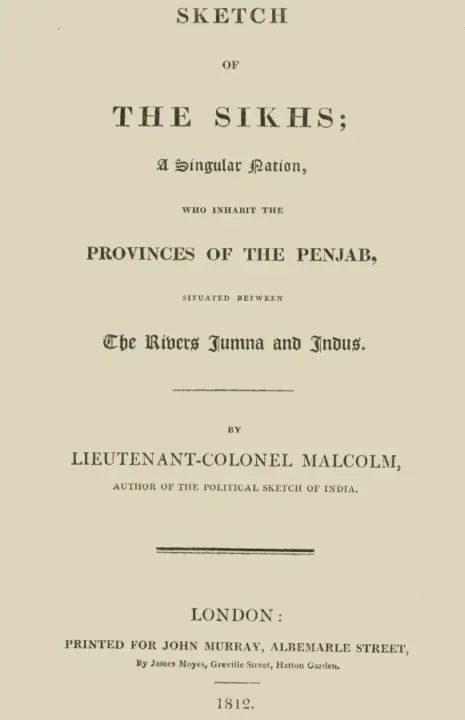
"Sketch of the Sikhs" by John Malcolm is a historical account written in the early 19th century. The work provides a concise narrative about the Sikhs, focusing on their unique religion, customs, and significant historical events as they relate to the British colonial context. Malcolm aims to shed light on this "singular nation," offering insights into a culture that was largely unfamiliar to European readers of his time. The opening of the book introduces Malcolm's motivations for writing, detailing his experiences and observations while stationed with the British army in Punjab. He discusses the challenges faced in gathering accurate information about the Sikh community, emphasizing the reliance on original Sikh sources to counteract misconceptions presented by both admirers and detractors. Notably, he begins the exploration of Sikh history with an account of Nánac, the founder of Sikhism, recounting his early life, spiritual inclinations, and establishing the basis for the Sikh faith while detailing his attempts to unify differing religious beliefs among the Hindus and Muslims. The beginning sets a foundation for a deeper understanding of the evolution of Sikhism and its significant figures.
Introduction adapted from the source catalogue; source summaries may be automatically generated.
Free to read · English · 34,654 words · No account needed
MAKE TIME FOR A GOOD BOOK
On by default. Untick to stop anonymous reading totals. Each page counts after 10 seconds in view. How this works.
Anonymous counting is on unless you have switched it off.
The contest carried on by Har Góvind against the Muhammedan chiefs in the Penjáb, though no doubt marked by that animosity which springs from a deep and implacable sense of injury on one part, and the insolence and violence of insulted power on the other, could not have been of great magnitude or importance, else it would have been more noticed by contemporary Muhammedan writers; but it was the first fruits of that desperate spirit of hostility, which was soon after to distinguish the wars between the followers of Nánac and those of Muhammed: and, from every account of Har Góvind's life, it appears to have been his anxious wish to inspire his followers with the most irreconcileable hatred of their oppressors.
It is stated, that this warlike[24] Gúrú, or priest militant, wore two swords in his girdle. Being asked why he did so: "The one," said he, "is to revenge the death of my father; the other, to destroy the miracles of Muhammed."
Har Góvind is reputed, by some authors, to have been the first who allowed his followers to eat[25] the flesh of all animals, with the exception of the cow: and it appears not improbable that he made this great change in their diet at the time when he effected a still more remarkable revolution in their habits, by converting a race of peaceable enthusiasts into an intrepid band of soldiers[26]. He had five sons, Bábú Gúrúdaitya, Saurat Singh, Tégh Bahádur, Anna Ráy, and Atal Ráy. The two last died without descendants. Saurat Singh and Tégh Singh, or Tégh Bahádur, were, by the cruel persecution of the Muhammedans, forced to fly into the mountains to the northward of the Penjáb. His eldest son, Gurudaítya, died early, but left two sons, Dáharmal and Har Ráy; the latter of whom succeeded his grandfather, who died in the year A. D. 1644, and of the Samvat 1701. It does not appear that Har Ráy enjoyed much temporal power, or that he entered into any hostilities with the Muhammedans: his rule was tranquil, and passed without any remarkable event; owing, probably, to the vigor which the Muhammedan power had attained in the early part of the reign of Aurungzéb. At his death, which happened in the year A. D. 1661, and of the Samvat 1718, a violent contest arose among the Sikhs, regarding the succession to the office of spiritual leader; for the temporal power of their ruler was, at this period, little more than nominal. The dispute between his sons, or, as some Sikh authors state, his son and grandson, Har Crishn and Rám Ráy, was referred to Dehli, whither both parties went; and, by an imperial decree of Aurungzéb, the Sikhs were allowed to elect their own priest. They chose Har Crishn, who died at Dehli in the year A. D. 1664, and of the Samvat 1721; and was succeeded by his uncle, Tégh Behádur. He, however, had to encounter the most violent opposition from his nephew, Rám Ráy[27], who remained at Dehli, and endeavoured, by every art and intrigue, to effect his ruin: he was seized, and brought to Dehli, in consequence of his nephew's misrepresentations; and, after being in prison for two years, was released at the intercession of Jayasingh, Rájá of Jayapúr, whom he accompanied to Bengal. Tégh Behádur afterwards took up his abode at the city of Patna[28]; but was pursued, agreeable to Sikh authors, to his retreat, with implacable rancour, by the jealousy and ambition of Rám Ráy; who at last accomplished the destruction of his rival. He was brought from Patna, and, by the accounts of the same authors, publicly put to death, without even the allegation of a crime, beyond a firm and undaunted assertion of the truth of that faith of which he was the high priest. This event is said to have taken place in the year A. D. 1675, and of the Samvat 1732: but the Sikh records of their own history, from the death of Har Góvind to that of Tégh Behádur, are contradictory and unsatisfactory, and appear to merit little attention. The fact is, that the sect was almost crushed, in consequence of their first effort to attain power, under Har Góvind; and, from the period of his death to that of Tégh Behádur, the Mogul empire was, as has been before stated, in the zenith of its power, under Aurungzéb: and the Sikhs, who had never attained any real strength, were rendered still weaker by their own internal dissensions. Their writers have endeavoured to supply this chasm in their history by a fabulous account of the numerous miracles which were wrought by their priests, Rám Ráy, Har Crishn, and even the unfortunate Tégh Behádur, at Delhi, all of whom are said to have astonished the emperor and his nobles, by a display of their supernatural powers: but their wide difference from each other, in these relations, would prove, if any proof was wanting, that all the annals of that period are fabricated.
Your reading position is saved on this browser. Take it to another device with a library code. Reading pages adapt to text, rather than matching a printed edition.
BEHIND THE BOOK
This eBook is for the use of anyone anywhere in the United States and most other parts of the world at no cost and with almost no restrictions whatsoever. You may copy it, give it away or re-use it under the terms of the Project Gutenberg License included with this eBook or online at www.gutenberg.org. If you are not located in the United States, you will have to check the laws of the country where you are located before using this eBook. Read the source licence.
The original source file, including credits and licence, is retained by this library. Request an original-format copy at no charge. Please include the book title and Project Gutenberg identifier #53510.
KEEP YOUR CURIOSITY GOING
David Patterson (Spirit) Hatch

David Patterson (Spirit) Hatch

David Patterson (Spirit) Hatch
Cécile Tormay

Moritz Busch
John L. Ransom