
Last letters from the living dead man
David Patterson (Spirit) Hatch
THE CLASSIC COLLECTION · 1826
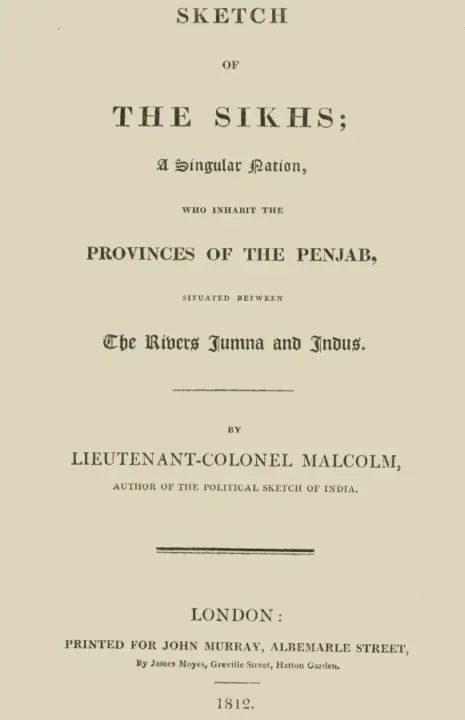
"Sketch of the Sikhs" by John Malcolm is a historical account written in the early 19th century. The work provides a concise narrative about the Sikhs, focusing on their unique religion, customs, and significant historical events as they relate to the British colonial context. Malcolm aims to shed light on this "singular nation," offering insights into a culture that was largely unfamiliar to European readers of his time. The opening of the book introduces Malcolm's motivations for writing, detailing his experiences and observations while stationed with the British army in Punjab. He discusses the challenges faced in gathering accurate information about the Sikh community, emphasizing the reliance on original Sikh sources to counteract misconceptions presented by both admirers and detractors. Notably, he begins the exploration of Sikh history with an account of Nánac, the founder of Sikhism, recounting his early life, spiritual inclinations, and establishing the basis for the Sikh faith while detailing his attempts to unify differing religious beliefs among the Hindus and Muslims. The beginning sets a foundation for a deeper understanding of the evolution of Sikhism and its significant figures.
Introduction adapted from the source catalogue; source summaries may be automatically generated.
Free to read · English · 34,654 words · No account needed
MAKE TIME FOR A GOOD BOOK
On by default. Untick to stop anonymous reading totals. Each page counts after 10 seconds in view. How this works.
Anonymous counting is on unless you have switched it off.
Printed by J. Moyes, Greville Street, London.
[96] This celebrated Súfi, or philosophical deist, lived in the time of the Emperor Shér Sháh. He was, by trade, a weaver; but has written several admired works. They are all composed in a strain of universal philanthropy and benevolence; and, above all, he inculcated religious toleration, particularly between the Muhammedans and Hindús, by both of whom his memory is held in the highest esteem and veneration.
[97] Nánac was celebrated for the manner in which he performed Tapasa, or austere devotion, which requires the mind to be so totally absorbed in the Divinity, as to be abstracted from every worldly thought, and this for as long a period as human strength is capable of sustaining.
[98] The most ancient Hindús do not appear to have paid adoration
to idols; but, though they adored God, they worshipped the sun and
elements.
[99] B'hai Gúrú Dás B'halé.
[100] Bráhmen, Cshatríya, Vaisya, and Súdra.
[101] Different sacred books of the Hindús.
[102] Yár signifies friend; and one of the prophet's titles, among his followers, is Yar-i-Khudá, or the Friend of God.
[103] The Muhammedan religion is said to be divided into seventy-two
sects.
[104] There is no ground to conclude that casts were altogether abolished by Nánac; though his doctrines and writings had a tendency to equalize the Hindús, and unite all in the worship of one God.
[105] A kind of ascetic devotion, which has been before explained.
[106] The Sidd'his (saints) are the attendants of the gods. The name is most generally applied to those who wait on Ganésa.
[107] The name Yatí is most usually applied to the priests of the Jainas; but it is also applicable to Sanyásís, and other penitents.
[108] Nánac appears on this, and every other occasion, to have preserved his attachment to this favourite dogma of the Hindús.
[109] This fact is admitted by Sikh authors. It is, however, probable, that Nánac was but imperfectly acquainted with the doctrines of that volume.
[110] A modified species of the Nágari character.
[111] Certainly no material alteration was made, either in the belief or forms of the Sikhs, by any of his successors before Gúrú Góvind. Har Góvind, who armed his followers to repel aggression, would only appear to have made a temporary effort to oppose his enemies, without an endeavour to effect any serious change in the religious belief or customs of the sect to which he belonged.
Your reading position is saved on this browser. Take it to another device with a library code. Reading pages adapt to text, rather than matching a printed edition.
BEHIND THE BOOK
This eBook is for the use of anyone anywhere in the United States and most other parts of the world at no cost and with almost no restrictions whatsoever. You may copy it, give it away or re-use it under the terms of the Project Gutenberg License included with this eBook or online at www.gutenberg.org. If you are not located in the United States, you will have to check the laws of the country where you are located before using this eBook. Read the source licence.
The original source file, including credits and licence, is retained by this library. Request an original-format copy at no charge. Please include the book title and Project Gutenberg identifier #53510.
KEEP YOUR CURIOSITY GOING
David Patterson (Spirit) Hatch

David Patterson (Spirit) Hatch

David Patterson (Spirit) Hatch
Cécile Tormay

Moritz Busch
John L. Ransom