
Last letters from the living dead man
David Patterson (Spirit) Hatch
THE CLASSIC COLLECTION · 1826
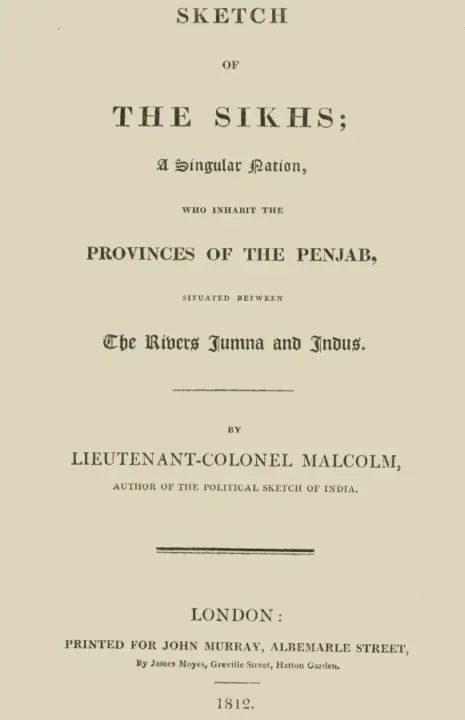
"Sketch of the Sikhs" by John Malcolm is a historical account written in the early 19th century. The work provides a concise narrative about the Sikhs, focusing on their unique religion, customs, and significant historical events as they relate to the British colonial context. Malcolm aims to shed light on this "singular nation," offering insights into a culture that was largely unfamiliar to European readers of his time. The opening of the book introduces Malcolm's motivations for writing, detailing his experiences and observations while stationed with the British army in Punjab. He discusses the challenges faced in gathering accurate information about the Sikh community, emphasizing the reliance on original Sikh sources to counteract misconceptions presented by both admirers and detractors. Notably, he begins the exploration of Sikh history with an account of Nánac, the founder of Sikhism, recounting his early life, spiritual inclinations, and establishing the basis for the Sikh faith while detailing his attempts to unify differing religious beliefs among the Hindus and Muslims. The beginning sets a foundation for a deeper understanding of the evolution of Sikhism and its significant figures.
Introduction adapted from the source catalogue; source summaries may be automatically generated.
Free to read · English · 34,654 words · No account needed
MAKE TIME FOR A GOOD BOOK
On by default. Untick to stop anonymous reading totals. Each page counts after 10 seconds in view. How this works.
Anonymous counting is on unless you have switched it off.
The above passages will convey an idea of that impression which Gúrú Góvind gave his followers of his divine mission. I shall shortly enumerate those alterations he made in the usages of the Sikhs, whom it was his object to render, through the means of religious enthusiasm, a warlike race.
Though Gúrú Góvind was brought up in the religion of Nánac, he appears, from having been educated among the Hindú priests of Mathura, to have been deeply tainted with their superstitious belief; and he was, perhaps, induced by considerations of policy, to lean still more strongly to their prejudices, in order to induce them to become converts to that religious military community, by means of which it was his object to destroy the Muhammedan power.
The principal of the religious institutions of Gúrú Góvind, is that of the Páhal,--the ceremony by which a convert is initiated into the tribe of Sikhs; or, more properly speaking, that of Singhs. The meaning of this institution is to make the convert a member of the Khálsa, or Sikh commonwealth, which he can only become by assenting to certain observances; the devoting himself to arms for the defence of the commonwealth, and the destruction of its enemies; the wearing his hair, and putting on a blue dress[112].
The mode in which Gúrú Góvind first initiated his converts, is described by a Sikh writer; and, as I believe it is nearly the same as that now observed, I shall shortly state it as he has described it. Gúrú Góvind, he says, after his arrival at Mák'haval, initiated five converts, and gave them instructions how to initiate others. The mode is as follows. The convert is told that he must allow his hair to grow. He must clothe himself from head to foot in blue clothes. He is then presented with the five weapons: a sword, a firelock, a bow and arrow, and a pike[113]. One of those who initiate him then says, "The Gúrú is thy holy teacher, and thou art his Sikh or disciple." Some sugar and water is put into a cup, and stirred round with a steel knife, or dagger, and some of the first chapters of the Adí-Grant'h, and the first chapters of the Dasama Pádsháh ká Grant'h, are read; and those who perform the initiation exclaim, Wá! Gúrúji ká Khálsa! Wá! Gúrúji kí Fateh! (Success to the state of the Gúrú! Victory attend the Gúrú!) After this exclamation has been repeated five times, they say, "This sherbet is nectar. It is the water of life; drink it." The disciple obeys; and some sherbet, prepared in a similar manner, is sprinkled over his head and beard. After these ceremonies, the disciple is asked if he consents to be of the faith of Gúrú Góvind. He answers, "I do consent." He is then told, "If you do, you must abandon all intercourse, and neither eat, drink, nor sit in company with men of five sects which I shall name. The first, the Mína D'hirmal; who, though of the race of Nánac, were tempted by avarice to give poison to Arjun; and, though they did not succeed, they ought to be expelled from society. The second are the Musandiá; a sect who call themselves Gúrús, or priests, and endeavour to introduce heterodox doctrines[114]. The third, Rám Ráyí, the descendants of Rám Ráy, whose intrigues were the great cause of the destruction of the holy ruler, Tégh Singh. The fourth are the Kud i-már, or destroyers[115] of their own daughters. Fifth, the Bhadaní, who shave the hair of their head and beards." The disciple, after this warning against intercourse with sectaries, or rather schismatics, is instructed in some general precepts, the observance of which regard the welfare of the community into which he has entered. He is told to be gentle and polite to all with whom he converses, to endeavour to attain wisdom, and to emulate the persuasive eloquence of Bábá Nánac. He is particularly enjoined, whenever he approaches any of the Sikh temples, to do it with reverence and respect, and to go to Amritsar, to pay his devotions to the Khálsa, or state; the interests of which he is directed, on all occasions, to consider paramount to his own. He is instructed to labour to increase the prosperity of the town of Amritsar; and told, that at every place of worship which he visits he will be conducted in the right path by the Gúrú (Gúrú Góvind). He is instructed to believe, that it is the duty of all those who belong to the Khálsa, or commonwealth of the Sikhs, neither to lament the sacrifice of property, nor of life, in support of each other; and he is directed to read the Adí-Grant'h and Dasama Pádsháh ká Grant'h, every morning and every evening. Whatever he has received from God, he is told it is his duty to share with others. And after the disciple has heard and understood all these and similar precepts, he is declared to be duly initiated.
Your reading position is saved on this browser. Take it to another device with a library code. Reading pages adapt to text, rather than matching a printed edition.
BEHIND THE BOOK
This eBook is for the use of anyone anywhere in the United States and most other parts of the world at no cost and with almost no restrictions whatsoever. You may copy it, give it away or re-use it under the terms of the Project Gutenberg License included with this eBook or online at www.gutenberg.org. If you are not located in the United States, you will have to check the laws of the country where you are located before using this eBook. Read the source licence.
The original source file, including credits and licence, is retained by this library. Request an original-format copy at no charge. Please include the book title and Project Gutenberg identifier #53510.
KEEP YOUR CURIOSITY GOING
David Patterson (Spirit) Hatch

David Patterson (Spirit) Hatch

David Patterson (Spirit) Hatch
Cécile Tormay

Moritz Busch
John L. Ransom