
Last letters from the living dead man
David Patterson (Spirit) Hatch
THE CLASSIC COLLECTION · 1826
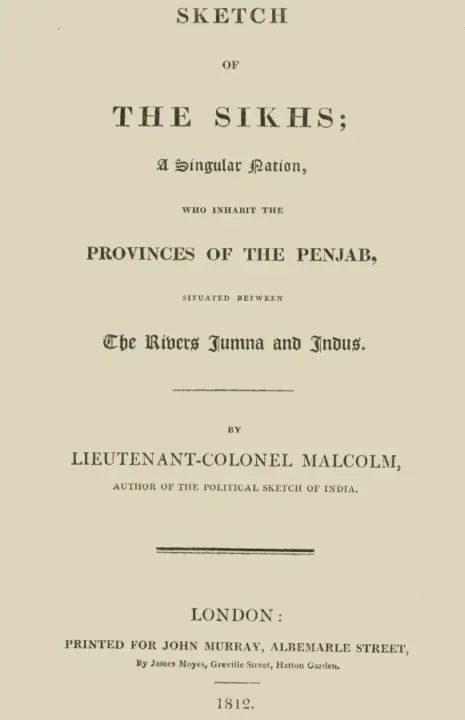
"Sketch of the Sikhs" by John Malcolm is a historical account written in the early 19th century. The work provides a concise narrative about the Sikhs, focusing on their unique religion, customs, and significant historical events as they relate to the British colonial context. Malcolm aims to shed light on this "singular nation," offering insights into a culture that was largely unfamiliar to European readers of his time. The opening of the book introduces Malcolm's motivations for writing, detailing his experiences and observations while stationed with the British army in Punjab. He discusses the challenges faced in gathering accurate information about the Sikh community, emphasizing the reliance on original Sikh sources to counteract misconceptions presented by both admirers and detractors. Notably, he begins the exploration of Sikh history with an account of Nánac, the founder of Sikhism, recounting his early life, spiritual inclinations, and establishing the basis for the Sikh faith while detailing his attempts to unify differing religious beliefs among the Hindus and Muslims. The beginning sets a foundation for a deeper understanding of the evolution of Sikhism and its significant figures.
Introduction adapted from the source catalogue; source summaries may be automatically generated.
Free to read · English · 34,654 words · No account needed
MAKE TIME FOR A GOOD BOOK
On by default. Untick to stop anonymous reading totals. Each page counts after 10 seconds in view. How this works.
Anonymous counting is on unless you have switched it off.
With the exact mode in which Nánac instructed his followers to address their prayers to that supreme Being whom he taught them to adore, I am not acquainted. Their D'herma Sála, or temples of worship, are, in general, plain buildings. Images are, of course, banished. Their prescribed forms of prayer are, I believe, few and simple. Part of the writings of Nánac, which have since been incorporated with those of his successors, in the Adí-Grant'h, are read, or rather recited, upon every solemn occasion. These are all in praise of the Deity, of religion, and of virtue; and against impiety and immorality. The Adí-Grant'h, the whole of the first part of which is ascribed to Nánac, is written, like the rest of the books of the Sikhs, in the Gúrúmuk'h[110] character. I can only judge very imperfectly of the value of this work: but some extracts, translated from it, appear worthy of that admiration which is bestowed upon it by the Sikhs.
The Adí-Grant'h is in verse; and many of the chapters, written by Nánac, are termed Pídi, which means, literally, a ladder or flight of steps; and, metaphorically, that by which a man ascends.
In the following fragment, literally translated from the Sódar rág ásá mahilla pehla of Nánac, he displays the supremacy of the true God, and the inferiority of the Dévatás, and other created beings, to the universal Creator; however they may have been elevated into deities by ignorance or superstition.
Thy portals, how wonderful they are, how wonderful thy palace, where thou sittest and governest all! Numberless and infinite are the sounds which proclaim thy praises. How numerous are thy Peris, skilful in music and song! Pavan (air), water, and Vasantar (fire), celebrate thee; D'herma Rájá (the Hindú Rhadamanthus) celebrates thy praises, at thy gates. Chitragupta (Secretary to D'herma Rájá) celebrates thy praises; who, skilful in writing, writes and administers final justice. Iswara, Brahmá, and Dévi, celebrate thy praises; they declare in fit terms thy majesty, at thy gates. Indra celebrates thy praises, sitting on the Indraic throne amid the Dévatás. The just celebrate thy praises in profound meditation, the pious declare thy glory. The Yatís and the Satís joyfully celebrate thy might. The Pandits, skilled in reading, and the Rishíswaras, who, age by age, read the Védas, recite thy praises. The Móhinís (celestial courtezans), heart alluring, inhabiting Swarga, Mritya, and Pátálá, celebrate thy praises. The Ratnas (gems), with the thirty-eight Tírt'has (sacred springs), celebrate thy praises. Heroes of great might celebrate thy name; beings of the four kinds of production celebrate thy praises. The continents, and regions of the world, celebrate thy praises; the universal Brahmánda (the mundane egg), which thou hast established firm. All who know thee praise thee, all who are desirous of thy worship. How numerous they are who praise thee! they exceed my comprehension: how, then, shall Nánac describe them? He, even he, is the Lord of truth, true, and truly just. He is, he was, he passes, he passes not, the preserver of all that is preserved. Of numerous hues, sorts and kinds, he is the original author of Máyá (deception). Having formed the creation, he surveys his own work, the display of his own greatness. What pleases him he does, and no order of any other being can reach him. He is the Pádsháh and the Pádsáheb of Sháhs; Nánac resides in his favour.
Your reading position is saved on this browser. Take it to another device with a library code. Reading pages adapt to text, rather than matching a printed edition.
BEHIND THE BOOK
This eBook is for the use of anyone anywhere in the United States and most other parts of the world at no cost and with almost no restrictions whatsoever. You may copy it, give it away or re-use it under the terms of the Project Gutenberg License included with this eBook or online at www.gutenberg.org. If you are not located in the United States, you will have to check the laws of the country where you are located before using this eBook. Read the source licence.
The original source file, including credits and licence, is retained by this library. Request an original-format copy at no charge. Please include the book title and Project Gutenberg identifier #53510.
KEEP YOUR CURIOSITY GOING
David Patterson (Spirit) Hatch

David Patterson (Spirit) Hatch

David Patterson (Spirit) Hatch
Cécile Tormay

Moritz Busch
John L. Ransom