
Last letters from the living dead man
David Patterson (Spirit) Hatch
THE CLASSIC COLLECTION · 1826
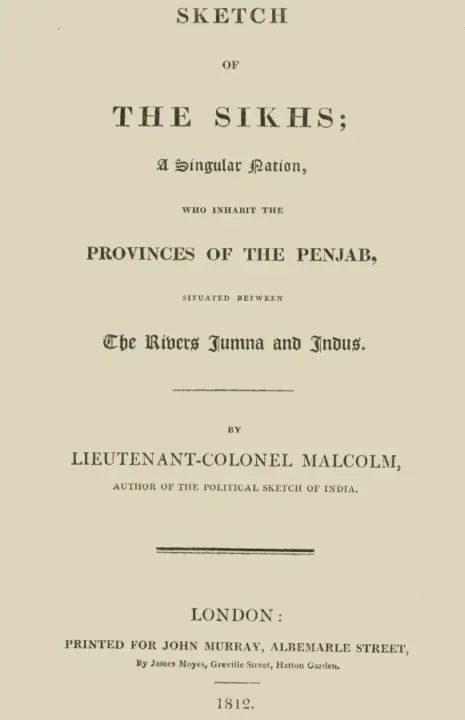
"Sketch of the Sikhs" by John Malcolm is a historical account written in the early 19th century. The work provides a concise narrative about the Sikhs, focusing on their unique religion, customs, and significant historical events as they relate to the British colonial context. Malcolm aims to shed light on this "singular nation," offering insights into a culture that was largely unfamiliar to European readers of his time. The opening of the book introduces Malcolm's motivations for writing, detailing his experiences and observations while stationed with the British army in Punjab. He discusses the challenges faced in gathering accurate information about the Sikh community, emphasizing the reliance on original Sikh sources to counteract misconceptions presented by both admirers and detractors. Notably, he begins the exploration of Sikh history with an account of Nánac, the founder of Sikhism, recounting his early life, spiritual inclinations, and establishing the basis for the Sikh faith while detailing his attempts to unify differing religious beliefs among the Hindus and Muslims. The beginning sets a foundation for a deeper understanding of the evolution of Sikhism and its significant figures.
Introduction adapted from the source catalogue; source summaries may be automatically generated.
Free to read · English · 34,654 words · No account needed
MAKE TIME FOR A GOOD BOOK
On by default. Untick to stop anonymous reading totals. Each page counts after 10 seconds in view. How this works.
Anonymous counting is on unless you have switched it off.
[74] Acálí, derived from Acál, a compound term of cál, death, and the Sanscrit privative a, which means never-dying, or immortal. It is one of the names of the Divinity; and has, probably, been given to this remarkable class of devotees, from their always exclaiming Acál! Acál! in their devotions.
[75] All Singhs do not wear bracelets; but it is indispensable to have steel about their persons, which they generally have in the shape of a knife or dagger. In support of this ordinance they quote the following verses of Gúrú Góvind:
Sáheb beá ki rach'ha hamné,
Tuhi Srí Sáheb, churi, káti, katár--
Acál purukh ki rach'ha hamné,
Serv lóh di rach'ha hamné,
Servacál di rach'ha hamné,
Serv lohji di sada rach'ha hamné.
which may be translated: "The protection of the infinite Lord is over us: thou art the lord, the cutlass, the knife, and the dagger. The protection of the immortal Being is over us: the protection of ALL-STEEL is over us: the protection of ALL-TIME is over us: the protection of ALL-STEEL is constantly over us."
[76] The Shahíd and Nirmala, two other religious tribes among the Sikhs, have Bungás, or places, upon the great reservoir of Amritsar; but both these are peaceful orders of priests, whose duty is to address the Deity, and to read and explain the Adí-Grant'h to the Sikhs. They are, in general, men of some education. A Sikh, of any tribe, may be admitted into either of these classes, as among the Acálís, who admit all into their body who choose to conform to their rules.
[77] A custom of a similar nature, with regard to all tribes eating promiscuously, is observed among the Hindús, at the temple of Jagannáth, where men of all religions and casts, without distinction, eat of the Mahá Prasád, the great offering; i.e. food dressed by the cooks of the idols, and sold on the stairs of the temple.
[78] The Sikh priest, who gave an account of this custom, was of a high Hindú tribe; and, retaining some of his prejudices, he at first said, that Muhammedan Sikhs, and those who were converts from the sweeper cast, were obliged, even on this occasion, to eat a little apart from the other Sikhs: but, on being closely questioned, he admitted the fact as stated in the narrative; saying, however, it was only on this solemn occasion that these tribes are admitted to eat with the others.
[79] The army is called, when thus assembled, the Dal Khálsá, or the
army of the state.
Your reading position is saved on this browser. Take it to another device with a library code. Reading pages adapt to text, rather than matching a printed edition.
BEHIND THE BOOK
This eBook is for the use of anyone anywhere in the United States and most other parts of the world at no cost and with almost no restrictions whatsoever. You may copy it, give it away or re-use it under the terms of the Project Gutenberg License included with this eBook or online at www.gutenberg.org. If you are not located in the United States, you will have to check the laws of the country where you are located before using this eBook. Read the source licence.
The original source file, including credits and licence, is retained by this library. Request an original-format copy at no charge. Please include the book title and Project Gutenberg identifier #53510.
KEEP YOUR CURIOSITY GOING
David Patterson (Spirit) Hatch

David Patterson (Spirit) Hatch

David Patterson (Spirit) Hatch
Cécile Tormay

Moritz Busch
John L. Ransom