
Last letters from the living dead man
David Patterson (Spirit) Hatch
THE CLASSIC COLLECTION · 1826
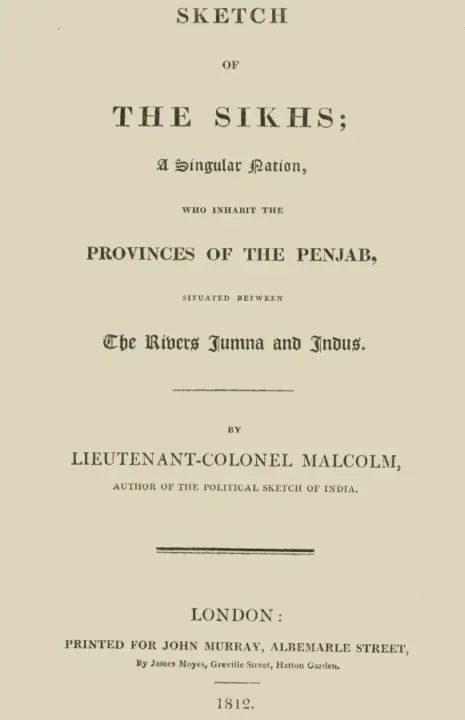
"Sketch of the Sikhs" by John Malcolm is a historical account written in the early 19th century. The work provides a concise narrative about the Sikhs, focusing on their unique religion, customs, and significant historical events as they relate to the British colonial context. Malcolm aims to shed light on this "singular nation," offering insights into a culture that was largely unfamiliar to European readers of his time. The opening of the book introduces Malcolm's motivations for writing, detailing his experiences and observations while stationed with the British army in Punjab. He discusses the challenges faced in gathering accurate information about the Sikh community, emphasizing the reliance on original Sikh sources to counteract misconceptions presented by both admirers and detractors. Notably, he begins the exploration of Sikh history with an account of Nánac, the founder of Sikhism, recounting his early life, spiritual inclinations, and establishing the basis for the Sikh faith while detailing his attempts to unify differing religious beliefs among the Hindus and Muslims. The beginning sets a foundation for a deeper understanding of the evolution of Sikhism and its significant figures.
Introduction adapted from the source catalogue; source summaries may be automatically generated.
Free to read · English · 34,654 words · No account needed
MAKE TIME FOR A GOOD BOOK
On by default. Untick to stop anonymous reading totals. Each page counts after 10 seconds in view. How this works.
Anonymous counting is on unless you have switched it off.
The internal state of Afghánistan, since the death of Ahmed Sháh, has prevented the progress of the Sikh nation receiving any serious check from that quarter; and the distracted and powerless condition of the empire of India has offered province after province to their usurpation. Their history, during this latter period, affords little but a relation of village warfare, and predatory incursions. Their hostilities were first directed against the numerous Muhammedan chiefs who were settled in the Penjáb, and who defended, as long as they could, their jágírs, or estates, against them: but these have either been conquered, or reduced to such narrow limits, as to owe their security to their insignificance, or the precarious friendship of some powerful Sikh chief, whose support they have gained; and who, by protecting them against the other leaders of his tribe, obtains a slight accession of strength and influence.
The Sikh nation, who have, throughout their early history, always appeared, like a suppressed flame, to rise into higher splendour from every attempt to crush them, had become, while they were oppressed, as formidable for their union, as for their determined courage and unconquerable spirit of resistance: but a state of persecution and distress was the one most favourable for the action of a constitution like theirs; which, formed upon general and abstract principles, required constant and great sacrifices of personal advantage to the public good; and such can alone be expected from men, acting under the influence of that enthusiasm, which the fervor of a new religion, or a struggle for independence, can alone impart, and which are ever most readily made, when it becomes obvious to all, that a complete union in the general cause is the only hope of individual safety.
The Sikhs would appear, from their own historians, to have attributed the conquests they made entirely to their valour, and to have altogether forgot that they owed them chiefly to the decline of the house of Taimúr, and the dissensions of the government of Cábul. Intoxicated with their success, they have given way to all those passions which assail the minds of men in the possession of power. The desire, which every petty chief entertained, of increasing his territories, of building strong forts, and adding to the numbers of his troops, involved them in internal wars; and these, however commenced, soon communicated to numbers, who engaged in the dispute as passion or interest dictated. Though such feuds have, no doubt, helped to maintain their military spirit, yet their extent and virulence have completely broken down that union, which their great legislator, Góvind, laboured to establish. Quarrels have been transmitted from father to son; and, in a country where the infant is devoted to steel, and taught to consider war as his only occupation, these could not but multiply in an extraordinary degree; and, independent of the comparative large conquests in which the greater chiefs occasionally engaged, every village[65] has become an object of dispute; and there are few, if any, in the Penjáb, the rule of which is not contested between brothers or near relations[66]. In such a state, it is obvious, the Sikhs could alone be formidable to the most weak and distracted governments. Such, indeed, was the character, till within a very late period, of all their neighbours; and they continued to plunder, with impunity, the upper provinces of Hindústan, until the establishment of the power of Daulet Ráo Sindíá, when the regular brigades, commanded by French officers in the service of that prince, not only checked their inroads, but made all the Sikh chiefs, to the southward of the Satléj, acknowledge obedience and pay tribute to Sindíá: and it was in the contemplation of General Perron, had the war with the English government not occurred, to have subdued the Penjáb, and made the Indus the limit of his possession: and every person acquainted with his means, and with the condition and resources of the Sikhs, must be satisfied he would have accomplished this project with great ease, and at a very early period.
Your reading position is saved on this browser. Take it to another device with a library code. Reading pages adapt to text, rather than matching a printed edition.
BEHIND THE BOOK
This eBook is for the use of anyone anywhere in the United States and most other parts of the world at no cost and with almost no restrictions whatsoever. You may copy it, give it away or re-use it under the terms of the Project Gutenberg License included with this eBook or online at www.gutenberg.org. If you are not located in the United States, you will have to check the laws of the country where you are located before using this eBook. Read the source licence.
The original source file, including credits and licence, is retained by this library. Request an original-format copy at no charge. Please include the book title and Project Gutenberg identifier #53510.
KEEP YOUR CURIOSITY GOING
David Patterson (Spirit) Hatch

David Patterson (Spirit) Hatch

David Patterson (Spirit) Hatch
Cécile Tormay

Moritz Busch
John L. Ransom