
Three girls and especially one
Marion Ames Taggart
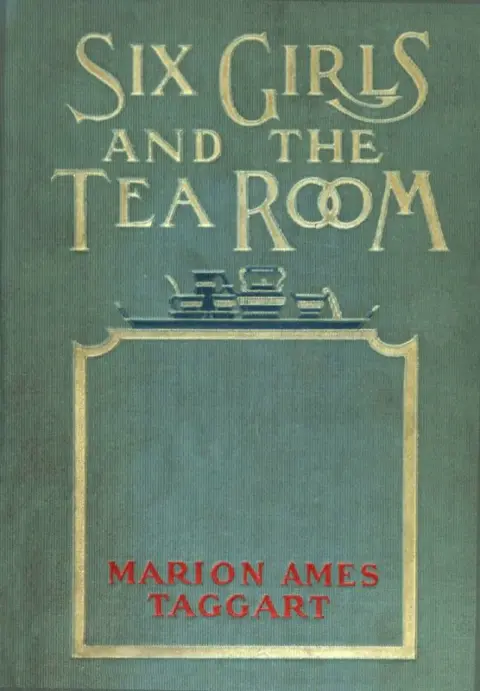
THE CLASSIC COLLECTION · 1907
"Six Girls and the Tea Room" by Marion Ames Taggart is a novel written in the early 20th century. This charming tale follows a group of six girls who embark on the adventure of creating a tea room to support their family. The story not only explores their entrepreneurial spirit but also delves into their friendships and the challenges they face, illustrating how love and togetherness can lead to happiness and success. The opening of the novel introduces the main characters welcomed back to their New York flat, affectionately nicknamed "the Patty-Pans." There is an air of excitement and nostalgia as they transition from life on a farm back to city living. The girls are particularly focused on setting up their tea room, fueled by their desire to make it a success while also hoping it will bring them closer together. As they prepare for this new venture, we see glimpses of their personalities through playful banter and heartfelt moments, establishing a warm and inviting atmosphere that hints at the joys and challenges ahead in their journey.
Introduction adapted from the source catalogue; source summaries may be automatically generated.
Free to read · English · 74,396 words · No account needed
MAKE TIME FOR A GOOD BOOK
On by default. Untick to stop anonymous reading totals. Each page counts after 10 seconds in view. How this works.
Anonymous counting is on unless you have switched it off.
"Ah, yes, we know that!" cried Happie. "But as well as we know it now, Margery and I often say we shall appreciate it better when we are older and see more of the unpleasant side of life, at which we only peep while we are young."
"Truer than you guess!" agreed Miss Keren briefly. "Now, Happie, listen to a story, a true story about one Keren-happuch, with a second Keren-happuch coming into the tale at the end. I am going to tell it to you because of what happened this afternoon. It will satisfy you forever as to my reasons for doing what I intend to do. Don't interrupt me. For the first time in my life it tires me to talk, and it spoils a story to interrupt it. Nearly fifty years ago the first of the two Keren-happuchs was young, a girl of definite opinions, considerable will, of few and strong attachments; the kind of girl that can be superlatively happy or altogether miserable, and who is likely to make a bad matter of her life if things go contrary with her. This girl had a friend, the most beautiful, best girl that the sun ever shone upon, with every grace of mind and character, and with the crowning grace of all,--entire unselfishness and unconsciousness of self. Her name was Elizabeth Vaughan, and she was your grandmother. One hears a good deal said of men's friendships and how no women are capable of equal love for each other, but I am certain David and Jonathan were not more truly devoted than were these two girls of a half century ago. Keren-happuch worshiped Elizabeth, and the tie was peculiarly tender on both sides. There came into Keren-happuch's life a new interest after a while. It was when Elizabeth was away, and there was nothing to divert this girl of natural strength of feeling from going with all her might with the tide that seemed to her the flood-tide of happiness. Of course you can guess what the new interest was, for the girls were not quite twenty, and romance loves the second decade. It looked as though this foolish Keren-happuch were going to sail into the port of bliss, but Elizabeth came home. And then--why, no one could remember Keren-happuch when Elizabeth was about, and Keren awoke from her dream to find it not hers, but Elizabeth's. It is good to know that Keren-happuch loved her friend no less that the love she had hoped was her own had turned to Elizabeth. Keren-happuch had common sense, I am glad to say, and she saw that only a blind man could have preferred herself. So she wept her little tear in private, as she hoped, but Elizabeth saw its stain, and she tried to turn back to Keren-happuch the love she had innocently diverted. That part of the story does not matter. Each girl tried to bring about the happiness of the other, but Elizabeth could not give to another what belonged to herself and she married Roland Spencer. Keren-happuch rejoiced in their happiness, because she loved them both best of all the world, yet--well, one can rejoice through a heartache, Happie, and it is a matter for gratitude when heartache takes the form which allows such rejoicing. The best of this story is that there was no break in the triangle of an affection beyond ordinary human attachment. No change came to it through the marriage of Elizabeth and the man she loved and who loved her, and whom Keren-happuch loved but who did not love Keren-happuch, not in that sense of the word love. To the end Elizabeth Spencer and her husband were the solitary Keren-happuch's loyal friends. But Keren-happuch knew at the beginning as well as she knows to-day that she was to be the solitary Keren-happuch all her life. She never cared for life in just the same, glad, youthful way again, and she saw clearly that her happiness must be found in peace, and in conferring happiness, if she were able. So she grew into the crotchety, eccentric maiden lady whom you know, and it has been her whim to live much within her means in order to afford the luxury of giving what, after all, she did not need. By and by Elizabeth and her husband both died. Keren-happuch likes to believe that they know how faithfully she loves them still, and that in their daughter Charlotte and their grandchildren, the little Scollards, she recognizes her nearest of kin--indeed her only kin, for she has never been kin to her kindred. So you see, Happie, why you are more than merely my namesake. You are the legacy to me of my more than sister, and the man I loved, and whom she married. I am a rich woman, my dear. By and by, when I cannot use my money any longer I shall give it to you to use it for me, feeling sure that you will do with it as I would have done. For you are my heir; my child by the tie of my lifelong loneliness and by your blood. I have told you this to prove to you how ridiculous it is for my nieces to fancy that anything could divert me from my intention in regard to you, and to satisfy you that whatever I do for you, or for your mother or the other children, is done as if you were my own children.
Your reading position is saved on this browser. Take it to another device with a library code. Reading pages adapt to text, rather than matching a printed edition.
Marion Ames Taggart

Marion Ames Taggart

Marion Ames Taggart & Karl May
Marion Ames Taggart
BEHIND THE BOOK
This eBook is for the use of anyone anywhere in the United States and most other parts of the world at no cost and with almost no restrictions whatsoever. You may copy it, give it away or re-use it under the terms of the Project Gutenberg License included with this eBook or online at www.gutenberg.org. If you are not located in the United States, you will have to check the laws of the country where you are located before using this eBook. Read the source licence.
The original source file, including credits and licence, is retained by this library. Request an original-format copy at no charge. Please include the book title and Project Gutenberg identifier #48389.
KEEP YOUR CURIOSITY GOING
Coulson Kernahan

Maurice Baring
Frances Wright
Cécile Tormay

Frederic Jesup Stimson

W. H. P. (William Henry Pope) Jarvis