THE CLASSIC COLLECTION✦Selected Poems of Francis ThompsonCLASSIC FREE BOOKS
Selected Poems of Francis Thompson
Francis Thompson
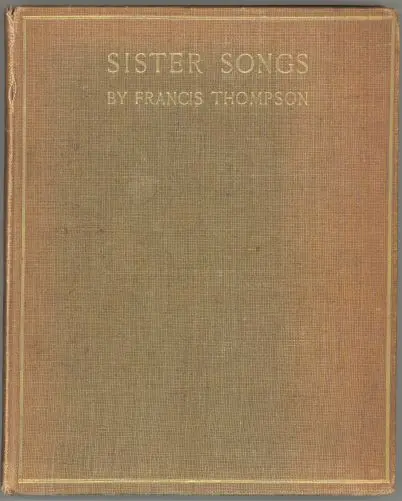
THE CLASSIC COLLECTION · 1895
"Sister Songs: An Offering to Two Sisters" by Francis Thompson is a poetic collection written during the late 19th century, likely around the Victorian era. This book is a unique offering that celebrates the bond of sisterhood and the beauty of nature, exploring themes of love, innocence, and the transcendent qualities of spring. The poem unfolds in various parts, each adorned with vivid imagery and rich metaphors symbolizing the connection between the speaker and the two sisters, Monica and Madeline Meynell, to whom the work is dedicated. Through the personification of nature, particularly in the guise of the goddess Spring, Thompson expresses admiration, longing, and a deep emotional resonance with the purity and innocence of childhood. The verses blend romantic idealism with a gentle nostalgia, culminating in a heartfelt tribute to the sisters that intertwines their existence with the cycle of nature, enchanting readers with its lyrical beauty while capturing the essence of familial love and companionship.
Introduction adapted from the source catalogue; source summaries may be automatically generated.
Free to read · English · 8,498 words · No account needed
MAKE TIME FOR A GOOD BOOK
On by default. Untick to stop anonymous reading totals. Each page counts after 10 seconds in view. How this works.
Anonymous counting is on unless you have switched it off.
Yet hear how my excuses may prevail,
Nor, tender white orb, be thou opposite!
Life and life’s beauty only hold their revels
In the abysmal ocean’s luminous levels.
There, like the phantasms of a poet pale,
The exquisite marvels sail:
Clarified silver; greens and azures frail
As if the colours sighed themselves away,
And blent in supersubtile interplay
As if they swooned into each other’s arms;
Repured vermilion,
Like ear-tips ’gainst the sun;
And beings that, under night’s swart pinion,
Make every wave upon the harbour-bars
A beaten yolk of stars.
But where day’s glance turns baffled from the deeps,
Die out those lovely swarms;
And in the immense profound no creature glides or creeps.
Love and love’s beauty only hold their revels
In life’s familiar, penetrable levels:
What of its ocean-floor?
I dwell there evermore.
From almost earliest youth
I raised the lids o’ the truth,
And forced her bend on me her shrinking sight;
Ever I knew me Beauty’s eremite,
In antre of this lowly body set.
Girt with a thirsty solitude of soul.
Nathless I not forget
How I have, even as the anchorite,
I too, imperishing essences that console.
Under my ruined passions, fallen and sere,
The wild dreams stir like little radiant girls,
Whom in the moulted plumage of the year
Their comrades sweet have buried to the curls.
Yet, though their dedicated amorist,
How often do I bid my visions hist,
Deaf to them, pleading all their piteous fills;
Who weep, as weep the maidens of the mist
Clinging the necks of the unheeding hills:
And their tears wash them lovelier than before,
That from grief’s self our sad delight grows more,
Fair are the soul’s uncrispèd calms, indeed,
Endiapered with many a spiritual form
Of blosmy-tinctured weed;
But scarce itself is conscious of the store
Suckled by it, and only after storm
Casts up its loosened thoughts upon the shore.
To this end my deeps are stirred;
And I deem well why life unshared
Was ordainèd me of yore.
In pairing-time, we know, the bird
Kindles to its deepmost splendour,
And the tender
Voice is tenderest in its throat;
Were its love, for ever nigh it,
Never by it,
It might keep a vernal note,
The crocean and amethystine
In their pristine
Lustre linger on its coat.
Therefore must my song-bower lone be,
That my tone be
Fresh with dewy pain alway;
She, who scorns my dearest care ta’en,
An uncertain
Shadow of the sprite of May.
And is my song sweet, as they say?
’Tis sweet for one whose voice has no reply,
Save silence’s sad cry:
And are its plumes a burning bright array?
They burn for an unincarnated eye
A bubble, charioteered by the inward breath
Which, ardorous for its own invisible lure,
Urges me glittering to aërial death,
I am rapt towards that bodiless paramour;
Blindly the uncomprehended tyranny
Obeying of my heart’s impetuous might.
The earth and all its planetary kin,
Starry buds tangled in the whirling hair
That flames round the Phoebean wassailer,
Speed no more ignorant, more predestined flight,
Than I, her viewless tresses netted in.
As some most beautiful one, with lovely taunting,
Her eyes of guileless guile o’ercanopies,
Does her hid visage bow,
And miserly your covetous gaze allow,
By inchmeal, coy degrees,
Saying—“Can you see me now?”
Yet from the mouth’s reflex you guess the wanting
Smile of the coming eyes
In all their upturned grievous witcheries,
Before that sunbreak rise;
And each still hidden feature view within
Your mind, as eager scrutinies detail
The moon’s young rondure through the shamefast veil
Drawn to her gleaming chin:
After this wise,
From the enticing smile of earth and skies
I dream my unknown Fair’s refusèd gaze;
And guessingly her love’s close traits devise,
Which she with subtile coquetries
Through little human glimpses slow displays,
Cozening my mateless days
By sick, intolerable delays.
And so I keep mine uncompanioned ways;
And so my touch, to golden poesies
Turning love’s bread, is bought at hunger’s price.
So,—in the inextinguishable wars
Which roll song’s Orient on the sullen night
Whose ragged banners in their own despite
Take on the tinges of the hated light,—
So Sultan Phoebus has his Janizars.
But if mine unappeasèd cicatrices
Might get them lawful ease;
Were any gentle passion hallowed me,
Who must none other breath of passion feel
Save such as winnows to the fledgèd heel
The tremulous Paradisal plumages;
The conscious sacramental trees
Which ever be
Shaken celestially,
Consentient with enamoured wings, might know my love for thee.
Yet is there more, whereat none guesseth, love!
Upon the ending of my deadly night
(Whereof thou hast not the surmise, and slight
Is all that any mortal knows thereof),
Thou wert to me that earnest of day’s light,
When, like the back of a gold-mailèd saurian
Heaving its slow length from Nilotic slime,
The first long gleaming fissure runs Aurorian
Athwart the yet dun firmament of prime.
Stretched on the margin of the cruel sea
Whence they had rescued me,
With faint and painful pulses was I lying;
Not yet discerning well
If I had ’scaped, or were an icicle,
Whose thawing is its dying.
Like one who sweats before a despot’s gate,
Summoned by some presaging scroll of fate,
And knows not whether kiss or dagger wait;
And all so sickened is his countenance,
The courtiers buzz, “Lo, doomed!” and look at him askance:—
At Fate’s dread portal then
Even so stood I, I ken,
Even so stood I, between a joy and fear,
And said to mine own heart, “Now if the end be here!”
Your reading position is saved on this browser. Take it to another device with a library code. Reading pages adapt to text, rather than matching a printed edition.
Francis Thompson
Francis Thompson
Francis Thompson
Francis Thompson
BEHIND THE BOOK
This eBook is for the use of anyone anywhere in the United States and most other parts of the world at no cost and with almost no restrictions whatsoever. You may copy it, give it away or re-use it under the terms of the Project Gutenberg License included with this eBook or online at www.gutenberg.org. If you are not located in the United States, you will have to check the laws of the country where you are located before using this eBook. Read the source licence.
The original source file, including credits and licence, is retained by this library. Request an original-format copy at no charge. Please include the book title and Project Gutenberg identifier #1731.
KEEP YOUR CURIOSITY GOING

Eric Mackay
Edmund Gosse
Sophia Margaretta Hensley
Gilbert Parker
George MacDonald

Elizabeth Bibesco