THE CLASSIC COLLECTION✦Selected Poems of Francis ThompsonCLASSIC FREE BOOKS
Selected Poems of Francis Thompson
Francis Thompson
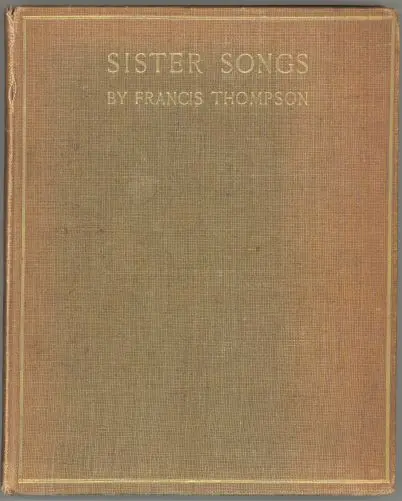
THE CLASSIC COLLECTION · 1895
"Sister Songs: An Offering to Two Sisters" by Francis Thompson is a poetic collection written during the late 19th century, likely around the Victorian era. This book is a unique offering that celebrates the bond of sisterhood and the beauty of nature, exploring themes of love, innocence, and the transcendent qualities of spring. The poem unfolds in various parts, each adorned with vivid imagery and rich metaphors symbolizing the connection between the speaker and the two sisters, Monica and Madeline Meynell, to whom the work is dedicated. Through the personification of nature, particularly in the guise of the goddess Spring, Thompson expresses admiration, longing, and a deep emotional resonance with the purity and innocence of childhood. The verses blend romantic idealism with a gentle nostalgia, culminating in a heartfelt tribute to the sisters that intertwines their existence with the cycle of nature, enchanting readers with its lyrical beauty while capturing the essence of familial love and companionship.
Introduction adapted from the source catalogue; source summaries may be automatically generated.
Free to read · English · 8,498 words · No account needed
MAKE TIME FOR A GOOD BOOK
On by default. Untick to stop anonymous reading totals. Each page counts after 10 seconds in view. How this works.
Anonymous counting is on unless you have switched it off.
Thou canst foreshape thy word;
The poet is not lord
Of the next syllable may come
With the returning pendulum;
And what he plans to-day in song,
To-morrow sings it in another tongue.
Where the last leaf fell from his bough,
He knows not if a leaf shall grow,
Where he sows he doth not reap,
He reapeth where he did not sow;
He sleeps, and dreams forsake his sleep
To meet him on his waking way.
Vision will mate him not by law and vow:
Disguised in life’s most hodden-grey,
By the most beaten road of everyday
She waits him, unsuspected and unknown.
The hardest pang whereon
He lays his mutinous head may be a Jacob’s stone.
In the most iron crag his foot can tread
A Dream may strew her bed,
And suddenly his limbs entwine,
And draw him down through rock as sea-nymphs might through brine.
But, unlike those feigned temptress-ladies who
In guerdon of a night the lover slew,
When the embrace has failed, the rapture fled,
Not he, not he, the wild sweet witch is dead!
And, though he cherisheth
The babe most strangely born from out her death,
Some tender trick of her it hath, maybe,—
It is not she!
Yet, even as the air is rumorous of fray
Before the first shafts of the sun’s onslaught
From gloom’s black harness splinter,
And Summer move on Winter
With the trumpet of the March, and the pennon of the May;
As gesture outstrips thought;
So, haply, toyer with ethereal strings!
Are thy blind repetitions of high things
The murmurous gnats whose aimless hoverings
Reveal song’s summer in the air;
The outstretched hand, which cannot thought declare,
Yet is thought’s harbinger.
These strains the way for thine own strains prepare;
We feel the music moist upon this breeze,
And hope the congregating poesies.
Sundered yet by thee from us
Wait, with wild eyes luminous,
All thy wingèd things that are to be;
They flit against thee, Gate of Ivory!
They clamour on the portress Destiny,—
“Set her wide, so we may issue through!
Our vans are quick for that they have to do!”
Suffer still your young desire;
Your plumes but bicker at the tips with fire,
Tarry their kindling; they will beat the higher.
And thou, bright girl, not long shalt thou repeat
Idly the music from thy mother caught;
Not vainly has she wrought,
Not vainly from the cloudward-jetting turret
Of her aërial mind, for thy weak feet,
Let down the silken ladder of her thought.
She bare thee with a double pain,
Of the body and the spirit;
Thou thy fleshly weeds hast ta’en,
Thy diviner weeds inherit!
The precious streams which through thy young lips roll
Shall leave their lovely delta in thy soul:
Where sprites of so essential kind
Set their paces,
Surely they shall leave behind
The green traces
Of their sportance in the mind,
And thou shalt, ere we well may know it,
Turn that daintiness, a poet,—
Elfin-ring
Where sweet fancies foot and sing.
So it may be, so it shall be,—
Oh, take the prophecy from me!
What if the old fastidious sculptor, Time,
This crescent marvel of his hands
Carveth all too painfully,
And I who prophesy shall never see?
What if the niche of its predestined rhyme,
Its aching niche, too long expectant stands?
Yet shall he after sore delays
On some exultant day of days
The white enshrouding childhood raise
From thy fair spirit, finished for our gaze;
While we (but ’mongst that happy “we”
The prophet cannot be!)
While we behold with no astonishments,
With that serene fulfilment of delight
Wherewith we view the sight
When the stars pitch the golden tents
Of their high campment on the plains of night.
Why should amazement be our satellite?
What wonder in such things?
If angels have hereditary wings,
If not by Salic law is handed down
The poet’s crown,
To thee, born in the purple of the throne,
The laurel must belong:
Thou, in thy mother’s right
Descendant of Castalian-chrismed kings—
O Princess of the Blood of Song!
Your reading position is saved on this browser. Take it to another device with a library code. Reading pages adapt to text, rather than matching a printed edition.
Francis Thompson
Francis Thompson
Francis Thompson
Francis Thompson
BEHIND THE BOOK
This eBook is for the use of anyone anywhere in the United States and most other parts of the world at no cost and with almost no restrictions whatsoever. You may copy it, give it away or re-use it under the terms of the Project Gutenberg License included with this eBook or online at www.gutenberg.org. If you are not located in the United States, you will have to check the laws of the country where you are located before using this eBook. Read the source licence.
The original source file, including credits and licence, is retained by this library. Request an original-format copy at no charge. Please include the book title and Project Gutenberg identifier #1731.
KEEP YOUR CURIOSITY GOING

Eric Mackay
Edmund Gosse
Sophia Margaretta Hensley
Gilbert Parker
George MacDonald

Elizabeth Bibesco