THE CLASSIC COLLECTION✦An American tragedy, v. 2CLASSIC FREE BOOKS
An American tragedy, v. 2
Theodore Dreiser
THE CLASSIC COLLECTION · 1900
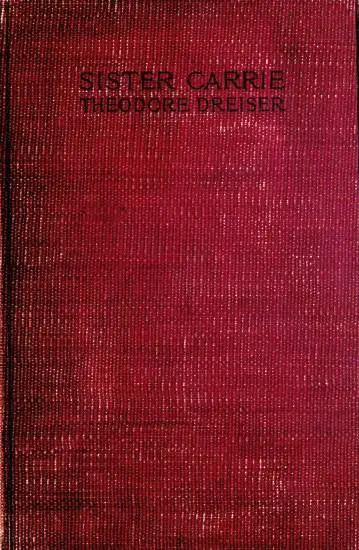
"Sister Carrie" by Theodore Dreiser is a novel published in 1900 about a young woman who leaves rural Wisconsin for Chicago in pursuit of the American Dream. Eighteen-year-old Caroline Meeber becomes entangled with two men—a charming salesman and a married bar manager—as she navigates the harsh realities of urban life. Through chance and ambition, she discovers her talent for acting and begins her ascent to stardom, while those around her face dramatically different fates in the unforgiving big city.
Introduction adapted from the source catalogue; source summaries may be automatically generated.
Free to read · English · 156,350 words · No account needed
MAKE TIME FOR A GOOD BOOK
On by default. Untick to stop anonymous reading totals. Each page counts after 10 seconds in view. How this works.
Anonymous counting is on unless you have switched it off.
"They've got that Martha Griswold in it again. She thinks she can act."
"Her family doesn't amount to anything, does it?" said Mrs. Hurstwood sympathetically. "They haven't anything, have they?"
"No," returned Jessica, "they're poor as church mice."
She distinguished very carefully between the young boys of the school, many of whom were attracted by her beauty.
"What do you think?" she remarked to her mother one evening; "that Herbert Crane tried to make friends with me."
"Who is he, my dear?" inquired Mrs. Hurstwood.
"Oh, no one," said Jessica, pursing her pretty lips. "He's just a student there. He hasn't anything."
The other half of this picture came when young Blyford, son of Blyford, the soap manufacturer, walked home with her. Mrs. Hurstwood was on the third floor, sitting in a rocking-chair reading, and happened to look out at the time.
"Who was that with you, Jessica?" she inquired, as Jessica came
upstairs.
"It's Mr. Blyford, mamma," she replied.
"Is it?" said Mrs. Hurstwood.
"Yes, and he wants me to stroll over into the park with him," explained Jessica, a little flushed with running up the stairs.
"All right, my dear," said Mrs. Hurstwood. "Don't be gone long."
As the two went down the street, she glanced interestedly out of the window. It was a most satisfactory spectacle indeed, most satisfactory.
In this atmosphere Hurstwood had moved for a number of years, not thinking deeply concerning it. His was not the order of nature to trouble for something better, unless the better was immediately and sharply contrasted. As it was, he received and gave, irritated sometimes by the little displays of selfish indifference, pleased at times by some show of finery which supposedly made for dignity and social distinction. The life of the resort which he managed was his life. There he spent most of his time. When he went home evenings the house looked nice. With rare exceptions the meals were acceptable, being the kind that an ordinary servant can arrange. In part, he was interested in the talk of his son and daughter, who always looked well. The vanity of Mrs. Hurstwood caused her to keep her person rather showily arrayed, but to Hurstwood this was much better than plainness. There was no love lost between them. There was no great feeling of dissatisfaction. Her opinion on any subject was not startling. They did not talk enough together to come to the argument of any one point. In the accepted and popular phrase, she had her ideas and he had his. Once in a while he would meet a woman whose youth, sprightliness, and humour would make his wife seem rather deficient by contrast, but the temporary dissatisfaction which such an encounter might arouse would be counterbalanced by his social position and a certain matter of policy. He could not complicate his home life, because it might affect his relations with his employers. They wanted no scandals. A man, to hold his position, must have a dignified manner, a clean record, a respectable home anchorage. Therefore he was circumspect in all he did, and whenever he appeared in the public ways in the afternoon, or on Sunday, it was with his wife, and sometimes his children. He would visit the local resorts, or those near by in Wisconsin, and spend a few stiff, polished days strolling about conventional places doing conventional things. He knew the need of it.
Your reading position is saved on this browser. Take it to another device with a library code. Reading pages adapt to text, rather than matching a printed edition.
Theodore Dreiser
Theodore Dreiser
Theodore Dreiser
Theodore Dreiser
BEHIND THE BOOK
This eBook is for the use of anyone anywhere in the United States and most other parts of the world at no cost and with almost no restrictions whatsoever. You may copy it, give it away or re-use it under the terms of the Project Gutenberg License included with this eBook or online at www.gutenberg.org. If you are not located in the United States, you will have to check the laws of the country where you are located before using this eBook. Read the source licence.
The original source file, including credits and licence, is retained by this library. Request an original-format copy at no charge. Please include the book title and Project Gutenberg identifier #5267.
KEEP YOUR CURIOSITY GOING
Coulson Kernahan

Maurice Baring
Frances Wright
Cécile Tormay

Frederic Jesup Stimson

W. H. P. (William Henry Pope) Jarvis