THE CLASSIC COLLECTION✦An American tragedy, v. 2CLASSIC FREE BOOKS
An American tragedy, v. 2
Theodore Dreiser
THE CLASSIC COLLECTION · 1900
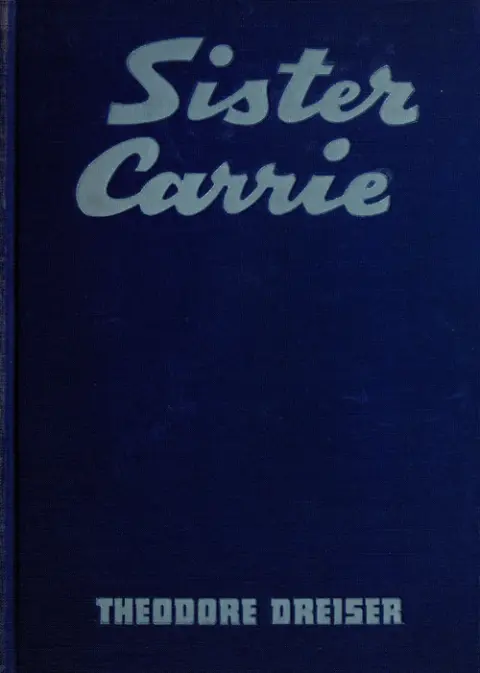
"Sister Carrie: A Novel" by Theodore Dreiser is a novel published in 1900. It follows eighteen-year-old Caroline Meeber, who leaves small-town Wisconsin for Chicago seeking a better life. In the big city, she becomes involved with two men—a charming salesman and a married bar manager—while discovering her talent for acting. As Carrie rises toward fame and fortune, those around her face vastly different fates. The novel explores ambition, desire, and the pursuit of the American Dream in urban America.
Introduction adapted from the source catalogue; source summaries may be automatically generated.
Free to read · English · 159,686 words · No account needed
MAKE TIME FOR A GOOD BOOK
On by default. Untick to stop anonymous reading totals. Each page counts after 10 seconds in view. How this works.
Anonymous counting is on unless you have switched it off.
“Well, she’s got more gumption than any one I’ve seen here so far—seems to take an interest in what she’s doing.”
“Pretty, too, isn’t she?” said Quincel.
The director strolled away without answering.
In the second scene, where she was supposed to face the company in the ball-room, she did even better, winning the smile of the director, who volunteered, because of her fascination for him, to come over and speak with her.
“Were you ever on the stage?” he asked insinuatingly.
“No,” said Carrie.
“You do so well, I thought you might have had some experience.”
Carrie only smiled consciously.
He walked away to listen to Bamberger, who was feebly spouting some
ardent line.
Mrs. Morgan saw the drift of things and gleamed at Carrie with envious
and snapping black eyes.
“She’s some cheap professional,” she gave herself the satisfaction of thinking, and scorned and hated her accordingly.
The rehearsal ended for one day, and Carrie went home feeling that she had acquitted herself satisfactorily. The words of the director were ringing in her ears, and she longed for an opportunity to tell Hurstwood. She wanted him to know just how well she was doing. Drouet, too, was an object for her confidences. She could hardly wait until he should ask her, and yet she did not have the vanity to bring it up. The drummer, however, had another line of thought to-night, and her little experience did not appeal to him as important. He let the conversation drop, save for what she chose to recite without solicitation, and Carrie was not good at that. He took it for granted that she was doing very well and he was relieved of further worry. Consequently he threw Carrie into repression, which was irritating. She felt his indifference keenly and longed to see Hurstwood. It was as if he were now the only friend she had on earth. The next morning Drouet was interested again, but the damage had been done.
She got a pretty letter from the manager, saying that by the time she got it he would be waiting for her in the park. When she came, he shone upon her as the morning sun.
“Well, my dear,” he asked, “how did you come out?”
“Well enough,” she said, still somewhat reduced after Drouet.
“Now, tell me just what you did. Was it pleasant?”
Carrie related the incidents of the rehearsal, warming up as she
proceeded.
“Well, that’s delightful,” said Hurstwood. “I’m so glad. I must get over there to see you. When is the next rehearsal?”
“Tuesday,” said Carrie, “but they don’t allow visitors.”
Your reading position is saved on this browser. Take it to another device with a library code. Reading pages adapt to text, rather than matching a printed edition.
Theodore Dreiser
Theodore Dreiser
Theodore Dreiser
Theodore Dreiser
BEHIND THE BOOK
This eBook is for the use of anyone anywhere in the United States and most other parts of the world at no cost and with almost no restrictions whatsoever. You may copy it, give it away or re-use it under the terms of the Project Gutenberg License included with this eBook or online at www.gutenberg.org. If you are not located in the United States, you will have to check the laws of the country where you are located before using this eBook. Read the source licence.
The original source file, including credits and licence, is retained by this library. Request an original-format copy at no charge. Please include the book title and Project Gutenberg identifier #233.
KEEP YOUR CURIOSITY GOING
Coulson Kernahan

Maurice Baring
Frances Wright
Cécile Tormay

Frederic Jesup Stimson

W. H. P. (William Henry Pope) Jarvis