
The Milkmaid of Montfermeil (Novels of Paul de Kock Volume XX)
Paul de Kock
THE CLASSIC COLLECTION · 1903
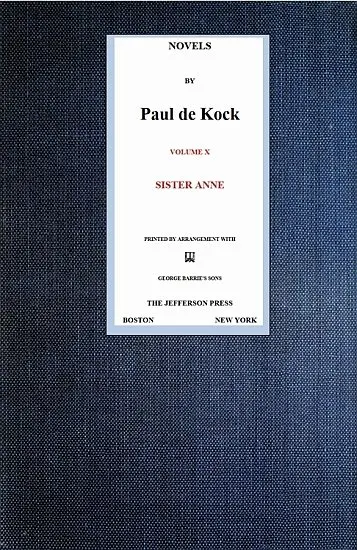
"Sister Anne" by Paul de Kock is a novel written in the early 19th century. The story centers around Dubourg, a somewhat careless and whimsical man in his thirties, who finds himself in a predicament after losing money that he received from his aunt. As he wanders the streets of Paris during a quiet night, he reflects on his past misadventures and contemplates reaching out to his friend Frédéric, the son of a count, for assistance. At the start of the novel, we meet Dubourg as he walks through the silent boulevards of Paris, captured in a mix of introspection and self-deprecating humor. He laments his poor financial decisions and considers the implications of his gambling habit on his friendship with Frédéric. As tension builds, Dubourg unexpectedly stumbles upon a lavish ball at Frédéric's home, quickly realizing he’s crashed a significant social event. The beginning sets the stage for a comedic exploration of friendship, societal expectations, and the consequences of one's choices amid the vibrant backdrop of early 19th-century Parisian life.
Introduction adapted from the source catalogue; source summaries may be automatically generated.
Free to read · English · 143,892 words · No account needed
MAKE TIME FOR A GOOD BOOK
On by default. Untick to stop anonymous reading totals. Each page counts after 10 seconds in view. How this works.
Anonymous counting is on unless you have switched it off.
The travellers resumed their journey. Dubourg was a curious sight in his full dress, starched ruff, and thin pumps, walking beside Ménard, who wore silk short-clothes, black stockings, and buckled shoes, and who was compelled, in that costume, to climb hills, jump ditches, and plod along over ground that, at the best, was very uneven. Luckily, they had taken their hats when they went out to see the fireworks, otherwise they would have had to traverse Dauphiné as if they were calling on their neighbors.
At daybreak, they stopped at a peasant's house and obtained breakfast. Dubourg ordered an omelet and some native wine. They ate their repast under an arbor, surrounded by domestic animals who came to keep them company.
"How pleasant it is in the open air!" said Dubourg; "are all the gilded halls and antechambers on earth equal to this open country--to the perfect liberty which is ours at this moment?"
"It is certain," rejoined Ménard, driving away a big cat that persisted in putting its paws in his plate, "it is certain that we are entirely at liberty here,--that there is no suspicion of restraint---- Well, well, here's the dog now, trying to get my bread!"
"Well, Monsieur Ménard, every creature must live. In the time of our first parents, these innocent beasts shared their masters' meals; the lion ate from the hand of man, and the tiger gambolled at his feet."
"You must agree, monsieur le baron, that those animals have changed greatly in their disposition."
"Never mind; I love everything that recalls those days of innocence. When I look at this hen walking on our table, and this duck splashing in the mud at our feet, I fancy that I am living in the Age of Gold. Not until I feel in my pocket do I realize the delusion."
Unluckily, the eggs in the omelet were not fresh, and the wine was sour; Ménard made a wry face at every mouthful and every swallow, while Dubourg said:
"I know of no healthier food than an omelet. Whatever country you travel in, wherever you may be, if there are eggs, you have an omelet! Everybody knows how to make it; it's a universal dish, the dish of nature."
"If only the eggs were fresh!"
"Faith! this little taste of straw isn't unpleasant; at need, it will take the place of tarragon. And this wine--at all events, I'll guarantee that it won't do us any harm."
"It's infernally sour!"
"A proof that it's unadulterated."
Despite all that Dubourg could say to make Ménard approve of the breakfast, the tutor said, as they left the table:
Your reading position is saved on this browser. Take it to another device with a library code. Reading pages adapt to text, rather than matching a printed edition.
Paul de Kock

Paul de Kock

Paul de Kock

Paul de Kock
BEHIND THE BOOK
This eBook is for the use of anyone anywhere in the United States and most other parts of the world at no cost and with almost no restrictions whatsoever. You may copy it, give it away or re-use it under the terms of the Project Gutenberg License included with this eBook or online at www.gutenberg.org. If you are not located in the United States, you will have to check the laws of the country where you are located before using this eBook. Read the source licence.
The original source file, including credits and licence, is retained by this library. Request an original-format copy at no charge. Please include the book title and Project Gutenberg identifier #40133.
KEEP YOUR CURIOSITY GOING
Coulson Kernahan

Maurice Baring
Frances Wright
Cécile Tormay

Frederic Jesup Stimson

W. H. P. (William Henry Pope) Jarvis