
The Milkmaid of Montfermeil (Novels of Paul de Kock Volume XX)
Paul de Kock
THE CLASSIC COLLECTION · 1903
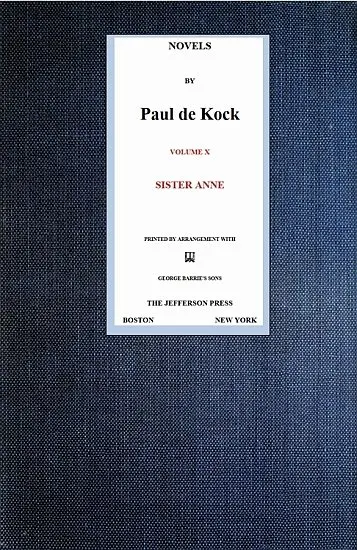
"Sister Anne" by Paul de Kock is a novel written in the early 19th century. The story centers around Dubourg, a somewhat careless and whimsical man in his thirties, who finds himself in a predicament after losing money that he received from his aunt. As he wanders the streets of Paris during a quiet night, he reflects on his past misadventures and contemplates reaching out to his friend Frédéric, the son of a count, for assistance. At the start of the novel, we meet Dubourg as he walks through the silent boulevards of Paris, captured in a mix of introspection and self-deprecating humor. He laments his poor financial decisions and considers the implications of his gambling habit on his friendship with Frédéric. As tension builds, Dubourg unexpectedly stumbles upon a lavish ball at Frédéric's home, quickly realizing he’s crashed a significant social event. The beginning sets the stage for a comedic exploration of friendship, societal expectations, and the consequences of one's choices amid the vibrant backdrop of early 19th-century Parisian life.
Introduction adapted from the source catalogue; source summaries may be automatically generated.
Free to read · English · 143,892 words · No account needed
MAKE TIME FOR A GOOD BOOK
On by default. Untick to stop anonymous reading totals. Each page counts after 10 seconds in view. How this works.
Anonymous counting is on unless you have switched it off.
"Don't be alarmed, my dear; I will take Lunel's pony, and he will ride behind. Whenever monsieur le baron chooses----"
"Faith! let us go," said Dubourg; and he added in an undertone, as he offered the lady his hand: "All the ruins in the world could not prevail against you!"
They left the château, Dubourg with Madame Chambertin on his arm, while her husband ran ahead, and Ménard followed, trying to discover the source of the smell of chicken which pursued him everywhere.
At a turn in the path, they discovered the cabriolet, in charge of a little man of about his master's years, who looked more like a butler than a jockey; beside him was an animal which, judging from its size and ears, was halfway between a horse and an ass. Madame Chambertin entered the carriage with her two guests.
"Give me your nag, Lunel," said Monsieur Chambertin.
"And what am I to do, monsieur?"
"Get up behind the carriage."
"You know very well, monsieur, that I can't hold on there."
"Then you shall walk. The idiot! not to have learned yet to hold on
behind a carriage!"
As he spoke, Monsieur Chambertin mounted the beast, and belabored him with his cane in default of a crop.
"Excuse me, if I ride ahead," he called to Dubourg; "but I have some
orders to give."
"Oh! no ceremony for us, I beg you, Monsieur de Chambertin!" was the
reply.
But the host was already far away; when he heard himself called De Chambertin again, he took the bit in his teeth.
Dubourg took the reins and drove, which did not prevent him from making many very gallant speeches to Madame Chambertin en route, or from motioning to Ménard to wipe his face. Lunel ran behind the cabriolet, consigning to the devil the strangers who were responsible for his master's taking his nag.
In due time they arrived at Allevard, a pretty village, through which flowed a mountain stream of considerable size that furnished power for a large number of windmills, iron foundries, and factories. Monsieur Chambertin's estate was on the right, just at the entrance to the village; it was a beautiful house, built according to modern ideas, and, as Madame Chambertin said, almost a château.
As they drove into a spacious courtyard shaded by tall lindens, Dubourg secretly felicitated himself on the chance meeting, and began to think that Madame Chambertin still possessed a very attractive figure and very bright eyes. As for Ménard, he had visions of a well-furnished kitchen, and he concluded that a man who owned such a charming estate deserved some consideration, although he was neither baron nor palatine.
Your reading position is saved on this browser. Take it to another device with a library code. Reading pages adapt to text, rather than matching a printed edition.
Paul de Kock

Paul de Kock

Paul de Kock

Paul de Kock
BEHIND THE BOOK
This eBook is for the use of anyone anywhere in the United States and most other parts of the world at no cost and with almost no restrictions whatsoever. You may copy it, give it away or re-use it under the terms of the Project Gutenberg License included with this eBook or online at www.gutenberg.org. If you are not located in the United States, you will have to check the laws of the country where you are located before using this eBook. Read the source licence.
The original source file, including credits and licence, is retained by this library. Request an original-format copy at no charge. Please include the book title and Project Gutenberg identifier #40133.
KEEP YOUR CURIOSITY GOING
Coulson Kernahan

Maurice Baring
Frances Wright
Cécile Tormay

Frederic Jesup Stimson

W. H. P. (William Henry Pope) Jarvis