
Birds of the wave and woodland
Phil Robinson
THE CLASSIC COLLECTION · 1883
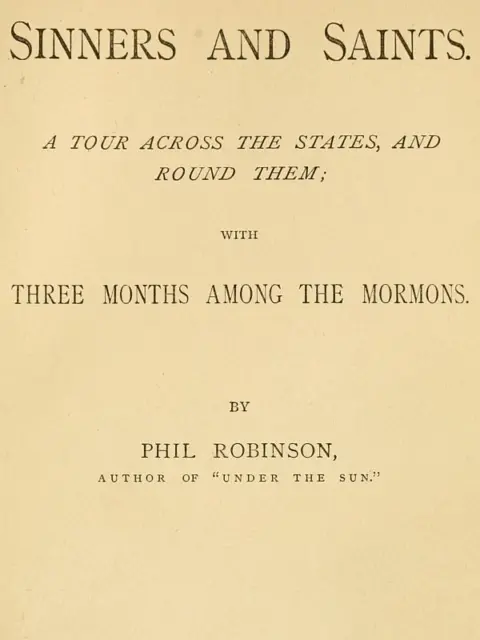
"Sinners and Saints" by Phil Robinson is a travel narrative written in the late 19th century. This account takes readers on a journey across the United States, particularly focusing on the experiences and observations of the author as he navigates through the emerging society of the Mormons and the American frontier. Through his narrative, Robinson explores various themes such as culture, society, and the development of towns, as he reflects on both the virtues and vices of the people he encounters. At the start of the book, Robinson embarks on a train journey across America, beginning in New York and heading towards Chicago. Through his keen observations, he describes the scenery outside the train, including the peculiarities of American life and the character of various towns along the route. The author interacts with fellow passengers, reflects on the agricultural landscape, and muses about the stark contrast between the natural beauty and the burgeoning civilization. His humorous and insightful commentary sets the tone for a travelogue that promises to blend personal anecdotes with sociocultural critiques as he continues his exploration across the states.
Introduction adapted from the source catalogue; source summaries may be automatically generated.
Free to read · English · 112,823 words · No account needed
MAKE TIME FOR A GOOD BOOK
On by default. Untick to stop anonymous reading totals. Each page counts after 10 seconds in view. How this works.
Anonymous counting is on unless you have switched it off.
And here just a word or two to those American gentlemen to whom it falls to amuse or edify the sight-seeing foreigner. Do not be disappointed if he shows little enthusiasm for your factories, and mills, and populous streets. Remember that these are just what he is trying to escape from. The chances are, that he would much rather see a prairie-dog city, than the Omaha smelting-works; an Indian lodge than Pittsburg; one wild bison than all the cattle of Chicago; a rattlesnake at home than all the legislature of New York in Albany assembled. He prefers canyons to streets, mountain streams to canals; and when he crosses the river, it is the river more than the bridge that interests him. Of course it is well for him to stay in your gigantic hotels, go down into your gigantic silver-mines, travel on your gigantic river-steamers, and be introduced to your gigantic millionaires. These are all American, and it is good for him, and seemly, that he should add them to his personal experiences. So too, he should eat terrapin and planked shad, clam-chowder, canvas-back ducks, and soft-shelled crabs. For these are also American. But the odds are he may go mad and bite thee fatally, if thou wakest him up at un-Christian hours to go and see a woollen factory, simply because thou art proud of it--or settest him down to breakfast before perpetual beefsteak, merely because he is familiar with that food. The intelligent traveller, being at Rome, wishes to be as much a Roman as possible. He would be as aboriginal as the aborigines. And it is a mistake to go on thrusting things upon him solely on the ground that he is already weary of them. As I write, I remember many hours of bitter anguish which I have endured--I who am familiar with Swansea, who have stayed in Liverpool, who live in London--in loitering round smelting works and factories, and places of business, trying to seem interested, and pretending to store my memory with statistics. Sometimes it would be almost on my tongue to say, "And now, sir, having shown off your possessions in order to gratify your own pride in them, suppose you show me something for my gratification." I never did, of course, but I groaned in the spirit, at my precious hours being wasted, and at the hospitality which so easily forgot itself in ostentatious display. I have perhaps said more than I meant to have done. But all I mean is this, that when a sojourner is at your mercy, throw him unreservedly upon his own resources for such time as you are busy, and deny yourself unreservedly for his amusement when you are at leisure. But do not spoil all his day, and half your own, by trying to work your usual business habits into his holiday, and take advantage of his foreign helplessness to show him what an important person (when at home) you are yourself. Do not, for instance, take him after breakfast to your office, and there settling to your work with your clerks, ask him to "amuse himself" with the morning papers--for three hours; and then, after a hurried luncheon at your usual restaurant, take him back to the office for a few minutes--another hour; and then, having carefully impressed upon him that you are taking a half-holiday solely upon his account, and in spite of all the overwhelming business that pours in upon you, do not take him for a drive in the Mall--in order to show off your new horses to your own acquaintances; and after calling at a few shops (during which time your friend stays in the trap and holds the reins), do not, oh do not, take him back to your house to a solitary dinner "quite in the English style." No, sir; this is not the way to entertain the wayfarer in such a land of wonders as this; and you ought not therefore to feel surprise when your guest, wearied of your mistaken hospitality, and wearied of your perpetual suggestions of your own self-sacrifice on his behalf, suddenly determines not to be a burden upon you any longer, and escapes the same evening to the most distant hotel in the town. Nor when you read this ought you to feel angry. You did him a great wrong in wasting a whole day out of his miserable three, and exasperated him by telling his friends afterwards what a "good time" he had with you. These few words are his retaliation--not written either in the vindictive spirit of reprisal, but as advice to you for the future and in the interests, of strangers who may follow him within your gates.
Your reading position is saved on this browser. Take it to another device with a library code. Reading pages adapt to text, rather than matching a printed edition.
Phil Robinson
BEHIND THE BOOK
This eBook is for the use of anyone anywhere in the United States and most other parts of the world at no cost and with almost no restrictions whatsoever. You may copy it, give it away or re-use it under the terms of the Project Gutenberg License included with this eBook or online at www.gutenberg.org. If you are not located in the United States, you will have to check the laws of the country where you are located before using this eBook. Read the source licence.
The original source file, including credits and licence, is retained by this library. Request an original-format copy at no charge. Please include the book title and Project Gutenberg identifier #54079.
KEEP YOUR CURIOSITY GOING
Wilfrid Scawen Blunt
Wilfrid Scawen Blunt

E. W. (Edgar Watson) Howe
Francis Greenleaf Allinson & Anne C. E. (Anne Crosby Emery) Allinson
Cyrenus Cole

John Martineau