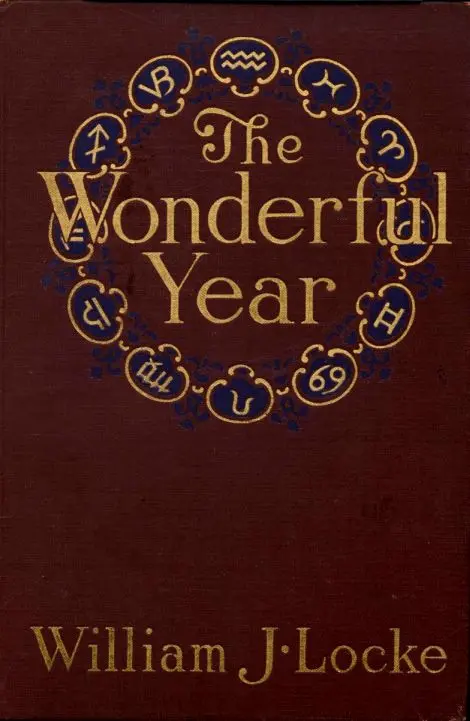
The Wonderful Year
William John Locke
THE CLASSIC COLLECTION · 1910
"Simon the Jester" by William John Locke is a novel likely written in the early 20th century. The story centers around Simon de Gex, an M.P. who seeks solitude in the desolate seaside town of Murglebed-on-Sea after receiving a terminal diagnosis. As he grapples with his impending demise, Simon reflects on his life, love, and the ambitions he is leaving behind, all while bringing humor and a contemplative attitude to his misfortunes. The beginning of the novel introduces Simon as he arrives in the bleak coastal town, seeking peace and distance from the hustle of political life. In his conversations with Renniker, a knowledgeable friend, Simon humorously inquires about the most dismal place in England, leading him to Murglebed, which he describes in vividly dismal terms. Through his eyes, we see a man confronting existential questions and exploring ideas of mortality and meaning. He reveals his engagement to Eleanor Faversham, who he admires but feels he cannot marry due to his illness. The opening sets a tone of sharp wit and introspection as Simon embarks on a journey of self-discovery amidst the gloom, intending to find joy and purpose in his remaining time.
Introduction adapted from the source catalogue; source summaries may be automatically generated.
Free to read · English · 98,598 words · No account needed
MAKE TIME FOR A GOOD BOOK
On by default. Untick to stop anonymous reading totals. Each page counts after 10 seconds in view. How this works.
Anonymous counting is on unless you have switched it off.
I tried, stumbled, and halted. The effort evoked in my mind a picture of Lola lithe, seductive, exotic, with gold flecks in her dusky, melting eyes, with strong shapely arms that had as yet only held me motherwise, with her pantherine suggestion of tremendous strength in languorous repose, with her lazy gestures and parted lips showing the wonderful white even teeth, with all her fascination and charm--a picture of Lola such as I had not seen since my emergence from the Valley--a picture of Lola, generous, tender, wistful, strong, yielding, fragrant, lovable, desirable, amorous--a picture of Lola which I could not put before this other woman equally brave and straight, who looked at me composedly out of her calm, blue eyes.
My description resolved itself into a loutish catalogue.
“It is not painful to you to talk of her, Simon?”
“Not at all. There are not many great-hearted women going about. It is my privilege to know two.”
“Am I the other?”
“Who else?”
“I'm glad you have the courage to class Madame Brandt and myself
together.”
“Why?” I asked.
“It proves beyond a doubt that you are honest with me. Now tell me about a few externals--things that don't matter--but help one to form an impression. Is she educated?”
“From books, no; from observation, yes.”
“Her manners?”
“Observation had educated them.”
“Accent?”
“She is sufficiently polyglot to have none.”
“She dresses and talks and behaves generally like a lady?”
“She does,” said I.
“In what way then does she differ from the women of our class?”
“She is less schooled, less reticent, franker, more natural. What is on her tongue to say, she says.”
“Temper?”
“I have never heard her say an angry word to or of a human creature. She has queer delicacies of feeling. For instance----”
I told her of Anastasius Papadopoulos's tawdry, gimcrack presents which Lola has suffered to remain in her drawing-room so as not to hurt the poor little wretch.
“That's very touching. Where does she live?”
“She has a flat in Cadogan Gardens.”
“Is she in London now?”
“Yes.”
“I should like very much to know her,” she said calmly.
I vow and declare again that the more straightforward and open-eyed, the less subtle, temperamental, and neurotic are women, the more are they baffling. I had wondered for some time whither the catechism tended, and now, with a sudden jerk, it stopped short at this most unexpected terminus. It was startling. I rose and mechanically placed my empty tea-cup on the tray by her side.
“The wish, my dear Eleanor,” said I, quite formally, “does great credit
to your heart.”
Your reading position is saved on this browser. Take it to another device with a library code. Reading pages adapt to text, rather than matching a printed edition.
William John Locke
William John Locke
William John Locke
William John Locke
BEHIND THE BOOK
This eBook is for the use of anyone anywhere in the United States and most other parts of the world at no cost and with almost no restrictions whatsoever. You may copy it, give it away or re-use it under the terms of the Project Gutenberg License included with this eBook or online at www.gutenberg.org. If you are not located in the United States, you will have to check the laws of the country where you are located before using this eBook. Read the source licence.
The original source file, including credits and licence, is retained by this library. Request an original-format copy at no charge. Please include the book title and Project Gutenberg identifier #3828.
KEEP YOUR CURIOSITY GOING
Coulson Kernahan

Maurice Baring
Frances Wright
Cécile Tormay

Frederic Jesup Stimson

W. H. P. (William Henry Pope) Jarvis