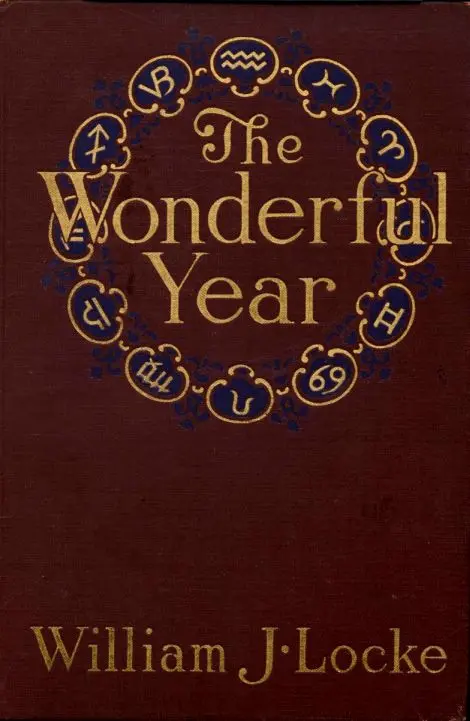
The Wonderful Year
William John Locke
THE CLASSIC COLLECTION · 1910
"Simon the Jester" by William John Locke is a novel likely written in the early 20th century. The story centers around Simon de Gex, an M.P. who seeks solitude in the desolate seaside town of Murglebed-on-Sea after receiving a terminal diagnosis. As he grapples with his impending demise, Simon reflects on his life, love, and the ambitions he is leaving behind, all while bringing humor and a contemplative attitude to his misfortunes. The beginning of the novel introduces Simon as he arrives in the bleak coastal town, seeking peace and distance from the hustle of political life. In his conversations with Renniker, a knowledgeable friend, Simon humorously inquires about the most dismal place in England, leading him to Murglebed, which he describes in vividly dismal terms. Through his eyes, we see a man confronting existential questions and exploring ideas of mortality and meaning. He reveals his engagement to Eleanor Faversham, who he admires but feels he cannot marry due to his illness. The opening sets a tone of sharp wit and introspection as Simon embarks on a journey of self-discovery amidst the gloom, intending to find joy and purpose in his remaining time.
Introduction adapted from the source catalogue; source summaries may be automatically generated.
Free to read · English · 98,598 words · No account needed
MAKE TIME FOR A GOOD BOOK
On by default. Untick to stop anonymous reading totals. Each page counts after 10 seconds in view. How this works.
Anonymous counting is on unless you have switched it off.
“This is from Finch, of the Universal Review.”
I put my hand on his shoulder.
“Tell him, my boy, that it's against my custom to breakfast at afternoon tea, and that I hope his wife is well.”
At his look of bewilderment I broke into a laugh.
“He wants me to write a dull article for his stupid paper, doesn't he?”
“Yes, on Poor Law Administration.”
“I'm not going to do it. I'm not going to do anything these people ask me. Say 'No, no, no, no,' to everybody.”
“In Heaven's name, Simon,” he cried, laying down his pencil, “what has
come over you?”
“Old age,” said I.
He uttered his usual interjection, and added that I was only
thirty-seven.
“Age is a relative thing,” I remarked. “Babes of five have been known to die of senile decay, and I have seen irresponsible striplings of seventy.”
“I really think Eleanor Faversham had better come back from Sicily.”
I tapped the letter still in my hand. “She's coming.”
“I'm jolly glad to hear it. It's all my silly fault that she went away. I thought she was getting on your nerves. But you want pulling together. That confounded place you've been to has utterly upset you.”
“On the contrary,” said I, “it has steadied and amplified my conception of sublunary affairs. It has shown me that motley is much more profitable wear than the edged toga of the senator--”
“Oh, for God's sake, dry up,” cried young England, “and tell me what answers I'm to give these people!”
He seemed so earnest about it that I humoured him; and my correspondents seemed so earnest that I humoured them. But it was a grim jest. Most of the matters with which I had to deal appeared so trivial. Only here and there did I find a chance for eumoiriety. The Wymington Hospital applied for their annual donation.
“You generally give a tenner,” said Dale.
“This time I'll give them a couple of hundred,” said I.
Dale earmarked the amount wonderingly; but when I ordered him to send five pounds apiece to the authors of various begging letters he argued vehemently and quoted the Charity Organisation Society.
“They're frauds, all of them,” he maintained.
“They're poor necessitous devils, at any rate,” said I, “and they want the money more than I do.”
Your reading position is saved on this browser. Take it to another device with a library code. Reading pages adapt to text, rather than matching a printed edition.
William John Locke
William John Locke
William John Locke
William John Locke
BEHIND THE BOOK
This eBook is for the use of anyone anywhere in the United States and most other parts of the world at no cost and with almost no restrictions whatsoever. You may copy it, give it away or re-use it under the terms of the Project Gutenberg License included with this eBook or online at www.gutenberg.org. If you are not located in the United States, you will have to check the laws of the country where you are located before using this eBook. Read the source licence.
The original source file, including credits and licence, is retained by this library. Request an original-format copy at no charge. Please include the book title and Project Gutenberg identifier #3828.
KEEP YOUR CURIOSITY GOING
Coulson Kernahan

Maurice Baring
Frances Wright
Cécile Tormay

Frederic Jesup Stimson

W. H. P. (William Henry Pope) Jarvis