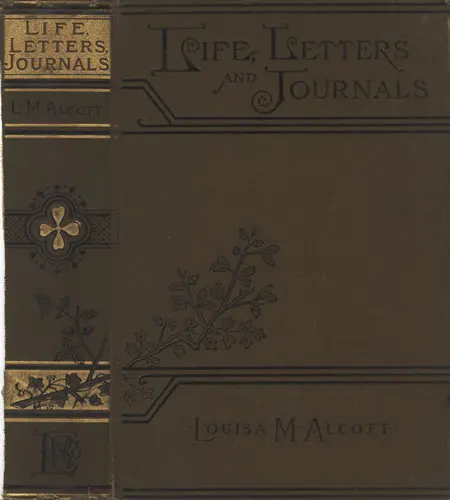
Louisa May Alcott : Her Life, Letters, and Journals
Louisa May Alcott
THE CLASSIC COLLECTION · 1876
"Silver Pitchers: and Independence, a Centennial Love Story" by Louisa May Alcott is a novel written in the late 19th century. The book revolves around three friends—Portia, Pauline, and Priscilla—who navigate the intricacies of societal expectations, personal values, and emerging independence, particularly in regard to issues such as temperance and social responsibility. Their journey showcases the strength of female bonds as they confront the challenges posed by their male peers and strive to lead by example. At the start of the story, the trio of friends engages in a serious discussion following a Thanksgiving festival where they are offended by the behavior of some young men who indulge in excessive drinking. Fueled by a sense of responsibility to their community and their ideals, they devise a plan to refuse invitations to upcoming social gatherings as a protest against the unbecoming conduct they witnessed. As each character reveals her unique personality—Portia with her beauty, Pauline with her wit, and Priscilla with her gentle strength—they pledge allegiance to a new society aimed at promoting temperance and moral integrity, setting the stage for a series of challenges and developments in their relationships with the men around them.
Introduction adapted from the source catalogue; source summaries may be automatically generated.
Free to read · English · 84,409 words · No account needed
MAKE TIME FOR A GOOD BOOK
On by default. Untick to stop anonymous reading totals. Each page counts after 10 seconds in view. How this works.
Anonymous counting is on unless you have switched it off.
Letty ran for basin and towel, and, pointing to the well, modestly retired into the kitchen, while Aunt Liddy watched the vigorous scrubbing that went on in the yard; for the tramp splashed the water about like a Newfoundland dog, and Bran assisted at the brief toilet with hospitable zeal.
It seemed as if a different man came out from that simple baptism; for the haggard cheek had a glow upon it, the eyes had lost their hopelessness, and something like courage and self-respect shone in the face that looked in at the door as the stranger gave back basin and towel, saying, with a wave of the old straw hat,--
"I'm heartily obliged, ma'am. Would you kindly tell me how far it is to
the next big town?"
"Twenty miles. The cars will take you right there, and the deepo ain't fur," answered Aunt Liddy, showing the way.
The man glanced at his ragged shoes, then squared his broad shoulders, as if bracing himself for the twenty long hot miles that his weary feet must carry him, since his pockets were empty, and he could not bring himself to ask for any thing but food enough to keep life in him.
"Good-by, ma'am, and God bless you." And, slouching the hat over his eyes, he limped away, escorted to the gate by Bran.
At the turn of the road he stopped and looked back as wistfully as ever Letty had done along the shadowy road, and as he looked it seemed as if he saw a younger self setting off with courage, hope, and energy upon the journey, which alas! had ended here. His eye went to the old well, as if there had been some healing in its water; then turned to the porch, where he had been fed and comforted, and lingered there as if some kindly memory warmed his solitary heart.
Just then a little figure in blue gingham ran out and came fluttering after him, accompanied by Bran, in a state of riotous delight. Rosy and breathless, Letty hurried to him, and, looking up with a face full of the innocent compassion that never can offend, she said, offering a parcel neatly folded up,--
"Aunt Liddy sends you some dinner; and this, so that you needn't walk, unless you like, you are so lame."
As if more touched than he cared to show, the man took the food, but gently put away the little roll of greenbacks, saying quickly,--
"Thank you for this; but I can't take your money."
"We ain't rich, but we love to help folks. So you needn't be proud about it." And Letty looked ruffled at his refusal.
Your reading position is saved on this browser. Take it to another device with a library code. Reading pages adapt to text, rather than matching a printed edition.
Louisa May Alcott
Louisa May Alcott
Louisa May Alcott
Louisa May Alcott
BEHIND THE BOOK
This eBook is for the use of anyone anywhere in the United States and most other parts of the world at no cost and with almost no restrictions whatsoever. You may copy it, give it away or re-use it under the terms of the Project Gutenberg License included with this eBook or online at www.gutenberg.org. If you are not located in the United States, you will have to check the laws of the country where you are located before using this eBook. Read the source licence.
The original source file, including credits and licence, is retained by this library. Request an original-format copy at no charge. Please include the book title and Project Gutenberg identifier #34920.
KEEP YOUR CURIOSITY GOING
Coulson Kernahan

Maurice Baring
Frances Wright
Cécile Tormay

Frederic Jesup Stimson

W. H. P. (William Henry Pope) Jarvis