THE CLASSIC COLLECTION✦An account of the giants lately discoveredCLASSIC FREE BOOKS
An account of the giants lately discovered
Horace Walpole
THE CLASSIC COLLECTION · 1903
"Shorter Novels, Eighteenth Century" by Johnson, Beckford, and Walpole is a collection of classic novels written during the later years of the eighteenth century. The volume includes notable works like Johnson’s "Rasselas", Walpole’s "The Castle of Otranto", and Beckford’s "Vathek", showcasing a mixture of philosophical reflection, Gothic terror, and Oriental fantasy. The collection illustrates a key transitional period in literature, where traditional themes began to give way to the emotions and imaginations celebrated in Romantic literature. The opening of the book introduces "Rasselas, Prince of Abyssinia", which centers on Prince Rasselas, who lives in a paradise-like valley but grows discontented with the pleasures and comforts of his life. Despite the lavish lifestyle provided to him and his siblings, Rasselas has an insatiable yearning to explore the world outside, leading him to reflect on the nature of happiness. His growing melancholy sets the stage for his eventual quest for meaning, as he grapples with existential questions about fulfillment and the human condition.
Introduction adapted from the source catalogue; source summaries may be automatically generated.
Free to read · English · 127,261 words · No account needed
MAKE TIME FOR A GOOD BOOK
On by default. Untick to stop anonymous reading totals. Each page counts after 10 seconds in view. How this works.
Anonymous counting is on unless you have switched it off.
Inscriptions of this sort are still retained. Thus Ludeke: "Interni non solum Divani pluriumque conclavium parietes, sed etiam frontispicia super portas inscriptiones habent."--Expositio, p. 54. In the History of Amine, we find an inscription over a gate, in letters of gold, analogous to this of Fakreddin: "Here is the abode of everlasting pleasures and content."--Arabian Nights, vol. i, p. 193.
PAGE 232. ... a magnificent tecthtrevan
This kind of moving throne, though more common at present than in the days of Vathek, is still confined to persons of the highest rank.
PAGE 233. ... your ivory limbs
The Arabians compare the skin of a beautiful woman to the egg of the ostrich, when preserved unsullied. Thus Amriolkais:
"Delicate was her shape; fair her skin; and her body well proportioned: her bosom was as smooth as a mirror,--
"Or like the pure egg of an ostrich, of a yellowish tint blended with
white."
Also the Koran: "Near them shall lie the virgins of Paradise, refraining their looks from beholding any besides their spouses, having large black eyes, and resembling the eggs of an ostrich, covered with feathers from dust."--Moallakat, p. 8. Al Koran, ch. 27.
But though the Arabian epithet be taken from thence, yet the word ivory is substituted, as more analogous to European ideas, and not foreign from the Eastern. Thus Amru:
"And two sweet breasts, smooth and white as vessels of ivory, modestly defended from the hand of those who presume to touch them."--Moallakat, p. 77.
PAGE 233. ... baths of rose-water
The use of perfumed waters for the purpose of bathing is of an early origin in the East, where every odoriferous plant sheds a richer fragrance than is known to our more humid climates. The rose which yields this lotion is, according to Hasselquist, of a beautiful pale blush colour, double, large as a man's fist, and more exquisite in scent than any other species. The quantities of this water distilled annually at Fajhum, and carried to distant countries, is immense. The mode of conveying it is in vessels of copper coated with wax.--Voyag., p. 248. Ben Jonson makes Volpone say to Celia:
"Their bath shall be the juyce of gillyflowres,
Spirit of roses, and of violets."
PAGE 233. ... lamb à la crême
No dish among the Easterns was more generally admired. The caliph Abdolmelek, at a splendid entertainment, to which whoever came was welcome, asked Amrou, the son of Hareth, what kind of meat he preferred to all others. The old man answered, "An ass's neck, well seasoned and roasted."--"But what say you," replied the caliph, "to the leg or shoulder of a LAMB à la crême?" and added:
Your reading position is saved on this browser. Take it to another device with a library code. Reading pages adapt to text, rather than matching a printed edition.
Horace Walpole
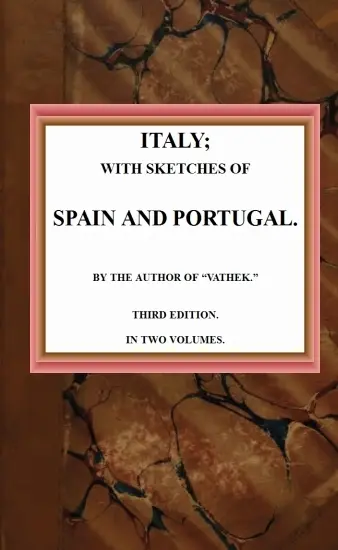
William Beckford
Robert Jephson & Horace Walpole
Horace Walpole
BEHIND THE BOOK
This eBook is for the use of anyone anywhere in the United States and most other parts of the world at no cost and with almost no restrictions whatsoever. You may copy it, give it away or re-use it under the terms of the Project Gutenberg License included with this eBook or online at www.gutenberg.org. If you are not located in the United States, you will have to check the laws of the country where you are located before using this eBook. Read the source licence.
The original source file, including credits and licence, is retained by this library. Request an original-format copy at no charge. Please include the book title and Project Gutenberg identifier #34766.
KEEP YOUR CURIOSITY GOING
Coulson Kernahan

Maurice Baring
Frances Wright
Cécile Tormay

Frederic Jesup Stimson

W. H. P. (William Henry Pope) Jarvis