THE CLASSIC COLLECTION✦An account of the giants lately discoveredCLASSIC FREE BOOKS
An account of the giants lately discovered
Horace Walpole
THE CLASSIC COLLECTION · 1903
"Shorter Novels, Eighteenth Century" by Johnson, Beckford, and Walpole is a collection of classic novels written during the later years of the eighteenth century. The volume includes notable works like Johnson’s "Rasselas", Walpole’s "The Castle of Otranto", and Beckford’s "Vathek", showcasing a mixture of philosophical reflection, Gothic terror, and Oriental fantasy. The collection illustrates a key transitional period in literature, where traditional themes began to give way to the emotions and imaginations celebrated in Romantic literature. The opening of the book introduces "Rasselas, Prince of Abyssinia", which centers on Prince Rasselas, who lives in a paradise-like valley but grows discontented with the pleasures and comforts of his life. Despite the lavish lifestyle provided to him and his siblings, Rasselas has an insatiable yearning to explore the world outside, leading him to reflect on the nature of happiness. His growing melancholy sets the stage for his eventual quest for meaning, as he grapples with existential questions about fulfillment and the human condition.
Introduction adapted from the source catalogue; source summaries may be automatically generated.
Free to read · English · 127,261 words · No account needed
MAKE TIME FOR A GOOD BOOK
On by default. Untick to stop anonymous reading totals. Each page counts after 10 seconds in view. How this works.
Anonymous counting is on unless you have switched it off.
"I have not leisure," said Manfred, "to listen to thy tales. I do not question thy honesty; but it is thy duty to conceal nothing from me. How long has Isabella been acquainted with Theodore?"
"Nay, there is nothing can escape your highness," said Bianca: "not that I know anything of the matter. Theodore, to be sure, is a proper young man, and, as my Lady Matilda says, the very image of good Alfonso: has not your highness remarked it?"
"Yes, yes,--no,--thou torturest me," said Manfred: "where did they meet?
when?"
"Who? my Lady Matilda?" said Bianca.
"No, no, not Matilda; Isabella. When did Isabella first become
acquainted with this Theodore?"
"Virgin Mary!" said Bianca, "how should I know?"
"Thou dost know," said Manfred, "and I must know; I will."
"Lord! your highness is not jealous of young Theodore!" said Bianca.
"Jealous! no, no: why should I be jealous? perhaps I mean to unite them, if I were sure Isabella would have no repugnance."
"Repugnance! no, I'll warrant her," said Bianca: "he is as comely a youth as ever trod on Christian ground. We are all in love with him; there is not a soul in the castle but would be rejoiced to have him for our prince--I mean, when it shall please Heaven to call your highness to itself."
"Indeed," said Manfred, "has it gone so far? oh, this cursed friar! but I must not lose time:--go, Bianca, attend Isabella; but I charge thee, not a word of what has passed. Find out how she is affected towards Theodore: bring me good news, and that ring has a companion. Wait at the foot of the winding staircase: I am going to visit the marquis, and will talk further with thee at my return."
Manfred, after some general conversation, desired Frederic to dismiss the two knights his companions, having to talk with him on urgent affairs. As soon as they were alone, he began, in artful guise, to sound the marquis on the subject of Matilda; and finding him disposed to his wish, he let drop hints on the difficulties that would attend the celebration of their marriage, unless--At that instant Bianca burst into the room with a wildness in her look and gestures that spoke the utmost terror.
"Oh, my lord, my lord!" cried she; "we are all undone! it is come again!
it is come again!"
"What is come again?" cried Manfred, amazed.
Your reading position is saved on this browser. Take it to another device with a library code. Reading pages adapt to text, rather than matching a printed edition.
Horace Walpole
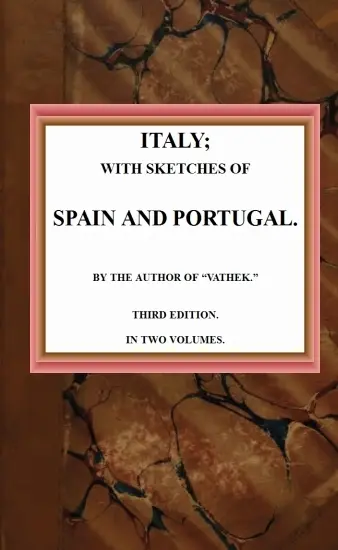
William Beckford
Robert Jephson & Horace Walpole
Horace Walpole
BEHIND THE BOOK
This eBook is for the use of anyone anywhere in the United States and most other parts of the world at no cost and with almost no restrictions whatsoever. You may copy it, give it away or re-use it under the terms of the Project Gutenberg License included with this eBook or online at www.gutenberg.org. If you are not located in the United States, you will have to check the laws of the country where you are located before using this eBook. Read the source licence.
The original source file, including credits and licence, is retained by this library. Request an original-format copy at no charge. Please include the book title and Project Gutenberg identifier #34766.
KEEP YOUR CURIOSITY GOING
Coulson Kernahan

Maurice Baring
Frances Wright
Cécile Tormay

Frederic Jesup Stimson

W. H. P. (William Henry Pope) Jarvis