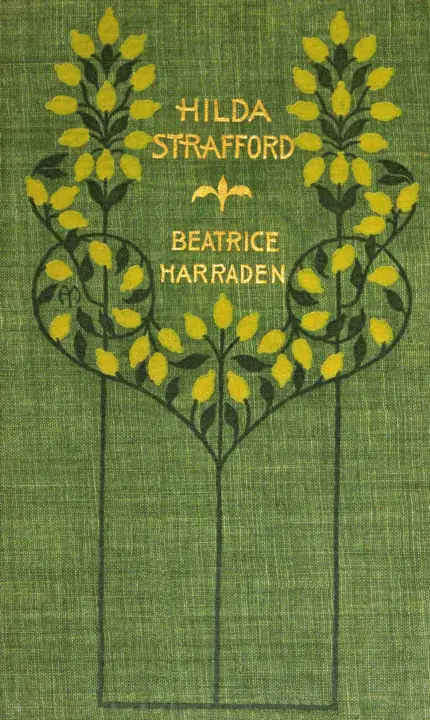
Hilda Strafford: A California Story
Beatrice Harraden
THE CLASSIC COLLECTION · 1893
"Ships that Pass in the Night" by Beatrice Harraden is a novel written during the late 19th century. The story revolves around the intricate interactions of its characters, particularly focusing on Bernardine Holme, a young woman who arrives at the Petershof Kurhaus for her health. The narrative captures her encounters with various guests at the resort, including the enigmatic "Disagreeable Man," Robert Allitsen, and others navigating their own struggles with illness and existential reflections. At the start of the novel, readers are introduced to the contrasting personalities at the dining table of Petershof Kurhaus, where a new-comer, Bernardine, finds herself lost in thought amid the conversations. The Disagreeable Man's sharp remarks about life's disappointments catch her attention, and their exchanges hint at a deeper connection. As classic themes of health, ambition, and the search for purpose emerge, Bernardine reflects on her past, her lost ambitions in teaching and writing, and her current state of illness. The interactions set the tone for a character-driven exploration of hope, resilience, and the weight of unfulfilled dreams, presenting Bernardine's journey as one of self-discovery within the confines of a society marked by suffering.
Introduction adapted from the source catalogue; source summaries may be automatically generated.
Free to read · English · 37,647 words · No account needed
MAKE TIME FOR A GOOD BOOK
On by default. Untick to stop anonymous reading totals. Each page counts after 10 seconds in view. How this works.
Anonymous counting is on unless you have switched it off.
But Bernardine smiled and shook her head, and went to greet the others who crowded round them; and at last poor Catharina drew near too, holding Bernardine's hand lovingly within her own. Then Hans, Liza's lover, came upon the scene, and Liza told the Disagreeable Man that she and Hans were to be married in a month's time. And the Disagreeable Man, much to Bernardine's amazement, drew from his pocket a small parcel, which he confided to Liza's care. Every one pressed round her while she opened it, and found what she had so often wished for, a silver watch and chain.
"Ach," she cried, "how heavenly! How all the girls here will envy me! How angry my dear friend Susanna will be!"
Then there were the photographs to be examined.
Liza looked with stubborn disapproval on the pictures of herself in her working-dress. But she did not conceal her admiration of the portraits which showed her to the world in her best finery.
"Ach," she cried, "this is something like a photograph!"
The Disagreeable Man grunted, but behaved after the fashion of a hero, claiming, however, a little silent sympathy from Bernardine.
It was a pleasant, homely scene: and Bernardine, who, felt quite at her ease amongst these people, chatted away with them as though she had known them all her life.
Then Frau Steinhart suddenly remembered that her guests needed some food, and Liza was despatched to her duties as cook; though it was some time before she could be induced to leave off looking at the photographs.
"Take them with you, Liza," said the Disagreeable Man. "Then we shall get our meal all the quicker!"
She ran off laughing, and finally Bernardine found herself alone with
Catharina.
"Liza is very happy," she said to Bernardine. "She loves, and is loved."
"That is the greatest happiness," Bernardine said half to herself.
"Fräulein knows?" Catharina asked eagerly.
Bernardine looked wistfully at her companion. "No, Catharina," she said. "I have only heard and read and seen."
"Then you cannot understand," Catharina said almost proudly. "But I
understand!"
She spoke no more after that, but took up her knitting, and watched Bernardine playing with the kittens. She was playing with the kittens, and she was thinking; and all the time she felt conscious that this peasant woman, stricken in mind and body, was pitying her because that great happiness of loving and being loved had not come into her life. It had seemed something apart from her; she had never even wanted it. She had wished to stand alone, like a little rock out at sea.
And now?
Your reading position is saved on this browser. Take it to another device with a library code. Reading pages adapt to text, rather than matching a printed edition.
BEHIND THE BOOK
This eBook is for the use of anyone anywhere in the United States and most other parts of the world at no cost and with almost no restrictions whatsoever. You may copy it, give it away or re-use it under the terms of the Project Gutenberg License included with this eBook or online at www.gutenberg.org. If you are not located in the United States, you will have to check the laws of the country where you are located before using this eBook. Read the source licence.
The original source file, including credits and licence, is retained by this library. Request an original-format copy at no charge. Please include the book title and Project Gutenberg identifier #12476.
KEEP YOUR CURIOSITY GOING
Coulson Kernahan

Maurice Baring
Frances Wright
Cécile Tormay

Frederic Jesup Stimson

W. H. P. (William Henry Pope) Jarvis