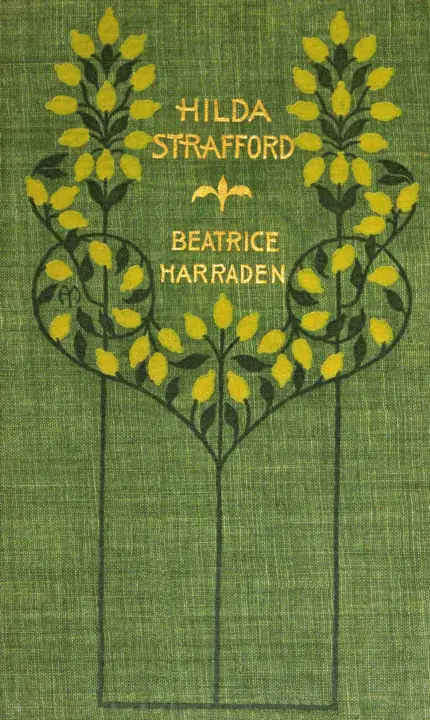
Hilda Strafford: A California Story
Beatrice Harraden
THE CLASSIC COLLECTION · 1893
"Ships that Pass in the Night" by Beatrice Harraden is a novel written during the late 19th century. The story revolves around the intricate interactions of its characters, particularly focusing on Bernardine Holme, a young woman who arrives at the Petershof Kurhaus for her health. The narrative captures her encounters with various guests at the resort, including the enigmatic "Disagreeable Man," Robert Allitsen, and others navigating their own struggles with illness and existential reflections. At the start of the novel, readers are introduced to the contrasting personalities at the dining table of Petershof Kurhaus, where a new-comer, Bernardine, finds herself lost in thought amid the conversations. The Disagreeable Man's sharp remarks about life's disappointments catch her attention, and their exchanges hint at a deeper connection. As classic themes of health, ambition, and the search for purpose emerge, Bernardine reflects on her past, her lost ambitions in teaching and writing, and her current state of illness. The interactions set the tone for a character-driven exploration of hope, resilience, and the weight of unfulfilled dreams, presenting Bernardine's journey as one of self-discovery within the confines of a society marked by suffering.
Introduction adapted from the source catalogue; source summaries may be automatically generated.
Free to read · English · 37,647 words · No account needed
MAKE TIME FOR A GOOD BOOK
On by default. Untick to stop anonymous reading totals. Each page counts after 10 seconds in view. How this works.
Anonymous counting is on unless you have switched it off.
"I am going to speak to this little thing," Mrs. Reffold had said to her two companions before they came near Bernardine. "I must find out who she is, and where she comes from. And, fancy, she has come quite alone. I have inquired. How hopelessly out of fashion she dresses. And what a hat!"
"I should not take the trouble to speak to her," said one of the men. "She may fasten herself on to you. You know what a bore that is."
"Oh, I can easily snub any one if I wish," replied Mrs. Reffold,
rather disdainfully.
So she hastened up to Bernardine, and held out her well-gloved hand.
"I had not a chance of speaking to you last night, Miss Holme," she said. "You retired so early. I hope you have rested after your journey. You seemed quite worn out."
"Thank you," said Bernardine, looking admiringly at the beautiful woman, and envying her, just as all plain women envy their handsome sisters.
"You are not alone, I suppose?" continued Mrs. Reffold.
"Yes, quite alone," answered Bernardine.
"But you are evidently acquainted with Mr. Allitsen, your neighbour at table," said Mrs. Reffold; "so you will not feel quite lonely here. It is a great advantage to have a friend at a place like this."
"I never saw him before last night," said Bernardine.
"Is it possible?" said Mrs. Reffold, in her pleasantest voice. "Then you have made a triumph of the Disagreeable Man. He very rarely deigns to talk with any of us. He does not even appear to see us. He sits quietly and reads. It would be interesting to hear what his conversation is like. I should be quite amused to know what you did talk about."
"I dare say you would," said Bernardine quietly.
Then Mrs. Reffold, wishing to screen her inquisitiveness, plunged into a description of Petershof life, speaking enthusiastically about everything, except the scenery, which she did not mention. After a time she ventured to begin once more taking soundings. But some how or other, those bright eyes of Bernardine, which looked at her so searchingly, made her a little nervous, and, perhaps, a little indiscreet.
"Your father will miss you," she said tentatively.
"I should think probably not," answered Bernardine. "One is not easily missed, you know." There was a twinkle in Bernardine's eye as she added, "He is probably occupied with other things!"
"What is your father?" asked Mrs. Reffold, in her most coaxing tones.
"I don't know what he is now," answered Bernardine placidly. "But he
was a genius. He is dead."
Your reading position is saved on this browser. Take it to another device with a library code. Reading pages adapt to text, rather than matching a printed edition.
BEHIND THE BOOK
This eBook is for the use of anyone anywhere in the United States and most other parts of the world at no cost and with almost no restrictions whatsoever. You may copy it, give it away or re-use it under the terms of the Project Gutenberg License included with this eBook or online at www.gutenberg.org. If you are not located in the United States, you will have to check the laws of the country where you are located before using this eBook. Read the source licence.
The original source file, including credits and licence, is retained by this library. Request an original-format copy at no charge. Please include the book title and Project Gutenberg identifier #12476.
KEEP YOUR CURIOSITY GOING
Coulson Kernahan

Maurice Baring
Frances Wright
Cécile Tormay

Frederic Jesup Stimson

W. H. P. (William Henry Pope) Jarvis