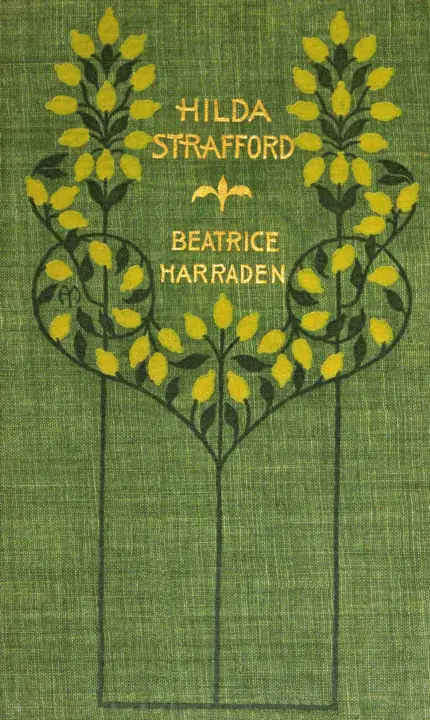
Hilda Strafford: A California Story
Beatrice Harraden
THE CLASSIC COLLECTION · 1893
"Ships that Pass in the Night" by Beatrice Harraden is a novel written during the late 19th century. The story revolves around the intricate interactions of its characters, particularly focusing on Bernardine Holme, a young woman who arrives at the Petershof Kurhaus for her health. The narrative captures her encounters with various guests at the resort, including the enigmatic "Disagreeable Man," Robert Allitsen, and others navigating their own struggles with illness and existential reflections. At the start of the novel, readers are introduced to the contrasting personalities at the dining table of Petershof Kurhaus, where a new-comer, Bernardine, finds herself lost in thought amid the conversations. The Disagreeable Man's sharp remarks about life's disappointments catch her attention, and their exchanges hint at a deeper connection. As classic themes of health, ambition, and the search for purpose emerge, Bernardine reflects on her past, her lost ambitions in teaching and writing, and her current state of illness. The interactions set the tone for a character-driven exploration of hope, resilience, and the weight of unfulfilled dreams, presenting Bernardine's journey as one of self-discovery within the confines of a society marked by suffering.
Introduction adapted from the source catalogue; source summaries may be automatically generated.
Free to read · English · 37,647 words · No account needed
MAKE TIME FOR A GOOD BOOK
On by default. Untick to stop anonymous reading totals. Each page counts after 10 seconds in view. How this works.
Anonymous counting is on unless you have switched it off.
"Why do you speak always of loneliness?" he asked.
"I have been thinking a good deal about it," she said. "When I was strong and vigorous, the idea of loneliness never entered my mind. Now I see how lonely most people are. If I believed in God as a Personal God, I should be inclined to think that loneliness were part of his scheme: so that the soul of man might turn to him and him alone."
The Disagreeable Man was standing by his camera again: his decision was
made.
"Don't think about those questions," he said kindly. "Don't worry and fret too much about the philosophy of life. Leave philosophy alone, and take to photography instead. Here, I will lend you my old camera."
"Do you mean that?" she asked, glancing at him in astonishment.
"Of course I mean it," he said.
He looked remarkably pleased with himself, and Bernardine could not
help smiling.
He looked just as a child looks when he has given up a toy to another child, and is conscious that he has behaved himself rather well.
"I am very much obliged to you," she said frankly. "I have had a great wish to learn photography."
"I might have lent my camera to you before, mightn't I?" he said
thoughtfully.
"No," she answered. "There was not any reason."
"No," he said, with a kind of relief, "there was not any reason. That
is quite true!"
"When will you give me my first lesson?" she asked. "Perhaps, though, you would like to wait a few days, in case you change your mind."
"It takes me some time to make up my mind," he replied, "but I do not change it. So I will give you your first lesson to-morrow. Only you must not be impatient. You must consent to be taught; you cannot possibly know everything!"
They fixed a time for the morrow, and Bernardine went off with the camera; and meeting Marie on the staircase, confided to her the piece of good fortune which had befallen her.
"See what Herr Allitsen has lent me, Marie!" she said.
Marie raised her hands in astonishment.
"Who would have thought such a thing of Herr Allitsen?" said Marie. "Why, he does not like lending me a match."
Bernardine laughed and passed on to her room.
And the Disagreeable Man meanwhile was cutting a new scientific book which had just come from England. He spent a good deal of money on himself. He was soon absorbed in this book, and much interested in the diagrams.
Suddenly he looked up to the corner where the old camera had stood, before Bernardine took it away in triumph.
Your reading position is saved on this browser. Take it to another device with a library code. Reading pages adapt to text, rather than matching a printed edition.
BEHIND THE BOOK
This eBook is for the use of anyone anywhere in the United States and most other parts of the world at no cost and with almost no restrictions whatsoever. You may copy it, give it away or re-use it under the terms of the Project Gutenberg License included with this eBook or online at www.gutenberg.org. If you are not located in the United States, you will have to check the laws of the country where you are located before using this eBook. Read the source licence.
The original source file, including credits and licence, is retained by this library. Request an original-format copy at no charge. Please include the book title and Project Gutenberg identifier #12476.
KEEP YOUR CURIOSITY GOING
Coulson Kernahan

Maurice Baring
Frances Wright
Cécile Tormay

Frederic Jesup Stimson

W. H. P. (William Henry Pope) Jarvis