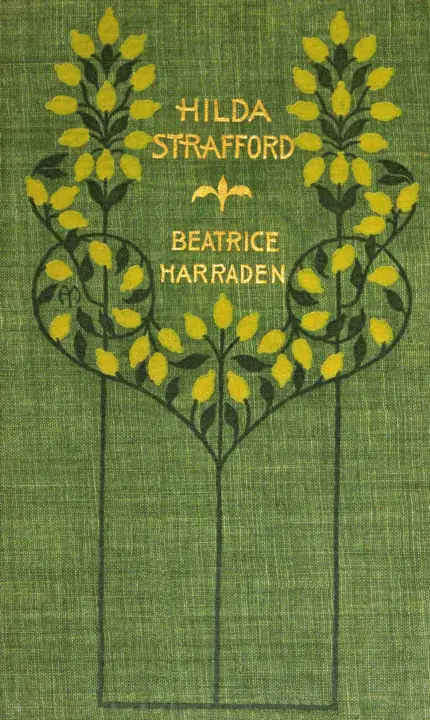
Hilda Strafford: A California Story
Beatrice Harraden
THE CLASSIC COLLECTION · 1893
"Ships that Pass in the Night" by Beatrice Harraden is a novel written during the late 19th century. The story revolves around the intricate interactions of its characters, particularly focusing on Bernardine Holme, a young woman who arrives at the Petershof Kurhaus for her health. The narrative captures her encounters with various guests at the resort, including the enigmatic "Disagreeable Man," Robert Allitsen, and others navigating their own struggles with illness and existential reflections. At the start of the novel, readers are introduced to the contrasting personalities at the dining table of Petershof Kurhaus, where a new-comer, Bernardine, finds herself lost in thought amid the conversations. The Disagreeable Man's sharp remarks about life's disappointments catch her attention, and their exchanges hint at a deeper connection. As classic themes of health, ambition, and the search for purpose emerge, Bernardine reflects on her past, her lost ambitions in teaching and writing, and her current state of illness. The interactions set the tone for a character-driven exploration of hope, resilience, and the weight of unfulfilled dreams, presenting Bernardine's journey as one of self-discovery within the confines of a society marked by suffering.
Introduction adapted from the source catalogue; source summaries may be automatically generated.
Free to read · English · 37,647 words · No account needed
MAKE TIME FOR A GOOD BOOK
On by default. Untick to stop anonymous reading totals. Each page counts after 10 seconds in view. How this works.
Anonymous counting is on unless you have switched it off.
She went to put on her cloak and, hat, and found him waiting for her at the top of the staircase. They passed out into the beautiful night: the sky was radiantly bejewelled, the air crisp and cold, and harmless to do ill. In the distance, the jodelling of some peasants. In the hotels, the fun and merriment, side by side with the suffering and hopelessness. In the deaconess's house, the body of the Dutchman. In God's heavens, God's stars.
Robert Allitsen and Bernardine walked silently for some time.
"Well," she said, "now tell me."
"The one great sacrifice," he said half to himself, "is the going on living one's life for the sake of another, when everything that would seem to make life acceptable has been wrenched away, not the pleasures, but the duties, and the possibilities of expressing one's energies, either in one direction or another: when, in fact, living is only a long tedious dying. If one has made this sacrifice, everything else may be forgiven."
He paused a moment, and then continued:
"I have made this sacrifice, therefore I consider I have done my part without flinching. The greatest thing I had to give up, I gave up: my death. More could not be required of any one!"
He paused again, and Bernardine was silent from mere awe.
"But freedom comes at last," he said, "and some day I shall be free. When my mother dies, I shall be free. She is old. If I were to die, I should break her heart, or, rather she would fancy that her heart was broken. (And it comes to the same thing). And I should not like to give her more grief than she has had. So I am just waiting, it may be months, or weeks, or years. But I know how to wait: if I have not learnt anything else, I have learnt how to wait. And then" . . . .
Bernardine had unconsciously put her hand on his arm; her face was full
of suffering.
"And then?" she asked, with almost painful eagerness.
"And then I shall follow your Dutchman's example," he said deliberately.
Bernardine's hand fell from the Disagreeable Man's arm.
She shivered.
"You are cold, you little thing," he said, almost tenderly for him.
"You are shivering."
"Was I?" she said, with a short laugh. "I was wondering when you would get your freedom, and whether you would use it in the fashion you now intend!"
"Why should there be any doubt?" he asked.
"One always hopes there would be a doubt," she said, half in a whisper.
Then he looked up, and saw all the pain on the little face.
Your reading position is saved on this browser. Take it to another device with a library code. Reading pages adapt to text, rather than matching a printed edition.
BEHIND THE BOOK
This eBook is for the use of anyone anywhere in the United States and most other parts of the world at no cost and with almost no restrictions whatsoever. You may copy it, give it away or re-use it under the terms of the Project Gutenberg License included with this eBook or online at www.gutenberg.org. If you are not located in the United States, you will have to check the laws of the country where you are located before using this eBook. Read the source licence.
The original source file, including credits and licence, is retained by this library. Request an original-format copy at no charge. Please include the book title and Project Gutenberg identifier #12476.
KEEP YOUR CURIOSITY GOING
Coulson Kernahan

Maurice Baring
Frances Wright
Cécile Tormay

Frederic Jesup Stimson

W. H. P. (William Henry Pope) Jarvis