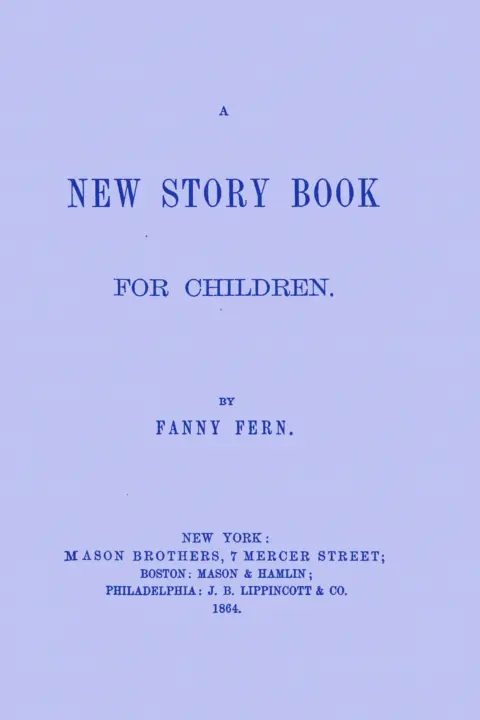
A New Story Book for Children
Fanny Fern
THE CLASSIC COLLECTION · 1854
"Shadows and Sunbeams: Being a Second Series of Fern Leaves from Fanny's Portfolio" is a collection of essays and reflections likely written in the mid-19th century. The work touches upon various themes related to everyday life, societal norms, and personal experiences through a blend of humor and pathos. The opening chapters introduce us to Hetty, a young woman who grapples with her dependent status within a harsh household while reflecting on her past and the comfort of her childhood. At the start of the narrative, Hetty recalls her beloved childhood home and the blissful moments spent with her father, juxtaposed against her present reality of loss and dependence on an unkind uncle. As she navigates her new life with her relatives, she confronts the overwhelming burden of gratitude versus the bitterness of her forced servitude. The opening passages establish a poignant emotional backdrop for her character, as she yearns for affection and purpose, anticipating her connection with the enigmatic schoolmaster, Mr. Grey, whose arrival signals a potential turning point in her life amidst the routine struggles of her domestic situation.
Introduction adapted from the source catalogue; source summaries may be automatically generated.
Free to read · English · 93,472 words · No account needed
MAKE TIME FOR A GOOD BOOK
On by default. Untick to stop anonymous reading totals. Each page counts after 10 seconds in view. How this works.
Anonymous counting is on unless you have switched it off.
Papa, too, had his male millenium. No more marketing to do; no more coal, or wood, or kindling to buy; no cistern, or pump, or gas-pipe to keep in repair. Such a luxury as it was to have a free pass to the “smoking-room” (alias bar-room), where the atmosphere was so dense that he couldn’t tell the latitude of his nose, and surrounded by “hale fellows well met.” His eldest boy accompanied him, listening, on his knee, to questionable jokes, which he repeated at bed-time to pert Nannie, the nurse, who understood their significance much better than his innocent little lordship.
Papa, to be sure, had some drawbacks, but they were VERY trifling—for instance, his shirts were quite buttonless, his dickeys stringless, and his stockings had ventilator toes; but then, how could mamma be seen patching and mending in such an aristocratic atmosphere? She might lose caste; and as to Nannie, her hands were full, what with babies and billet-doux.
You should have seen Mrs. Emily in the evening; with sparkling eyes and bracelets, flounced robe and daintily-shod feet, twisting her Chinese fan, listening to moustached idlers, and recollecting, with a shudder, the long Caudle evenings, formerly divided between her husband, his newspaper, and her darning needle.
Then the petite soupers at ten o’clock in the evening, where the ladies were enchanting, the gentlemen quite entirely irresistible; where wit and champagne corks flew with equal celerity; and headaches, and dyspepsia, and nightmare, lay perdu amid fried oysters, venison steaks, chicken salad, and India-rubber, anti-temperance jellies.
Then followed the midnight reunion in the drawing-room, where promiscuous polkaing and waltzing (seen through champagne fumes) seemed not only proper, but delightful.
It was midnight. There was hurrying to and fro in the entry-halls and lobbies; a quick, sharp cry for medical help; the sobs and tears of an agonized mother, and the low moan of a dying child; for nature had rebelled at last at impure air, unwholesome food, and alternate heats and chills.
“No hope,” the doctor said; “no hope,” papa mechanically repeated; “no hope!” echoed inexorable Death, as he laid his icy finger on the quivering little lips.
It was a dearly bought lesson. The Lady Emily never forgot it. Over her remaining bud of promise she tearfully bends, finding her quiet happiness in the healthful, sacred and safe retreat of the home fireside.
“The American ladies, when promenading, cross their arms in front, and look like trussed turkeys.”
Your reading position is saved on this browser. Take it to another device with a library code. Reading pages adapt to text, rather than matching a printed edition.
Fanny Fern

Fanny Fern
Fanny Fern
Fanny Fern
BEHIND THE BOOK
This eBook is for the use of anyone anywhere in the United States and most other parts of the world at no cost and with almost no restrictions whatsoever. You may copy it, give it away or re-use it under the terms of the Project Gutenberg License included with this eBook or online at www.gutenberg.org. If you are not located in the United States, you will have to check the laws of the country where you are located before using this eBook. Read the source licence.
The original source file, including credits and licence, is retained by this library. Request an original-format copy at no charge. Please include the book title and Project Gutenberg identifier #69784.
KEEP YOUR CURIOSITY GOING

David Patterson (Spirit) Hatch

David Patterson (Spirit) Hatch

David Patterson (Spirit) Hatch
Coulson Kernahan

Ralph Waldo Emerson

Maurice Baring