THE CLASSIC COLLECTION✦A dead man’s diaryCLASSIC FREE BOOKS
A dead man’s diary
Coulson Kernahan
THE CLASSIC COLLECTION · 1885
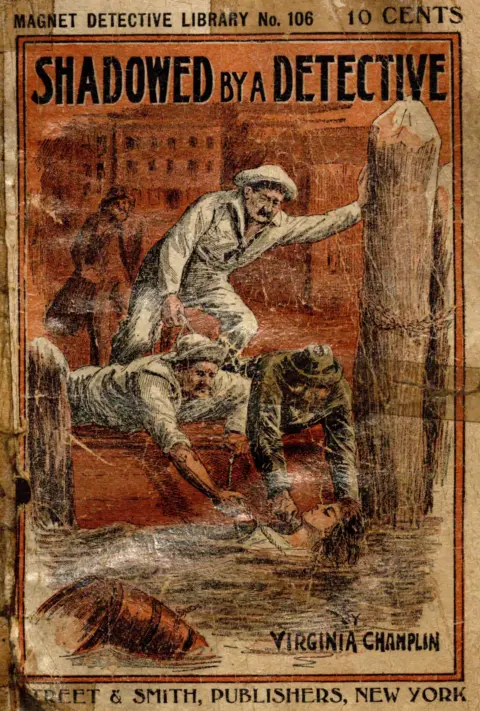
Shadowed by a Detective by Virginia Champlin is a detective novel written in the late 19th century. It centers on the glamorous and mysterious Ada Ricard, whose brazen abduction from a New York masked ball ignites a chain of jealousy, pursuit, and scandal involving her wealthy suitor Willie Saunders, the dashing Colonel Edward Forster, and rival forces of private and official policing.
The opening of Shadowed by a Detective follows Ada’s sudden kidnapping by three “Sioux” masqueraders during her ball, her secret transfer by carriage to Yorkville, a night crossing of the East River, and a rendezvous with Colonel Forster, who spirits her aboard his yacht, the Gleam. Spurned by the police chief, the frantic Saunders hires the private firm Robertson Brothers & Co. and races after the yacht in the steamer Firefly; in a foggy night near Staten Island, a collision at the harbor channel is followed by a woman’s cry and the Gleam’s abrupt departure. Soon after, laborers find a young woman’s body weighted by a tar barrel; an autopsy concludes she was killed before entering the water. Identified at the morgue as Ada Ricard, the death draws official scrutiny, and Saunders is urgently summoned by the police, setting the stage for the investigation.
Introduction adapted from the source catalogue; source summaries may be automatically generated.
Free to read · English · 65,811 words · No account needed
MAKE TIME FOR A GOOD BOOK
On by default. Untick to stop anonymous reading totals. Each page counts after 10 seconds in view. How this works.
Anonymous counting is on unless you have switched it off.
James Gobson had called the guard and ordered some ham, cold meats and
Chester cheese.
Good Mr. Midler was sitting opposite his penitent.
“To your health,” said the latter, after filling a glass for the
excellent man.
“To the health of your soul,” answered the pastor, with true unction, and raising his eyes to heaven he devoutly drank the wine, then bravely attacked the iced partridge which his host had placed before him.
James Gobson also fell to with a will, and there was a momentary silence between the convivial host and guest.
William Dow himself would have been astonished at the philosophy and coolness of the man he had caused to be arrested, and Mr. Davis, at the sight of his calmness, would have remembered his first doubts, which the arguments, it is true, had quickly banished from his mind.
When his partridge had disappeared, and his glass was emptied a second time, the Methodist threw himself back, uttering a deep sigh.
“What is the matter, reverend sir?” asked the prisoner, affectionately.
“What a misfortune,” answered Mr. Midler, “that I did not know you sooner. I should certainly have checked you by my advice on the path you have entered.”
“Do you think I regret it any less than you, sir? Will you have a slice
of this ham?”
“Resist one’s propensities; everything is in that, Mr. Gobson. This ham
is excellent.”
“It comes from York, where the best wine is had, too.”
“Yours is delicious. We are all predestined to eternal felicity,
and----”
“Will you have a glass of port?”
“With pleasure. And these are the first concessions we make to our passions, and to our tastes, which lead us on, but----”
“Will you have a little of this cheese, it is perfect for digestion?”
“Yes, epicures think a great deal of it. But if our miserable nature causes us to fall, God renders our faith a justification and conversion takes place instantaneously----”
“Do you like coffee?”
“I think it indispensable to every meal.”
“I have not failed to ask for it. One would say that my guard was only waiting for the proper moment to bring it, for, see, here he comes.”
In fact, the servant appointed to wait on the prisoner was that moment
entering the cell with a waiter, which he placed on the table, then
left.
James Gobson filled Mr. Midler’s cup, who thanked him with a tender
glance.
“Do you smoke?” asked the prisoner.
“No, thanks,” answered the minister; “Mrs. Midler does not allow me to
do so.”
“But smoke does not incommode you.”
“By no means. What was I saying?”
Your reading position is saved on this browser. Take it to another device with a library code. Reading pages adapt to text, rather than matching a printed edition.
BEHIND THE BOOK
This eBook is for the use of anyone anywhere in the United States and most other parts of the world at no cost and with almost no restrictions whatsoever. You may copy it, give it away or re-use it under the terms of the Project Gutenberg License included with this eBook or online at www.gutenberg.org. If you are not located in the United States, you will have to check the laws of the country where you are located before using this eBook. Read the source licence.
The original source file, including credits and licence, is retained by this library. Request an original-format copy at no charge. Please include the book title and Project Gutenberg identifier #78812.
KEEP YOUR CURIOSITY GOING
Coulson Kernahan

Maurice Baring
Frances Wright
Cécile Tormay

Frederic Jesup Stimson

W. H. P. (William Henry Pope) Jarvis