THE CLASSIC COLLECTION✦A dead man’s diaryCLASSIC FREE BOOKS
A dead man’s diary
Coulson Kernahan
THE CLASSIC COLLECTION · 1885
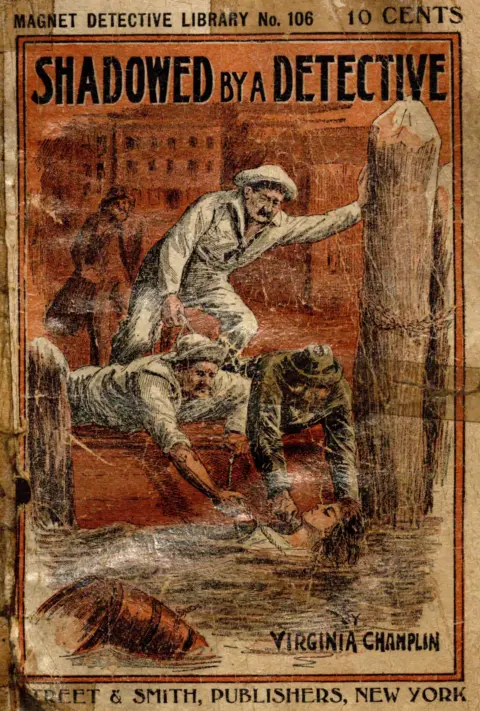
Shadowed by a Detective by Virginia Champlin is a detective novel written in the late 19th century. It centers on the glamorous and mysterious Ada Ricard, whose brazen abduction from a New York masked ball ignites a chain of jealousy, pursuit, and scandal involving her wealthy suitor Willie Saunders, the dashing Colonel Edward Forster, and rival forces of private and official policing.
The opening of Shadowed by a Detective follows Ada’s sudden kidnapping by three “Sioux” masqueraders during her ball, her secret transfer by carriage to Yorkville, a night crossing of the East River, and a rendezvous with Colonel Forster, who spirits her aboard his yacht, the Gleam. Spurned by the police chief, the frantic Saunders hires the private firm Robertson Brothers & Co. and races after the yacht in the steamer Firefly; in a foggy night near Staten Island, a collision at the harbor channel is followed by a woman’s cry and the Gleam’s abrupt departure. Soon after, laborers find a young woman’s body weighted by a tar barrel; an autopsy concludes she was killed before entering the water. Identified at the morgue as Ada Ricard, the death draws official scrutiny, and Saunders is urgently summoned by the police, setting the stage for the investigation.
Introduction adapted from the source catalogue; source summaries may be automatically generated.
Free to read · English · 65,811 words · No account needed
MAKE TIME FOR A GOOD BOOK
On by default. Untick to stop anonymous reading totals. Each page counts after 10 seconds in view. How this works.
Anonymous counting is on unless you have switched it off.
Saunders, like his companions, had to make the best of these primitive lounges; he sat down, or rather threw himself down, on one of them; milk and maize cakes were at once served, then the chief lighted his long pipe, and after smoking in silence for a full quarter of an hour, he entered into conversation with Butler, which the latter, in a measure, translated.
Jimin inquired about the disposition of the government towards the Indians, about the price of provisions, and he bitterly complained of the agents of the great fur companies, who in exchange for the hunting products of the Indians gave them only worthless gunpowder, wretched weapons, adulterated brandy, and execrable tobacco.
The trapper assured him, in the names of his friends, that his just grievances should be conveyed to the President of the United States, who would not fail to inquire into it, and he advised him to go himself to Washington to make out his complaints.
“Of what use would that be?” resumed Jimin, shaking his head, sadly. “Our brothers, the pale-faces, promise, but forget their promises. Four moons ago I went with ten of my warriors to Washington; they swore to us that our claims should be made right, but nothing has been changed. The Great Father forsakes his children.”
“Ask him,” said William Dow to Butler, having listened attentively to every word of the chief, “if he did not return full of wonder at the splendor of our cities?”
“The Indian,” answered Jimin, “sees nothing when he goes to your cities; his eyes, like his heart, bound over space to find his wigwam and prairies again. I should not have remained more than one day at Washington if I had not been waiting for two of my warriors who had wandered away.”
“Which ones?” asked Butler, at the detective’s entreaty.
“Washah and Winka,” said the chief, pointing to the two Sioux crouched at his right. “One of your people, whose wife had been carried off, asked them for the help of their arms. He knew that the Indian, oppressed himself, is always at the service of him who suffers. The pale-face was not ungrateful, and with the gold he gave to Washah and Winka they bought weapons superior to those the agents sell us so dear.”
Each of the two warriors, in fact, had a solid double-barreled carbine
by his side.
As the trapper translated Jimin’s last words, William Dow’s face expressed a more and more lively satisfaction.
“Dear sir,” he said, addressing Saunders when the interpreter had finished, and pointing to the two Sioux, whose eyes shone with pride, “do you not recognize two of your guests?”
Your reading position is saved on this browser. Take it to another device with a library code. Reading pages adapt to text, rather than matching a printed edition.
BEHIND THE BOOK
This eBook is for the use of anyone anywhere in the United States and most other parts of the world at no cost and with almost no restrictions whatsoever. You may copy it, give it away or re-use it under the terms of the Project Gutenberg License included with this eBook or online at www.gutenberg.org. If you are not located in the United States, you will have to check the laws of the country where you are located before using this eBook. Read the source licence.
The original source file, including credits and licence, is retained by this library. Request an original-format copy at no charge. Please include the book title and Project Gutenberg identifier #78812.
KEEP YOUR CURIOSITY GOING
Coulson Kernahan

Maurice Baring
Frances Wright
Cécile Tormay

Frederic Jesup Stimson

W. H. P. (William Henry Pope) Jarvis