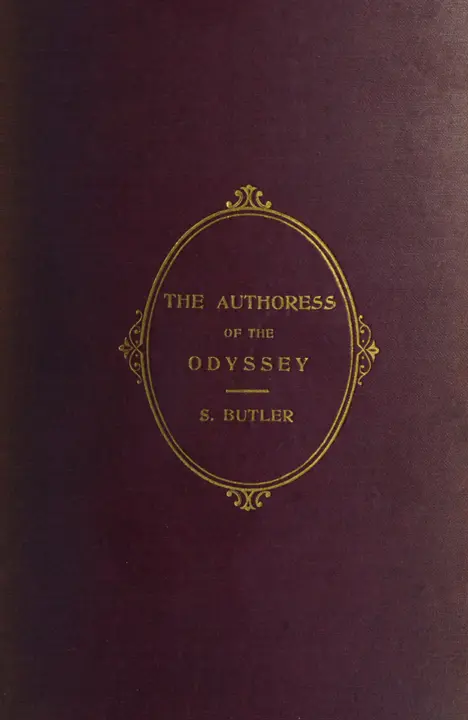
The Authoress of the Odyssey Where and when she wrote, who she was, the use she made of the Iliad, and how the poem grew under her hands
Samuel Butler
THE CLASSIC COLLECTION · 1890
"Selections from Previous Works" by Samuel Butler is a collection of essays and writings penned in the late 19th century. The text includes critical reflections on various topics, including Butler's insights on science and morality, and features selections from his earlier works, notably "Erewhon". The aim of the collection seems to be to challenge established views on societal norms, ethics, and the intersection between human behavior and health. The opening of the book presents a preface that sets the stage for Butler's commentary, particularly focusing on a critique of Mr. G. J. Romanes' views regarding instinct and inherited memory. Butler expresses his frustrations about scientific inaccuracies and the lack of accountability in the scientific community, showcasing his analytical mindset and a keen interest in the intersections of morality and health. The narrative proceeds to explore the peculiar customs of the fictional society of Erewhon, such as its inversions of morality regarding illness and crime, challenging readers to reconsider their perceptions of justice and social norms. This provocative beginning invites readers into a thought-provoking examination of societal values, making the text a rich resource for those interested in philosophical inquiry and social critique.
Introduction adapted from the source catalogue; source summaries may be automatically generated.
Free to read · English · 96,117 words · No account needed
MAKE TIME FOR A GOOD BOOK
On by default. Untick to stop anonymous reading totals. Each page counts after 10 seconds in view. How this works.
Anonymous counting is on unless you have switched it off.
{181c} The Spirit of Nature, p. 39. J. A. Churchill & Co. 1880.
{184} I have put these words into the mouth of my supposed objector, and shall put others like them, because they are characteristic; but nothing can become so well known as to escape being an inference.
{189} Erewhon, chap, xxiii.
{198a} It must be remembered that this passage is put as if in the mouth
of an objector.
{198b} Mr. Herbert Spencer denies that there can be memory without a "tolerably deliberate succession of psychical states." {198c} So that practically he denies that there can be any such thing as "unconscious memory." Nevertheless a few pages later on he says that "conscious memory passes into unconscious or organic memory." {198d} It is plain, therefore, that he could after all find no expression better suited for his purpose.
Mr. Romanes is, I think, right in setting aside Mr. Spencer's limitation of memory to conscious memory. He writes, "Because I have so often seen the sun shine that my memory of it as shining has become automatic, I see no reason why my memory of this fact, simply on account of its perfection, should be called no memory." {198e}
{198c} Principles of Psychology, I., 447.
{198d} Ibid, p. 452.
{198e} Mental Evolution in Animals, p. 130
{217} Nineteenth Century, Nov. 1878, p. 826.
{218} Encyclopedia Britannica, Art. Biology, 9th ed., Vol. 3, p. 689.
{220a} Professor Huxley, Encycl. Brit., 9th ed., Art. Evolution, p. 750.
{220b} "Hume," by Professor Huxley, p. 45.
{220c} "The Philosophy of Crayfishes," by the Right Rev. the Lord Bishop of Carlisle. Nineteenth Century for October 1880, p. 636.
{221} Les Amours des Plantes, p. 360. Paris, 1800.
{222a} Philosophie Zoologique, tom. i. p. 231. Ed. M. Martin. Paris,
1873.
{222b} Those who read the three following chapters will see that these words, written in 1880, have come out near the truth in 1884.
{223a} Journal of the Proceedings of the Linnean Society. Williams &
Norgate. 1858, p. 61.
{223b} Contributions to the Theory of Natural Selection, 2d ed., 1871,
p. 41.
{223c} Origin of Species, p. I, ed. 1872.
{223d} Origin of Species, 6th ed., p. 206. I ought in fairness to Mr Darwin to say that he does not hold the error to be quite as serious as he once did. It is now "a serious error" only; in 1859 it was "most serious error."--Origin of Species, 1st ed., p. 209.
{224} Origin of Species, 1st ed., p. 242; 6th ed., p. 233.
{225a} I never could find what these particular points were.
{225b} Isidore Geoffrey, Hist. Nat. Gen., tom. ii. p. 407, 1859.
{225c} M. Martin's edition of the Philosophie Zoologique (Paris, 1873),
Introduction, p. vi.
{225d} Encyclopaedia Britannica, 9th ed., p. 750.
{228a} Kegan Paul & Co., 1883.
{228b} Principles of Psychology, Vol. I. p. 445.
{228c} Ibid. I. 456.
Your reading position is saved on this browser. Take it to another device with a library code. Reading pages adapt to text, rather than matching a printed edition.
Samuel Butler
Samuel Butler
Samuel Butler
Samuel Butler
BEHIND THE BOOK
This eBook is for the use of anyone anywhere in the United States and most other parts of the world at no cost and with almost no restrictions whatsoever. You may copy it, give it away or re-use it under the terms of the Project Gutenberg License included with this eBook or online at www.gutenberg.org. If you are not located in the United States, you will have to check the laws of the country where you are located before using this eBook. Read the source licence.
The original source file, including credits and licence, is retained by this library. Request an original-format copy at no charge. Please include the book title and Project Gutenberg identifier #19610.
KEEP YOUR CURIOSITY GOING

David Patterson (Spirit) Hatch

David Patterson (Spirit) Hatch

David Patterson (Spirit) Hatch
Coulson Kernahan

Ralph Waldo Emerson

Maurice Baring