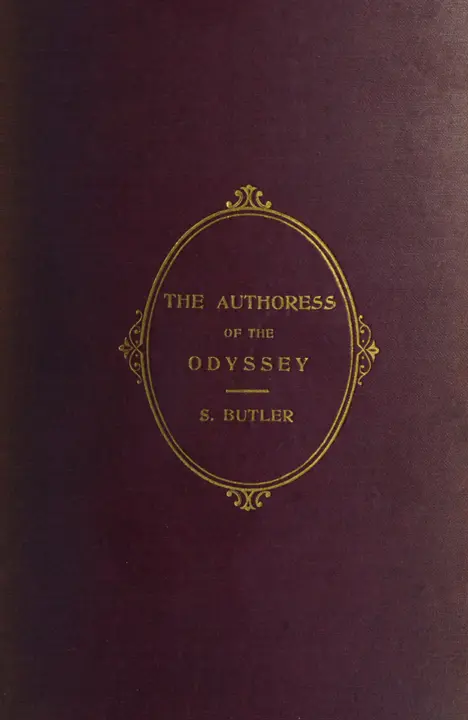
The Authoress of the Odyssey Where and when she wrote, who she was, the use she made of the Iliad, and how the poem grew under her hands
Samuel Butler
THE CLASSIC COLLECTION · 1890
"Selections from Previous Works" by Samuel Butler is a collection of essays and writings penned in the late 19th century. The text includes critical reflections on various topics, including Butler's insights on science and morality, and features selections from his earlier works, notably "Erewhon". The aim of the collection seems to be to challenge established views on societal norms, ethics, and the intersection between human behavior and health. The opening of the book presents a preface that sets the stage for Butler's commentary, particularly focusing on a critique of Mr. G. J. Romanes' views regarding instinct and inherited memory. Butler expresses his frustrations about scientific inaccuracies and the lack of accountability in the scientific community, showcasing his analytical mindset and a keen interest in the intersections of morality and health. The narrative proceeds to explore the peculiar customs of the fictional society of Erewhon, such as its inversions of morality regarding illness and crime, challenging readers to reconsider their perceptions of justice and social norms. This provocative beginning invites readers into a thought-provoking examination of societal values, making the text a rich resource for those interested in philosophical inquiry and social critique.
Introduction adapted from the source catalogue; source summaries may be automatically generated.
Free to read · English · 96,117 words · No account needed
MAKE TIME FOR A GOOD BOOK
On by default. Untick to stop anonymous reading totals. Each page counts after 10 seconds in view. How this works.
Anonymous counting is on unless you have switched it off.
When we consider the force with which Buffon's conclusion is led up to; the obviousness of the conclusion itself when the premises are once admitted; the impossibility that such a conclusion should be again lost sight of if the reasonableness of its being drawn had been once admitted; the position in his scheme which is assigned to it by its propounder; the persistency with which he demonstrates during forty years thereafter that the premises, which he has declared should establish the conclusion in question, are indisputable;--when we consider, too, that we are dealing with a man of unquestionable genius, and that the times and circumstances of his life were such as would go far to explain reserve and irony--is it, I would ask, reasonable to suppose that Buffon did not in his own mind, and from the first, draw the inference to which he leads his reader, merely because from time to time he tells the reader, with a shrug of the shoulders, that he draws no inferences opposed to the Book of Genesis? Is it not more likely that Buffon intended his reader to draw his inferences for himself, and perhaps to value them all the more highly on that account?
The passage to which I am alluding is as follows:--
"If from the boundless variety which animated nature presents to us, we choose the body of some animal or even that of man himself to serve as a model with which to compare the bodies of other organised beings, we shall find that though all these beings have an individuality of their own, and are distinguished from one another by differences of which the gradations are infinitely subtle, there exists at the same time a primitive and general design which we can follow for a long way, and the departures from which (degenerations) are far more gentle than those from mere outward resemblance. For not to mention organs of digestion, circulation, and generation, which are common to all animals, and without which the animal would cease to be an animal, and could neither continue to exist nor reproduce itself--there is none the less even in those very parts which constitute the main difference in outward appearance, a striking resemblance which carries with it irresistibly the idea of a single pattern after which all would appear to have been conceived. The horse, for example--what can at first sight seem more unlike mankind? Yet when we compare man and horse point by point and detail by detail, is not our wonder excited rather by the points of resemblance than of difference that are to be found between them? Take the skeleton of a man; bend forward the bones in the region of the pelvis, shorten the thigh bones, and those of the leg and arm, lengthen those of the feet and hands, run the joints together, lengthen the jaws, and shorten the frontal bone, finally, lengthen the spine, and the skeleton will now be that of a man no longer, but will have become that of a horse--for it is easy to imagine that in lengthening the spine and the jaws we shall at the same time have increased the number of the vertebrae, ribs, and teeth. It is but in the number of these bones, which may be considered accessory, and by the lengthening, shortening, or mode of attachment of others, that the skeleton of the horse differs from that of the human body. . . . We find ribs in man, in all the quadrupeds, in birds, in fishes, and we may find traces of them as far down as the turtle, in which they seem still to be sketched out by means of furrows that are to be found beneath the shell. Let it be remembered that the foot of the horse, which seems so different from a man's hand, is, nevertheless, as M. Daubenton has pointed out, composed of the same bones, and that we have at the end of each of our fingers a nail corresponding to the hoof of a horse's foot. Judge, then, whether this hidden resemblance is not more marvellous than any outward differences--whether this constancy to a single plan of structure which we may follow from man to the quadrupeds, from the quadrupeds to the cetacea, from the cetacea to birds, from birds to reptiles, from reptiles to fishes--in which all such essential parts as heart, intestines, spine are invariably found--whether, I say, this does not seem to indicate that the Creator when He made them would use but a single main idea, though at the same time varying it in every conceivable way, so that man might admire equally the magnificence of the execution and the simplicity of the design." {174}
Your reading position is saved on this browser. Take it to another device with a library code. Reading pages adapt to text, rather than matching a printed edition.
Samuel Butler
Samuel Butler
Samuel Butler
Samuel Butler
BEHIND THE BOOK
This eBook is for the use of anyone anywhere in the United States and most other parts of the world at no cost and with almost no restrictions whatsoever. You may copy it, give it away or re-use it under the terms of the Project Gutenberg License included with this eBook or online at www.gutenberg.org. If you are not located in the United States, you will have to check the laws of the country where you are located before using this eBook. Read the source licence.
The original source file, including credits and licence, is retained by this library. Request an original-format copy at no charge. Please include the book title and Project Gutenberg identifier #19610.
KEEP YOUR CURIOSITY GOING

David Patterson (Spirit) Hatch

David Patterson (Spirit) Hatch

David Patterson (Spirit) Hatch
Coulson Kernahan

Ralph Waldo Emerson

Maurice Baring