
Last letters from the living dead man
David Patterson (Spirit) Hatch
THE CLASSIC COLLECTION · 1914
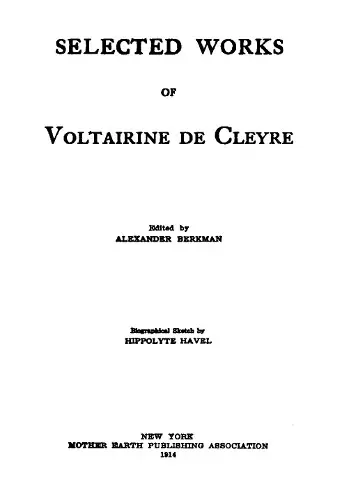
"Selected Works of Voltairine de Cleyre" by Voltairine De Cleyre is a collection of poetic and prose writings, likely composed during the late 19th century. The works encompass a range of themes including personal reflection, social justice, feminism, and anarchist principles, reflecting the author's deep commitment to individual liberty and critique of societal norms. As one of the notable figures within the anarchist movement, de Cleyre's writings serve as a poignant exploration of human freedom and the struggles faced by marginalized groups. The opening portion introduces Voltairine de Cleyre as a revolutionary thinker and passionate advocate for freedom, setting the tone for the collection. It features a biographical sketch that narrates de Cleyre's tumultuous early life, her awakening to free thought, and her eventual embrace of anarchism. The text reflects her literary journey and personal evolution, capturing her experiences with societal repression and her fight for the rights of the oppressed. Through a combination of autobiographical elements and reflections on broader social issues, de Cleyre’s voice emerges as both personal and political, inviting readers to rethink freedom and justice in their own lives.
Introduction adapted from the source catalogue; source summaries may be automatically generated.
Free to read · English · 136,747 words · No account needed
MAKE TIME FOR A GOOD BOOK
On by default. Untick to stop anonymous reading totals. Each page counts after 10 seconds in view. How this works.
Anonymous counting is on unless you have switched it off.
And if we wish to know what master-thought ruled the lives of men when the mediæval period had had time to ripen it, one has only at this day to stray into some quaint, out-of-the-way English village, where a strong old towered Church yet stands in the midst of little straw-thatched cottages, like a brooding mother-hen surrounded by her chickens. Everywhere the greatening of God, and the lessening of Man: the Church so looming, the home so little. The search for the spirit, for the enduring thing (not the poor endurance of granite which in the ages crumbles, but the eternal), the eternal,--and contempt for the body which perishes, manifest in studied uncleanliness, in mortifications of the flesh, as if the spirit should have spat its scorn upon it.
Such was the dominant idea of that middle age which has been too much cursed by modernists. For the men who built the castles and the cathedrals were men of mighty works, though they made no books, and though their souls spread crippled wings, because of their very endeavors to soar too high. The spirit of voluntary subordination for the accomplishment of a great work, which proclaimed the aspiration of the common soul,--that was the spirit wrought into the cathedral stones; and it is not wholly to be condemned.
In waking dream, when the shadow-shapes of world-ideas swim before the vision, one sees the Middle-Age Soul an ill-contorted, half-formless thing, with dragon wings and a great, dark, tense face, strained sunward with blind eyes.
If now we look around us to see what idea dominates our own civilization, I do not know that it is even as attractive as this piteous monster of the old darkness. The relativity of things has altered: Man has risen and God has descended. The modern village has better homes and less pretentious churches. Also the conception of dirt and disease as much-sought afflictions, the patient suffering of which is a meet offering to win God's pardon, has given place to the emphatic promulgation of cleanliness. We have Public School nurses notifying parents that "pediculosis capitis" is a very contagious and unpleasant disease; we have cancer associations gathering up such cancers as have attached themselves to impecunious persons, and carefully experimenting with a view to cleaning them out of the human race; we have tuberculosis societies attempting the Herculean labor of clearing the Augean stables of our modern factories of the deadly bacillus, and they have got as far as spittoons with water in them in some factories; and others, and others, and others, which, while not yet overwhelmingly successful in their avowed purposes, are evidence sufficient that humanity no longer seeks dirt as a means of grace. We laugh at those old superstitions, and talk much about exact experimental knowledge. We endeavor to galvanize the Greek corpse, and pretend that we enjoy physical culture. We dabble in many things; but the one great real idea of our age, not copied from any other, not pretended, not raised to life by any conjuration, is the Much Making of Things,--not the making of beautiful things, not the joy of spending living energy in creative work; rather the shameless, merciless driving and over-driving, wasting and draining of the last bit of energy, only to produce heaps and heaps of things,--things ugly, things harmful, things useless, and at the best largely unnecessary. To what end are they produced? Mostly the producer does not know; still less does he care. But he is possessed with the idea that he must do it, every one is doing it, and every year the making of things goes on more and faster; there are mountain ranges of things made and making, and still men go about desperately seeking to increase the list of created things, to start fresh heaps and to add to the existing heaps. And with what agony of body, under what stress and strain of danger and fear of danger, with what mutilations and maimings and lamings they struggle on, dashing themselves out against these rocks of wealth! Verily, if the vision of the Mediæval Soul is painful in its blind staring and pathetic striving, grotesque in its senseless tortures, the Soul of the Modern is most amazing with its restless, nervous eyes, ever searching the corners of the universe, its restless, nervous hands ever reaching and grasping for some useless toil.
Your reading position is saved on this browser. Take it to another device with a library code. Reading pages adapt to text, rather than matching a printed edition.
BEHIND THE BOOK
This eBook is for the use of anyone anywhere in the United States and most other parts of the world at no cost and with almost no restrictions whatsoever. You may copy it, give it away or re-use it under the terms of the Project Gutenberg License included with this eBook or online at www.gutenberg.org. If you are not located in the United States, you will have to check the laws of the country where you are located before using this eBook. Read the source licence.
The original source file, including credits and licence, is retained by this library. Request an original-format copy at no charge. Please include the book title and Project Gutenberg identifier #43098.
KEEP YOUR CURIOSITY GOING
David Patterson (Spirit) Hatch

David Patterson (Spirit) Hatch

David Patterson (Spirit) Hatch
Coulson Kernahan

Ralph Waldo Emerson

Maurice Baring