
Last letters from the living dead man
David Patterson (Spirit) Hatch
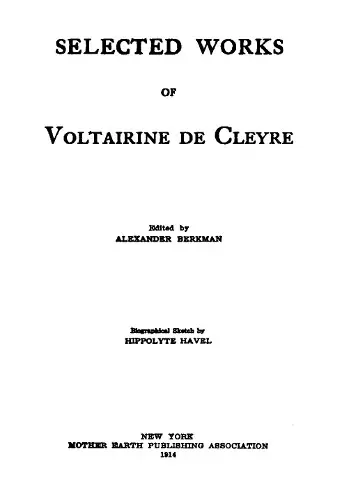
THE CLASSIC COLLECTION · 1914
"Selected Works of Voltairine de Cleyre" by Voltairine De Cleyre is a collection of poetic and prose writings, likely composed during the late 19th century. The works encompass a range of themes including personal reflection, social justice, feminism, and anarchist principles, reflecting the author's deep commitment to individual liberty and critique of societal norms. As one of the notable figures within the anarchist movement, de Cleyre's writings serve as a poignant exploration of human freedom and the struggles faced by marginalized groups. The opening portion introduces Voltairine de Cleyre as a revolutionary thinker and passionate advocate for freedom, setting the tone for the collection. It features a biographical sketch that narrates de Cleyre's tumultuous early life, her awakening to free thought, and her eventual embrace of anarchism. The text reflects her literary journey and personal evolution, capturing her experiences with societal repression and her fight for the rights of the oppressed. Through a combination of autobiographical elements and reflections on broader social issues, de Cleyre’s voice emerges as both personal and political, inviting readers to rethink freedom and justice in their own lives.
Introduction adapted from the source catalogue; source summaries may be automatically generated.
Free to read · English · 136,747 words · No account needed
MAKE TIME FOR A GOOD BOOK
On by default. Untick to stop anonymous reading totals. Each page counts after 10 seconds in view. How this works.
Anonymous counting is on unless you have switched it off.
From the point of vantage of 100 years' experience it is seen that Paine's political creed, like his religious one, will no longer fit. But that does not matter. Neither will ours fit in a hundred years, and none of us, no, not one, is great enough to foresee where the misfit will arise. It is not our business to bear the evils of the thrice unborn upon our necks; nor was it Paine's to bear ours.
Yet while not claiming for him the prophetic gift, it is still true that he did see the moral patchwork in our constitution, the trouble of 1812 brewing, and the greater trouble of '61-'65.
When he first came to this country he wrote a number of contributions to the Pennsylvania Magazine, in one of which he pleaded justice for the negro, basing his plea then as always upon the natural equality of man irrespective of color. Afterwards when the constitution was framed, he objected that nothing had been done for the negro, and in his letters to the American people, written after his imprisonment in France, in which the constitution was caustically reviewed, he cries out again for this yoked man not yet to be freed for more than half a hundred years,--foreseeing that nothing good can in the end come from slavery, that every evil must bring a compensating evil. The soldiers' graves in the National cemeteries, the thousands of limping, haggard tatters and rags of white men attest how well Paine foresaw Time's revenges.
In the letter to Washington, partially unjust as it is in view of the fact that Gouverneur Morris and not Washington was responsible for the failure to save Paine from prison in France, as we now know, thanks to Moncure Conway, but which Paine did not know,--in this letter, I say, will be found the most terrible arraignment of the constitution ever penned. We who are Anarchists are called traitors for much calmer talk. Yet here was the man "whose pen had done more for the revolution than Washington's sword," as his bitterest enemy declared; who believed heart and soul in the republic, who had given his money and his substance and taken the chances of his life in battle for it; the man whose devotion to America could not be gainsaid; this man declared that the American constitution was the mirror of the most vicious features of the British constitution, a fecund soil for monopolies with all their ills. It is we who experience those ills, we who know what a gigantic tool of oppression the constitution and the cumbersome machinery of the lawmaking power have become. Yet probably even we do not feel so keenly as he the fatal blunder; for while we know how it grinds us in our flesh and souls, rears its prisons and scaffolds for us, we have had the yoke about our necks always,--while he had once seen the country free. He had been through all the battle, had fought his fight and won his victory, only to see it lost through cowardice of thought. That was indeed bitter; and it is that bitter outcry against this sacrifice which marks Paine out among most of his time for influence on future history. The fact that he was the initiator of the direct movement for political independence in America, in the famous meeting where Adams, Franklin and Washington all shrank from uttering the thought heavy upon their souls, is a matter of past history. The fact that he was the one man in America to write the right thing at the right time, his voice the wind to sweep the scattering flames of insubordination and revolt into the conflagration of revolution; the fact that he proposed and headed with the whole contents of his purse the subscription to save the army when even Washington was in despair at the prospect of mutiny and desertion among the soldiers; the fact that he raised all the feeling possible against the fiction of divine rights and so got himself hunted out of England; the fact that he took the most active part possible in aiding the work of the French revolutionists, which he believed would be the beginning of the breakdown of monarchy throughout Europe and the building up either of one universal continental republic or a confederation of sister republics; the fact that he was the one man in the convention who dared to stand for the life of Louis the XVI, and thereby got himself suspected, thrown into prison, and condemned to death--all these facts are of import in reading the character of the man, and in comprehending the record of those days when they were making history fast. Yet none of these has so much influence upon the demands of to-day as the voice of discontent crying for eternal vigilance, which sounds through these almost unknown letters. These are the things which it will pay to reprint in the day when American liberty feels in its tomb the first stirrings of the resurrection. Did we like Paine believe in God, we might say "Pray God it may not be far away."
Your reading position is saved on this browser. Take it to another device with a library code. Reading pages adapt to text, rather than matching a printed edition.
BEHIND THE BOOK
This eBook is for the use of anyone anywhere in the United States and most other parts of the world at no cost and with almost no restrictions whatsoever. You may copy it, give it away or re-use it under the terms of the Project Gutenberg License included with this eBook or online at www.gutenberg.org. If you are not located in the United States, you will have to check the laws of the country where you are located before using this eBook. Read the source licence.
The original source file, including credits and licence, is retained by this library. Request an original-format copy at no charge. Please include the book title and Project Gutenberg identifier #43098.
KEEP YOUR CURIOSITY GOING
David Patterson (Spirit) Hatch

David Patterson (Spirit) Hatch

David Patterson (Spirit) Hatch
Coulson Kernahan

Ralph Waldo Emerson

Maurice Baring